Hardware
China’s Shenzhen Coship plans to set up STB making unit in India


KOLKATA: China’s Shenzhen Coship Electronics Co Ltd, a cable television and broadband equipment maker, plans to set up a set-top box (STB) manufacturing facility in India.
“We are planning to set up a set-top box manufacturing facility with a capacity to make 2.5 lakh units a month in India to start with and the scale up the operations on the back of demand,” Vipan Kumar Sharma, Country Manager, India, Coship, told indiantelevision.com, on the sidelines of Cable TV Show 2014, an exhibition of cable television industry in Kolkata.

“We will see and evaluate the benefits and policies of the government”, he said.
Sharma further said the company might look at a place near Delhi, in Chennai or around Pune. “We already have our technical office at Chennai and our commercial office is in Delhi,” he said.
The proposed STB manufacturing unit would employ about 1,000 workers, he said.
Sharma did not disclose the investments that would be required for setting up the STB manufacturing facility but said the average cost of producing one STB would be around $22.
Shenzhen Coship, which has already supplied 10 million STBs in India since 2007, is planning to export to India another 5 million STBs by the end of 2014.
The company’s clients include Siticable, Kerala Communicators Cable Limited (KCCL) and Sun Direct DTH.
Sharma said it is also in talks with Videocon d2h for supplying its STBs.
He said demand for STBs in phase III and phase IV of digitisation would be the growth driver for the company in India. He, however, said in rural and semi-urban areas, availability of funds is an issue for the multi-system operators (MSO) and local cable operators (LCOs).
As per the Information and Broadcasting Ministry estimates, a total of 75 million STBs would be required for installation in the third and fourth phases of digitisation. The deadline for the third phase of digitisation is 30 September and for the fourth phase is 31 December.
Shenzen Coship has three factories in China with combined capacity to manufacture 25 million STBs — both SD and HD — a year.




Hardware
India clears Rs 1.6 lakh crore semiconductor projects under Semicon India
Ten projects cleared as production begins and design ecosystem gathers pace
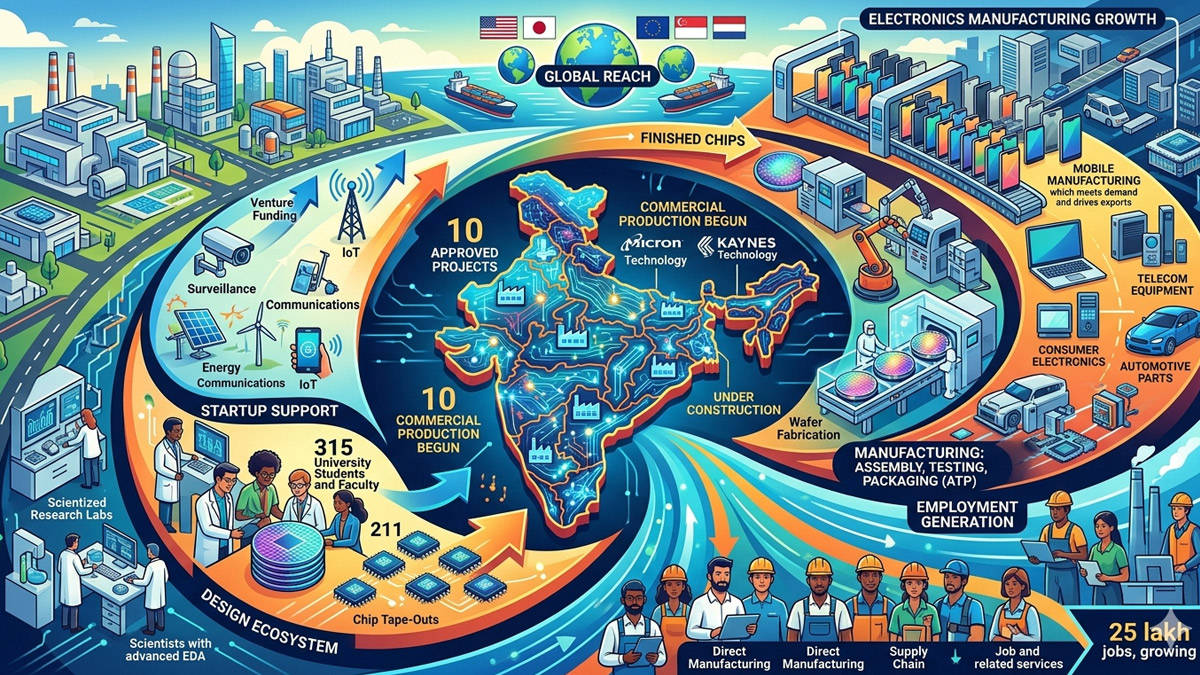
NEW DELHI: India’s push to become a global electronics powerhouse is gaining momentum, with the Semicon India Programme driving the creation of a full-fledged semiconductor ecosystem from design to manufacturing.
Launched in 2022, the programme aims to build capabilities across the entire value chain, including chip design, fabrication, assembly, testing and packaging. In just four years, the government has approved 10 semiconductor projects with a combined investment commitment of around Rs 1.6 lakh crore.
Two of these facilities have already begun commercial production, including units led by Micron Technology Inc. and Kaynes Technology India Limited. Two more plants are expected to go live later this year, signalling that India’s chip ambitions are moving from blueprint to factory floor.
The broader electronics manufacturing story has also seen sharp growth over the past decade. Production has jumped from roughly Rs 1.9 lakh crore in 2014-15 to about Rs 12 lakh crore in 2024-25, while exports have surged nearly eightfold. Mobile phone manufacturing, once heavily import-dependent, now meets almost all domestic demand and has become a major export driver.
Alongside manufacturing, the government is investing heavily in design capabilities. Through access to advanced chip design tools provided free to 315 universities, students and researchers have clocked over 200 lakh hours of usage. This effort has already resulted in 211 chip tape-outs from 75 institutions.
Support for startups is also picking up pace. Twenty-four chip design projects have been approved, targeting sectors such as surveillance, energy, communications and IoT. Of these, 14 companies have collectively raised over Rs 650 crore in venture funding, while several designs have progressed to fabrication, including at advanced nodes.
To strengthen supply chains, India has also signed semiconductor cooperation agreements with countries including the United States, Japan, the European Union, Singapore and the Netherlands. These partnerships aim to reduce global dependencies while boosting domestic capabilities.
The employment impact is equally significant. The electronics sector now supports an estimated 25 lakh jobs, with mobile manufacturing alone accounting for nearly half. As more semiconductor units come online under the India Semiconductor Mission, indirect job creation across supply chains is expected to rise further.
Sharing these updates in Parliament, Ministry of Electronics and Information Technology minister of state Jitin Prasada underscored the government’s focus on building a resilient, end-to-end semiconductor ecosystem.
With factories taking shape, designs moving to silicon and investments flowing in, India’s semiconductor story is steadily shifting gears from ambition to execution.






