News Broadcasting
China to have over 32 mn mobile video users in 2008


MUMBAI: The mobile video market in China will take off in 2008, driven by interest in the Beijing Olympics. A new study from ABI Research forecasts total mobile video users at more than 32 million in 2008.
About 27 per cent of these consumers will use broadcasting technology, and 73 per cent will use unicast streaming technology, while a number of viewers are likely to use both.
This year the Chinese State Administration of Radio, Film, and Television (Sarft) had announced two handset-related standards. DAB is likely to be the first phase of mobile multimedia broadcasting standards development in China. DAB paves the way for upgrading to China’s proposed mobile multimedia broadcasting standard, T-DMB, a terrestrial implementation of SK Telecom’s mobile video format.

ABI research director Jake Saunders says, “Because both standards are voluntary, there are questions surrounding their effect in the market. “It is likely that local media groups and TV stations will deploy DAB initially, and implement T-DMB at a later date. The Chinese government will give preference to a standard that will be used in the 2008 Olympics, and DAB has been listed as one of the broadcast services that will be available at the Beijing Games.
“Although lack of content is still deemed to be a bottleneck for mobile video in mainland China, the problem will be solved in the next two years. The current content shortage is caused by the limited number of handset TV SP licenses. When more companies obtain licenses, competition will become the lubricant to drive up the market.”
Meanwhile in Hong Kong, mobile operators are active in mobile video streaming. Their international operations backgrounds allow them to provide diversified content to users. PCCW’s experience in operating its IPTV business will boost its performance in the 3G market.
ABI Research forecasts approximately 715,000 mobile video users in Hong Kong in 2008, of which 99 per cent will be streaming users. In Taiwan, ABI Research forecasts that there will be over 1.5 million mobile video users in 2008, with 97 per cent receiving content via streaming.







News Broadcasting
Network18 channels lead YouTube news viewership in March 2026
CNN-News18, News18 India and CNBC channels top categories with record views
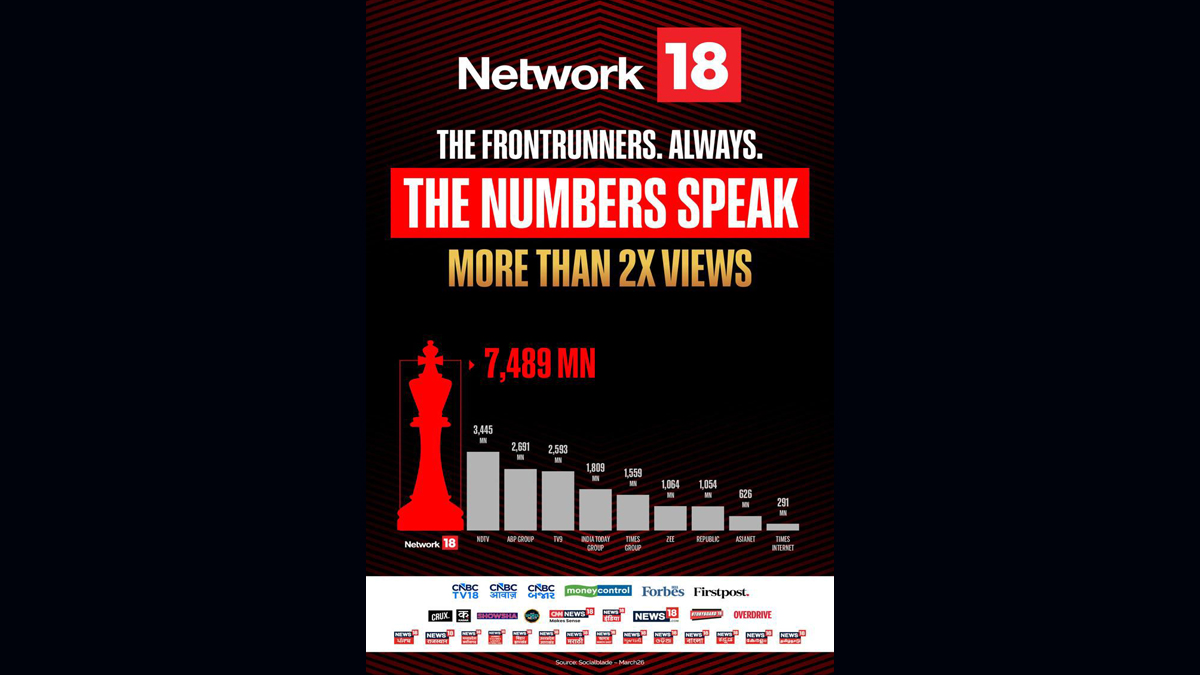
MUMBAI: When the world hit refresh on breaking news, Network18’s channels were already streaming ahead. As geopolitical tensions and war-driven headlines fuelled a surge in global news consumption, the network’s digital playbook delivered big clocking record Youtube viewership across English, Hindi and business news categories in March 2026.
At the forefront was CNN-News18, which emerged as the clear leader in the English news segment with 130 million live and video-on-demand views. The channel edged past competitors such as Times of India (126.5 million), Times Now (101.1 million), India Today (88.2 million) and NDTV (77.5 million), according to Databeings data for March.
In the Hindi news arena, News18 India delivered a commanding performance, racking up a staggering 3,297 million views on YouTube. The channel comfortably outpaced NDTV India, which recorded 3,119 million views, underlining its deep reach and consistent engagement with mass audiences, as per Playboard data.
The network’s dominance wasn’t confined to general news. In the Hindi business segment, CNBC Awaaz topped the charts with 92 million views, narrowly ahead of Zee Business (90 million) and well ahead of ET Now Swadesh (57 million). Meanwhile, its English counterpart CNBC-TV18 posted a strong 58 million views, reinforcing the network’s cross-category strength.
The spike in viewership reflects a broader shift in audience behaviour, with viewers increasingly turning to digital platforms particularly Youtube for real-time updates and in-depth coverage during high-intensity news cycles. For Network18, the numbers signal more than just scale; they underline the effectiveness of a multi-platform strategy that blends speed, credibility and continuous coverage.
In a month where the news never paused, it seems viewers chose to stay tuned where the stream never stopped.






