News Broadcasting
Cell users worldwide prefer GSM: study

MUMBAI: The subscriber results from Informa Telecoms and Media’s World Cellular Information Service for 1Q 2006, 3G Americas reports that cell phone users across the globe choose GSM 10 to one over any other wireless mobile technology.
According to the study, the customer base for the GSM family of technologies which include, GSM, GPRS, EDGE and UMTS/HSDPA — grew by nearly 120 million additional subscribers in 1Q 2006 alone, compared to the total net growth of CDMA of about 12 million customers.
Today, the 1.85 billion users of the GSM family of technologies make up more than 81 per cent of the wireless mobile market worldwide, with total subscribers of CDMA at less than 300 million and a 13 per cent market share. There were 57 million customers using UMTS services at the close of 1Q 2006.

The results also indicate that from Q1 ’05 to Q1 ’06, the GSM family of technologies showed continued growth throughout the Western Hemisphere, adding nearly 95 million new customers — 3.5 times as many as CDMA – and approaching a quarter of a billion customers in this region alone.
CDMA’s customer base in the region grew to a total of 169 million in the same time period with 27 million new customers and market share declining to 34.6 per cent, along with CDMA to 11.6 per cent. By contrast, the growing market share for GSM reached 47.8 per cent. Latin America and the Caribbean once again nearly doubled their GSM customer base in these 12 months, growing from 77 million customers in March 2005 to 150 million by March 2006.
In this region, more than 19 million GSM users were added, versus 2 million for CDMA. GSM now has nearly 150 million customers in Latin America and the Caribbean and over a 58 per cent share of market, indicating that it is the no.1 technology for wireless mobile services.
In the US and Canada, GSM operators reported exceptional growth, with 4.8 million new customers added in the 1Q 2006 for a customer base of 84 million.
3G Americas president Chris Pearson said, “The majority of wireless customers are selecting GSM service for the value and variety of products and services that are supported by a global eco-system of manufacturers, encouraged by open technology standards versus proprietary standards.”
“In addition, carriers throughout the Americas and worldwide continue to choose EDGE and UMTS/HSDPA as leading next generation technologies for wireless data services for many compelling reasons, such as spectral efficiency, global roaming, economies of scale, handset availability, as well as the potential for increased revenues from 3G services,” he added.
According to a release, the growth of GSM is evident in the number of carriers upgrading or changing their technology platforms in the industry for a variety of strategic business reasons. These include veteran CDMA operators such as Telstra in Australia, and KT Freetel and SK Telecom in Korea who are deploying UMTS/HSPDA. Chinook Wireless (Montana) made a similar announcement to deploy GSM/EDGE to ‘enable their subscribers to benefit from higher performing network service with increased coverage, higher voice quality and advanced digital data services like multimedia messaging and Internet browsing.’ To date, at least 11 operators have announced CDMA to GSM migrations or dual technology deployments.
Globally, the GSM family of technologies continues its rapid evolution to 3G high-speed wireless data. EDGE is commercially offered by 133 operators across 80 countries, including 31 countries in Latin America and the Caribbean. There are 81 additional EDGE networks planned or in deployment. Currently, there are 105 UMTS networks in service across 50 countries, with 59 more planned or in deployment. HSDPA, which is an enhanced version of UMTS for high speed mobile broadband, was launched first in the world by Cingular Wireless in 16 markets in December 2005.
Now, five months later, HSDPA is commercial on 22 networks and 73 additional operators have networks planned, in deployment, or in trial. Rogers Wireless of Canada will deploy HSDPA before year end 2006; T-Mobile USA has announced plans to do the same when spectrum resources are acquired. It is expected that nearly all UMTS operators will deploy HSDPA, essentially a software upgrade to UMTS, resulting in a significant increase in data capacity and offering operators a much-reduced network cost for data services.
Additionally, through its level of scale, GSM serves emerging markets, providing a sub $30 GSM cost handset to the market and reducing typical capital expenditure for deploying a GSM network to a quarter of that required for CDMA, according to the GSM Association.
This data is based on figures from Informa Telecoms & Media, which provides business intelligence and strategic services to the global telecoms and media markets.


News Broadcasting
India Today Group sweeps top honours at Ramnath Goenka Awards
Journalists recognised for fearless investigative and civic reporting.
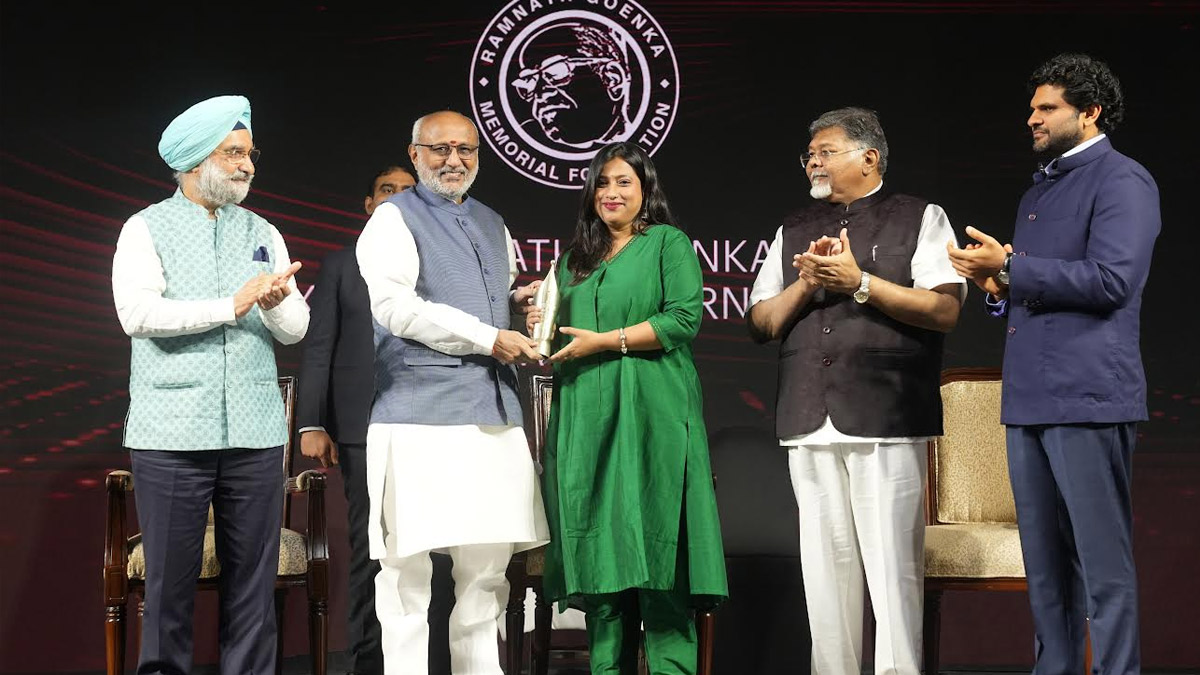
MUMBAI: India Today Group just turned the Ramnath Goenka Awards into its own trophy cabinet because when your reporters dig this deep, even the judges have to award a clean sweep. India Today Group journalists have secured multiple top honours at the latest edition of the prestigious Ramnath Goenka Excellence in Journalism Awards, reinforcing the network’s legacy as the gold standard of Indian journalism. The awards were conferred by vice president C. P. Radhakrishnan at a ceremony held on 27 March 2026.
Sreya Chatterjee won in the ‘Investigative Reporting – Broadcast’ category for her powerful India Today TV report ‘Operation Illegals: The Alarming Rise in Bangladeshi Infiltration Across India’s Fragile Eastern Frontier’. The investigation stood out for its depth, on-ground rigour and national relevance.
In the ‘Civic Journalism – Print/Digital’ category, Sreya Chatterjee along with Arvind Ojha were honoured for their indiatoday.in report on unregulated water extraction and the ‘Tanker Mafia’ in Delhi’s Bawana Industrial Area. The story exposed critical systemic gaps and environmental challenges affecting daily life.
Additionally, aajtak.in was recognised in the ‘Investigative Reporting – Print/Digital’ category for its hard-hitting exposé ‘The Surrogate Mother Market’, which highlighted the human, legal and ethical dimensions of the surrogacy ecosystem.
India Today Group emerged as the only network honoured in Investigative Journalism across both Print/Digital and Broadcast categories. The wins reflect the strength of its multi-platform newsroom and its unwavering commitment to credible, high-impact reporting that informs public discourse and drives accountability.
In an era when speed often trumps substance, these awards remind us that the most powerful stories are still the ones dug out with courage, told with clarity, and delivered with conscience, one fearless byline at a time.








