News Headline
CDG urges TRAI to allocate PCS1900 spectrum to operators

MUMBAI: The CDMA (Code Division Multiple Access) Development Group (CDG) has recommended to the Telecom Regulatory Authority of India (TRAI) that the PCS1900 spectrum be allocated to CDMA operators to ensure that CDMA is allowed to co-exist and compete on a fair basis with other wireless standards in India, according to an official release.
“The CDG commends India for its leadership in adopting policies that promote the use of wireless technologies in expanding the reach of telecommunication services and implementing advanced services in the market,” stated CDMA Development Group executive director Perry LaForge in the release.
The CDMA Development Group is a trade association formed to foster the worldwide development, implementation and use of CDMA technologies. The more than 100 member companies of the CDG include many of the world’s largest wireless carriers and equipment manufacturers.

The primary activities of the CDG include development of CDMA features and services, public relations, education and seminars, regulatory affairs and international support. Currently, there are more than 500 individuals working within various CDG subcommittees on CDMA-related matters.
“With the introduction of the Unified License, CDMA has thrived in India and has greatly contributed to the expansion of wireless services in the past year. We hope that TRAI will continue to promote policies that embrace the concepts of technology neutrality and spectrum flexibility to ensure the long-term growth of mobile services in India,” adds LaForge
As of July 2004, CDMA technology served more than 10 million subscribers across India. CDMA services have created competition, lowered tariffs and allowed many citizens access to communication services for the first time. However, the spectrum allocated to CDMA operators in the regions is roughly half of that allocated to other technologies and is not enough to support even the minimum capacity projections required over the next two years for voice services only.
Spectrum in the 1800 MHz band is not a viable option for CDMA carriers in India. There are no CDMA systems operating in this band, nor are there dual band handsets or network equipment available for both the 800 MHz and 1800 MHz bands.
Indian operators would have to wait years before the appropriate systems and devices were available to offer service, and even then they would be uniquely developed for the Indian region and therefore very expensive.
“Policies that allow for co-existence of multiple technologies and in-band migration to 3G services have resulted in rapid growth in mobile penetration and faster deployment of advanced wireless services in many markets across the world, including Asia, Latin America and North America,” said LaForge.
“The CDG urges TRAI to ensure that enough spectrum is available to all carriers to support growth and stimulate continued innovation and competition.
“The CDG strongly believes that it is essential that spectrum in the 1900 MHz band be allocated to CDMA operators to ensure that they participate in and contribute to the development of the wireless market in India,” he added
CDMA technology is the fastest growing wireless technology worldwide. As of June 2004, there were 222 CDMA networks and over 212 million CDMA subscribers across all six continents. CDMA2000(r) is the leading 3G technology deployed by 90 operators and servicing over 112 million users worldwide.
There are more than 650 CDMA2000 devices available today. The economies of scale CDMA2000 provides in terms of infrastructure and handsets enable operators to deploy networks rapidly and cost-effectively and to offer high-quality voice and innovative data services to users across all economic groups.






NEW DELHI: Hamdard Laboratories gathered a cross-section of India’s achievers in New Delhi on Friday, handing out the Hakeem Abdul Hameed Excellence Awards to figures who have left their mark across healthcare, education, sport, public service and the arts.
The ceremony, attended by minister of state for defence Sanjay Seth and senior officials from the ministry of Ayush, celebrated individuals whose work blends professional success with a sense of public purpose. It was as much a roll call of achievement as it was a reminder that influence is not measured only in profits or podiums, but in people reached and lives improved.
Among the headline awardees was Alakh Pandey, founder and chief executive of PhysicsWallah, recognised for turning affordable digital learning into a mass movement. On the sporting front, Arjuna Awardee and kabaddi player Sakshi Puniya was honoured for her contribution to the game and for pushing women’s participation onto bigger stages.
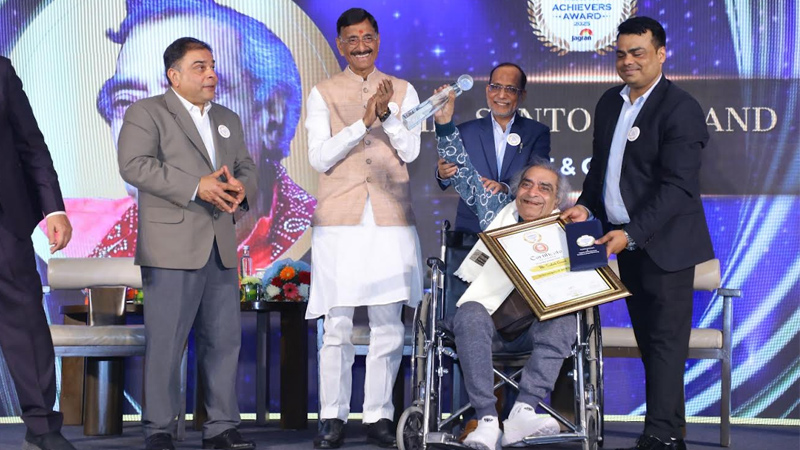
The cultural spotlight fell on veteran lyricist and poet Santosh Anand, whose songs have echoed across generations of Hindi cinema. At 97, Anand accepted the honour with characteristic humility, reflecting on a life shaped by perseverance and hope.
Healthcare honours spanned both modern and traditional systems. Manoj N. Nesari was recognised for strengthening Ayurveda’s place in national and global health frameworks. Padma shri Mohammed Abdul Waheed was honoured for his research-backed work in Unani medicine, while padma shri Mohsin Wali received recognition for his long-standing contribution to patient-centred care.
Education and social development also featured prominently. Padma shri Zahir Ishaq Kazi was honoured for decades of work in education, while former Meghalaya superintendent of Police T. C. Chacko was recognised for public service. Goonj founder Anshu Gupta received an award for his dignity-centred rural development initiatives, and the Hunar Shakti Foundation was honoured for empowering women and young girls through skill development.
The Lifetime Achievement Award went to former IAS officer Shailaja Chandra for her long career in public healthcare and governance, particularly in the traditional systems under Ayush.
Speaking at the event, Hamdard chairman Abdul Majeed said the awards were a tribute to those who combine excellence with empathy. “These awardees reflect Hakeem Sahib’s belief that healthcare, education and public service must ultimately serve humanity,” he said.
Minister Seth struck a forward-looking note, saying India’s young population gives the country a unique opportunity to become a global destination for learning, health and wellness by 2047.
The ceremony also featured the trailer launch of Unani Ki Kahaani, an upcoming documentary starring actor Jim Sarbh, set to premiere on Discovery on 11 February.
Instituted in memory of Unani scholar and educationist Hakeem Abdul Hameed, the awards have grown into a national platform that celebrates those building a more inclusive and resilient India. For one evening at least, the spotlight was not just on success, but on service with substance.







