Hardware
Catvision to install 200 headends by December 2016


KOLKATA: Catvision, a manufacturer, re-seller and system integrator, which has installed more than 60 headends till now, aims to install around 200 more headends by the end of 2016 through its joint venture company Catvision Unitron.
By looking at an additional 200 headends, the company is aiming at about 25 per cent share in the headend installation vertical by 2016.

Speaking to Indiantelevision.com, Catvision managing director Athar Abbas said, “We have installed more than 60 headends in locations like Guwahati, Dimapur, Sonipat, Dehradun among others till now. In phase III and IV, we are looking at a market share of 25 per cent. By December 2015, we are looking at 100 headends and another 100 by 2016.”
Catvision signed a joint venture agreement with Belgian company Unitron Group NV to set up a 50:50 joint venture called Catvision Unitron in India. The company develops AV encoders for the cable television industry.
Now the JV develops CATV digital systems and products with the latest world-class technology. Unitron Group NV of Belgium has years of experience in the state-of-the-art digital headend technology, and is one of the leading companies in Europe in providing solutions for TV distribution to multi- dwelling units and residential complexes.
On the other hand, Catvision has experience in the CATV industry in India, a market that is migrating to digital technology totally by the end of 2016.
“This joint venture with Unitron has enabled Catvision to become a leading player in India and surrounding countries in the emerging digital TV space,” Abbas said.
As was reported earlier by Indiantelevision.com, the company aims to manufacture around 15 lakh STBs to be used in the third and fourth phases of cable TV digitization process in India.




Hardware
India clears Rs 1.6 lakh crore semiconductor projects under Semicon India
Ten projects cleared as production begins and design ecosystem gathers pace
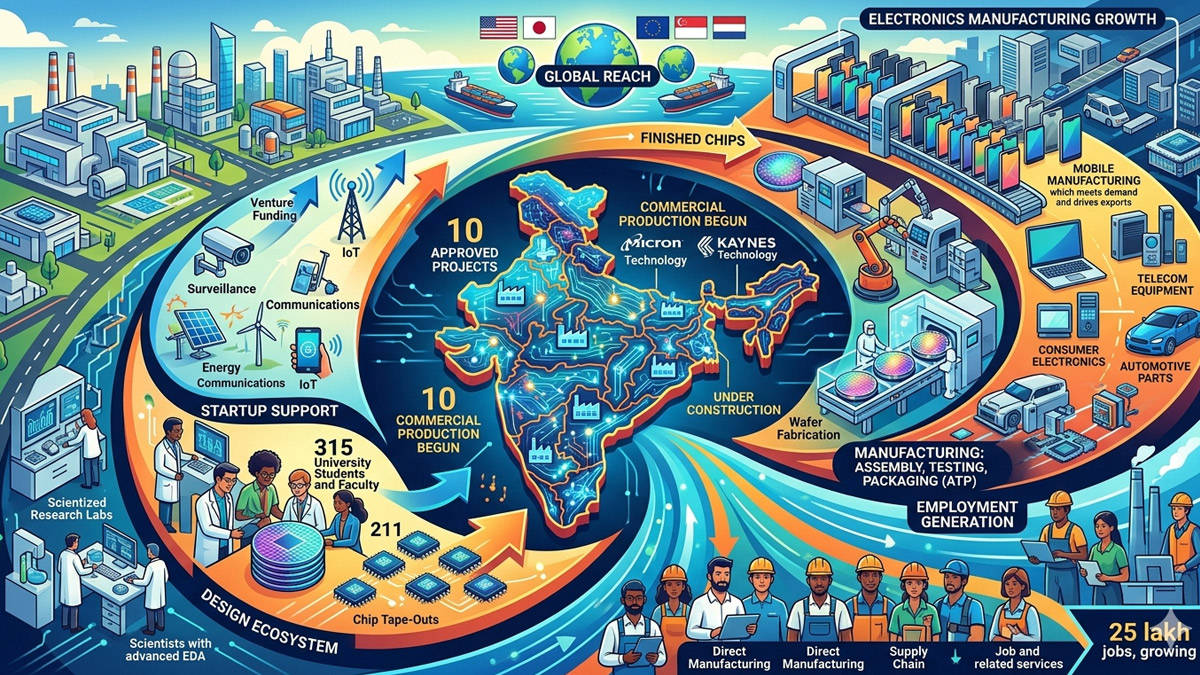
NEW DELHI: India’s push to become a global electronics powerhouse is gaining momentum, with the Semicon India Programme driving the creation of a full-fledged semiconductor ecosystem from design to manufacturing.
Launched in 2022, the programme aims to build capabilities across the entire value chain, including chip design, fabrication, assembly, testing and packaging. In just four years, the government has approved 10 semiconductor projects with a combined investment commitment of around Rs 1.6 lakh crore.
Two of these facilities have already begun commercial production, including units led by Micron Technology Inc. and Kaynes Technology India Limited. Two more plants are expected to go live later this year, signalling that India’s chip ambitions are moving from blueprint to factory floor.
The broader electronics manufacturing story has also seen sharp growth over the past decade. Production has jumped from roughly Rs 1.9 lakh crore in 2014-15 to about Rs 12 lakh crore in 2024-25, while exports have surged nearly eightfold. Mobile phone manufacturing, once heavily import-dependent, now meets almost all domestic demand and has become a major export driver.
Alongside manufacturing, the government is investing heavily in design capabilities. Through access to advanced chip design tools provided free to 315 universities, students and researchers have clocked over 200 lakh hours of usage. This effort has already resulted in 211 chip tape-outs from 75 institutions.
Support for startups is also picking up pace. Twenty-four chip design projects have been approved, targeting sectors such as surveillance, energy, communications and IoT. Of these, 14 companies have collectively raised over Rs 650 crore in venture funding, while several designs have progressed to fabrication, including at advanced nodes.
To strengthen supply chains, India has also signed semiconductor cooperation agreements with countries including the United States, Japan, the European Union, Singapore and the Netherlands. These partnerships aim to reduce global dependencies while boosting domestic capabilities.
The employment impact is equally significant. The electronics sector now supports an estimated 25 lakh jobs, with mobile manufacturing alone accounting for nearly half. As more semiconductor units come online under the India Semiconductor Mission, indirect job creation across supply chains is expected to rise further.
Sharing these updates in Parliament, Ministry of Electronics and Information Technology minister of state Jitin Prasada underscored the government’s focus on building a resilient, end-to-end semiconductor ecosystem.
With factories taking shape, designs moving to silicon and investments flowing in, India’s semiconductor story is steadily shifting gears from ambition to execution.






