News Broadcasting
CASBAA convention to address television industry issues


MUMBAI: Asian pay TV growth, video piracy, opportunities from China and the roll-out of 3G services will top the agenda when the regions leading broadcasters and satellite and cable operators meet this year at the annual Cable and Satellite Broadcasting Association of Asia (CASBAA) Convention in Hong Kong from 27-29 October.
“This is a great time for the regions cable and satellite broadcasters to come together, with massive opportunities opening up in China and from the genuine convergence of broadband and wireless technologies,” said CASBAA chairman Marcel Fenez.
“The China wireless market alone, with more than 300 million subscribers and a fast-growing mobile data segment, is one of the worlds great media and entertainment prospects. The CASBAA event is where the industry meets to understand the market dynamics and meet the decision-makers.”
The CASBAA Convention 2004 will hear from senior broadcast and studio executives, specialists on technology, and regulation and industry leaders from growing markets such as China, Korea and India.
Among the keynote addresses, Sony Pictures Television International president Michael Grindon and Star Group CEO Michelle Guthrie will speak on corporate strategies in the current industry environment, GE chief marketing officer Beth Comstock will give the global view on Asian advertising, and Harmonic Convergent Systems president Yaron Simler will examine the impact of digital video.

One panel session will reveal new estimates on the impact of pay-TV piracy in the region and the latest strategies in tackling theft of content, and another will be devoted to advertising and advertising agencies.
On Day two, the technology spotlight will be on wireless content and MMORPGs Massively Multi-player Online Role-Playing Games.
The Day three fora will be devoted wholly to the China market, with sessions on wireless entertainment and business models for digital content. China International TV Corp president Li Jian will speak on the Chinese media groups global ambitions.
CASBAA CEO Simon Twiston Davies said this years line-up of speakers and topics goes well beyond the pay TVs industry traditional boundaries.
“With the focus on the key areas of advertising, technology and the China market, we examine some of the central issues of the day,” Twiston Davies said. “The conference is all about approaching the new convergence technologies as platforms for delivery of multi-channel content.”
He said the event has also extended into vertical markets such as wireless and multimedia content which are becoming increasingly important to Asian pay TV operators and content owners.
The CASBAA Convention 2004 will be held at the Hong Kong Academy for Performing Arts from 27-29 October, presented by InvestHK and with CableTV and StarTV as official partners.



News Broadcasting
UDF poised to return to power in Kerala, says Manorama-CVoter survey
Massive opinion poll projects shift in Kerala politics ahead of 2026 Assembly elections.
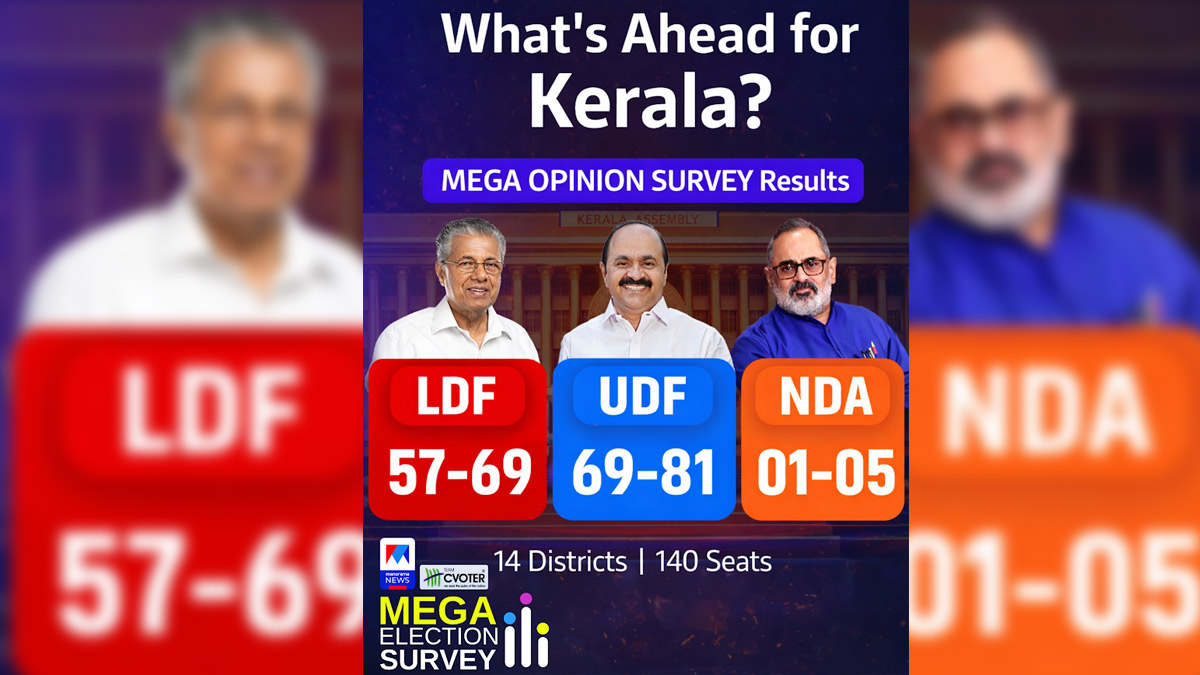
MUMBAI: The winds of change appear to be blowing through Kerala’s political landscape and this time, they seem to favour the United Democratic Front. A comprehensive mega opinion survey conducted by Manorama News in partnership with CVoter projects a potential comeback for the UDF in the upcoming Kerala Legislative Assembly Elections 2026. The survey, covering all 140 constituencies with a massive sample size of nearly 90,000 respondents, predicts the UDF could win between 69 and 81 seats.
The ruling Left Democratic Front (LDF) is expected to secure 57 to 69 seats, a significant drop from the 99 seats it won in the 2021 elections. This would mean the LDF losing 30 to 42 of its sitting seats. Meanwhile, the National Democratic Alliance (NDA), which drew a blank in 2021, is projected to open its account with 1 to 5 seats.
Region-wise, the UDF is expected to make strong gains in Malabar, winning 25 to 34 out of 48 seats, and in Central Kerala, where it could bag 29 to 33 out of 53 seats. In South Kerala, the LDF is likely to retain an edge with 21 to 25 seats, while the UDF may improve to 12 to 16 seats. The NDA could pick up 1 to 3 seats in the southern region.
The survey was conducted between 14 and 26 March 2026, with additional tracker and snap polls carried out from December 2025 to March 2026. A total of 89,693 respondents participated, ensuring representation across all demographics and social segments.
Manorama News has a strong track record of accuracy, with its previous projections closely matching the actual results of the 2019 and 2024 Lok Sabha elections as well as the 2021 Kerala Assembly polls.
In Kerala’s famously fierce political battles, this survey suggests the pendulum may be swinging back. Whether the final verdict matches these numbers or throws up another surprise, one thing is clear, the 2026 Assembly elections are shaping up to be one of the most keenly watched contests in the state’s history.






