News Headline
Cartosat-1, Hamsat in orbit; fillip to mapping & Ham radio

|
MUMBAI: The Indian Space Research Organisation (Isro) has successfully launched India’s heaviest remote sensing satellite Cartosat-1 and lightweight Hamsat from the newly set up Second Launch Pad at the Satish Dhawan Space Centre, Sriharikota, Andhra Pradesh. |
|
The 1560 kg Cartosat will be used for mapping applications while the 42.5 kg Hamsat, a microsatellite, will help expand bandwidth to help amateur radio operators around the world. |
|
Intended for cartographic applications, Cartosat-1 carries two panchromatic cameras that take black-and-white stereoscopic pictures in the visible region of the electromagnetic spectrum. The imageries will have a spatial resolution of 2.5 metre and cover a swath of 30 km. The imageries will be useful for generating digital elevation maps for urban and rural development, land and water resources management, disaster assessment, relief planning and management and environmental impact assessment. Cartosat-1 also carries a Solid State Recorder with a capacity of 120 Giga Bits to store the images taken by its cameras.  Hamsat will meet the long felt need of the Amateur Radio Operators in the South Asian region who possess the required equipment and operate in the UHF/VHF band based Satellite Radio Communication. One of the transponders of Hamsat has been developed indigenously involving Indian amateurs, with the expertise of Isro and the experience of Amsat-India. The second transponder has been developed by a Dutch amateur radio operator and graduate engineering student at Higher Technical Institute, Venlo, Netherlands. Hamsat is India’s contribution to the international community of Amateur Radio Operators. This effort is also meant to bring Isro’s Satellite services within the reach of the common man and popularise Space Technology among the masses. With the successful launch of Cartosat-1 and Hamsat today, PSLV has reiterated its reliability and versatility for launching satellites of different weight classes precisely into specified orbits, says an Isro statement. |
 The Polar Satellite Launch Vehicle (PSLV) soared into the sky at 10.14 am and placed the satellites in the 618 km polar Sun Synchronous Orbit (SSO) at 10.32 am. Both the satellites have been placed in polar Sun Synchronous Orbit (SSO) at an altitude of 632 x 621 km with an inclination of 97.8 deg with respect to the equator. The solar panels of Cartosat-1 were deployed soon after its injection into orbit.

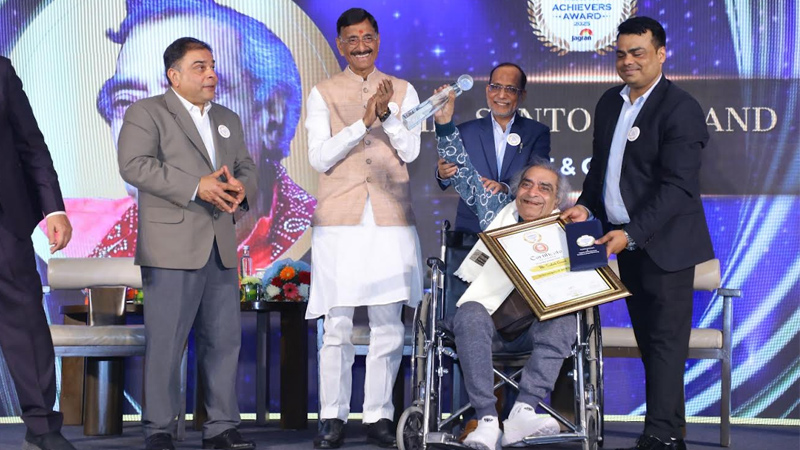
NEW DELHI: Hamdard Laboratories gathered a cross-section of India’s achievers in New Delhi on Friday, handing out the Hakeem Abdul Hameed Excellence Awards to figures who have left their mark across healthcare, education, sport, public service and the arts.
The ceremony, attended by minister of state for defence Sanjay Seth and senior officials from the ministry of Ayush, celebrated individuals whose work blends professional success with a sense of public purpose. It was as much a roll call of achievement as it was a reminder that influence is not measured only in profits or podiums, but in people reached and lives improved.
Among the headline awardees was Alakh Pandey, founder and chief executive of PhysicsWallah, recognised for turning affordable digital learning into a mass movement. On the sporting front, Arjuna Awardee and kabaddi player Sakshi Puniya was honoured for her contribution to the game and for pushing women’s participation onto bigger stages.
The cultural spotlight fell on veteran lyricist and poet Santosh Anand, whose songs have echoed across generations of Hindi cinema. At 97, Anand accepted the honour with characteristic humility, reflecting on a life shaped by perseverance and hope.
Healthcare honours spanned both modern and traditional systems. Manoj N. Nesari was recognised for strengthening Ayurveda’s place in national and global health frameworks. Padma shri Mohammed Abdul Waheed was honoured for his research-backed work in Unani medicine, while padma shri Mohsin Wali received recognition for his long-standing contribution to patient-centred care.
Education and social development also featured prominently. Padma shri Zahir Ishaq Kazi was honoured for decades of work in education, while former Meghalaya superintendent of Police T. C. Chacko was recognised for public service. Goonj founder Anshu Gupta received an award for his dignity-centred rural development initiatives, and the Hunar Shakti Foundation was honoured for empowering women and young girls through skill development.
The Lifetime Achievement Award went to former IAS officer Shailaja Chandra for her long career in public healthcare and governance, particularly in the traditional systems under Ayush.
Speaking at the event, Hamdard chairman Abdul Majeed said the awards were a tribute to those who combine excellence with empathy. “These awardees reflect Hakeem Sahib’s belief that healthcare, education and public service must ultimately serve humanity,” he said.
Minister Seth struck a forward-looking note, saying India’s young population gives the country a unique opportunity to become a global destination for learning, health and wellness by 2047.
The ceremony also featured the trailer launch of Unani Ki Kahaani, an upcoming documentary starring actor Jim Sarbh, set to premiere on Discovery on 11 February.
Instituted in memory of Unani scholar and educationist Hakeem Abdul Hameed, the awards have grown into a national platform that celebrates those building a more inclusive and resilient India. For one evening at least, the spotlight was not just on success, but on service with substance.






