News Broadcasting
Cartoon Network introduces mobile TV in Italy

MUMBAI: Turner has signed its first mobile broadcasting agreement for Cartoon Network. As per this Italian mobile operator 3 will distribute Cartoon Network to its videophone subscribers.
The arrangement will offer 3’s users the opportunity to watch a daily block of Cartoon Network programming on their videophones.
Through the new service with “3”, Cartoon Network’s Italian fans will be the first in the world able to live the network’s experience through their videophones. Courtesy of third-generation mobile technology, known as UMTS, a daily block of Cartoon Network will be broadcast live and then replayed throughout the day.

3’s subscribers will be able to enjoy episodes of The Powerpuff Girls, Dexter’s Laboratory, Ed, Edd n Eddy – and many other Cartoon Network shows – wherever they are – whenever they want. Viewers will pay 0.90 Euro cents for every five minutes of viewing.
Cartoon Network’s existing mobile portfolio already includes games, wallpapers and ringtones. The content has broad distribution around the world in more than 30 countries to over 50 mobile operators. This deal with “3” represents the first for Cartoon Network to distribute portions of its TV channel. The company is in discussions with additional operators worldwide for similar services. Turner currently distributes its CNN 24-hour news channel to mobile phone users in Austria, The Netherlands, Finland, Sweden and Australia.
Turner Broadcasting System International VP for wireless and emerging technology Mitch Lazar added, “This agreement once again confirms how the value of the Cartoon Network brand and its characters are fully integrated into contemporary culture. Our cartoons are able to reach targets of every age in different ways: from TV to consumer products, from PC to telephony and to all new communication means”.
Cartoon Network Mobile is Turner Broadcasting System’s service for mobile devices. Launched in 2001, the service offers content based on its shows and characters. The content includes java games, ringtones and wallpapers compatible with WAP and i-mode devices as well as SMS. Cartoon Network’s java games has been developed by Macrospace. Cartoon Network Mobile is available in over 30 countries to more than 50 operators.







News Broadcasting
Network18 channels lead YouTube news viewership in March 2026
CNN-News18, News18 India and CNBC channels top categories with record views
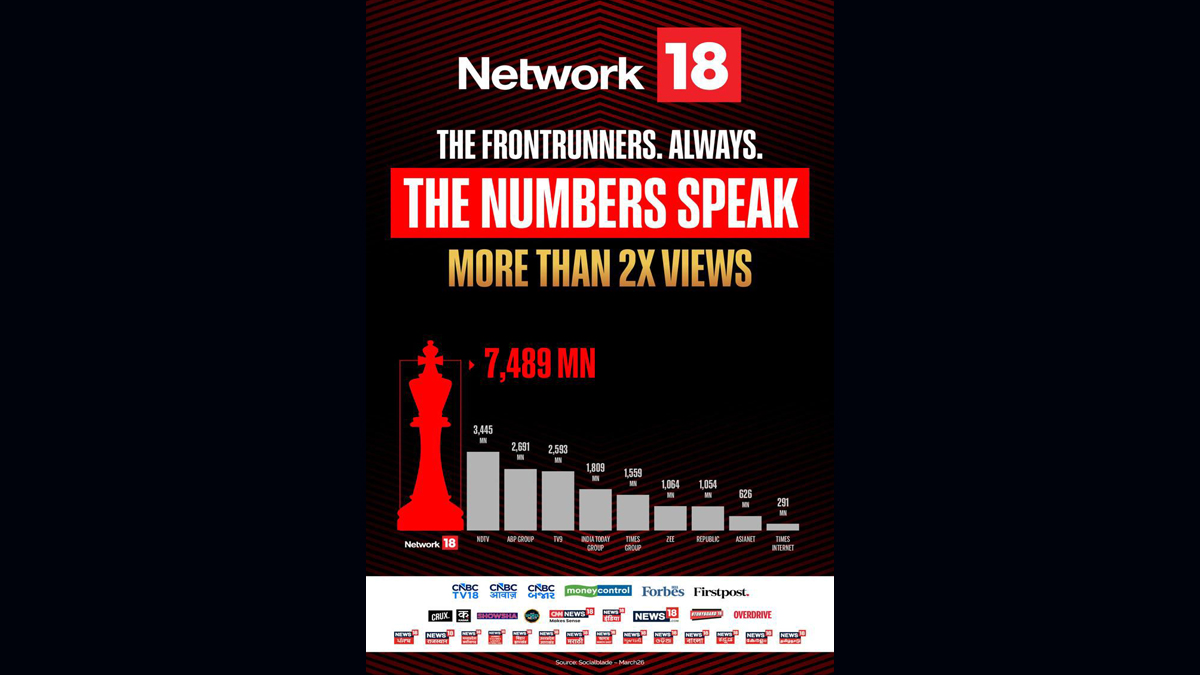
MUMBAI: When the world hit refresh on breaking news, Network18’s channels were already streaming ahead. As geopolitical tensions and war-driven headlines fuelled a surge in global news consumption, the network’s digital playbook delivered big clocking record Youtube viewership across English, Hindi and business news categories in March 2026.
At the forefront was CNN-News18, which emerged as the clear leader in the English news segment with 130 million live and video-on-demand views. The channel edged past competitors such as Times of India (126.5 million), Times Now (101.1 million), India Today (88.2 million) and NDTV (77.5 million), according to Databeings data for March.
In the Hindi news arena, News18 India delivered a commanding performance, racking up a staggering 3,297 million views on YouTube. The channel comfortably outpaced NDTV India, which recorded 3,119 million views, underlining its deep reach and consistent engagement with mass audiences, as per Playboard data.
The network’s dominance wasn’t confined to general news. In the Hindi business segment, CNBC Awaaz topped the charts with 92 million views, narrowly ahead of Zee Business (90 million) and well ahead of ET Now Swadesh (57 million). Meanwhile, its English counterpart CNBC-TV18 posted a strong 58 million views, reinforcing the network’s cross-category strength.
The spike in viewership reflects a broader shift in audience behaviour, with viewers increasingly turning to digital platforms particularly Youtube for real-time updates and in-depth coverage during high-intensity news cycles. For Network18, the numbers signal more than just scale; they underline the effectiveness of a multi-platform strategy that blends speed, credibility and continuous coverage.
In a month where the news never paused, it seems viewers chose to stay tuned where the stream never stopped.






