News Broadcasting
Can digitisation heal TV news industry?


NEW DELHI: Crippled by high carriage payouts to cable networks, low subscription revenues, muted ad growth and rise in personnel costs, television news broadcasters are looking at digitisation to play the rescue act as they struggle to stay profitable.
“The success of digitisation is critical for all of us. We will have fatter revenues, better content and investments will go up,” said NDTV Group executive vice chairman KVL Narayan Rao.
Calling it the “new dawn for the TV news industry,” Rao said digitisation would throw open a huge opportunity for growth as carriage fees reduce and subscription revenues go up. India will have 100 million new viewers in the next five years and with digitisation consumers will have better access to content.

“Digitisation is the gamechanger. But there needs to be close co-operation among the stakeholders for making it a success,” said Rao, while speaking at the 5th News Television Summit here Wednesday.
News broadcasters have themselves to blame for the terrible financial mess they are in. Fierce competition, an oversupply of channels, lack of unity and audience fragmentation within the genre have kept advertising prices low.
“News as a genre is terribly under-priced. There is a lot of scope for us to take it forward if we stand united. We also need to develop new selling techniques and go beyond TAM (the currency for measuring TV audiences) ratings if we are to get the right value for a genre that is so impactful,” said TV Today Network chief executive officer Joy Chakravorthy.
The international market is also getting spoilt by the new entrants as they launch price wars to grab market share.
“The industry has suffered because we have not worked together. Considering the current revenue position, the news industry also can’t afford to be lavish,” averred Chakravorthy.
News broadcasters had committed several mistakes in the past and there is a pressing need to take a U-turn now. “We have converted a potential revenue earner to a huge cost head. The monster called ‘carriage’ is created by us. While it will be too naïve to believe that digitisation is not going to be a panacea to the industry, we must also realise that there is a huge opportunity to grow under a DAS (digital addressable systems) regime,” said Zee News Ltd chief executive officer Barun Das.
Media Network Distribution (India) Ltd MD & CEO Yogesh Radhakrishnan agrees that DAS could prove to be the turning point. “The news business needs to turn a new leaf. We can’t blame the multi-sytem operators (MSOs) for looking at news channels as a cash cow. News channels, after all, started the carriage system in the TV business.”
With digitisation set to kick off in the four metros of Delhi, Mumbai, Kolkata and Chennai, broadcasters believe there will be a substantial reduction in carriage costs. “Some of that money that we manage to save will go to the shareholders, some will be used to pay debt and most of it will go towards content. When people have choice, news channels that have build brands will stand at an advantage,” said Rao.
Den Networks chief executive officer SN Sharma does not believe that carriage costs will evaporate. “The distribution cost has to be attached to the business model in a digital environment. The problem with the news genre is that there is no clear leader and there is no big differentiated content. There is so much of competition in the genre that the last entrant drives up the carriage prices and derails everybody’s business.”
MCCS chief executive officer Ashok Venkatramani does not share the bullish sentiments echoed by the other speakers. “News channels spend one-third of their costs on carriage. Even if that drops by half, what do we do with the savings? The big question that we need to ask ourselves is whether we are in the right industry.”
Venkatramani does not think that the time is ripe for launching more regional news channels. “What is the value that we are going to create by launching more channels? Going regional is not the answer. Is there any business in TV news? There is no light at the end of the tunnel. We are all fishing in troubled waters.”
Das does not agree that there is no room for expansion. “News has a tremendous advantage over general entertainment channels when it comes to regional markets. GECs can’t expand due to language constraints. News channels on the other hand can come up with local content. News proliferation will happen in regional markets.”
Alternate sources of revenue like mobile TV and 4G have tremendous potential. However, they are too thin to make any significant impact in the near future and TV will stay as the main revenue stream for long.




News Broadcasting
UDF poised to return to power in Kerala, says Manorama-CVoter survey
Massive opinion poll projects shift in Kerala politics ahead of 2026 Assembly elections.
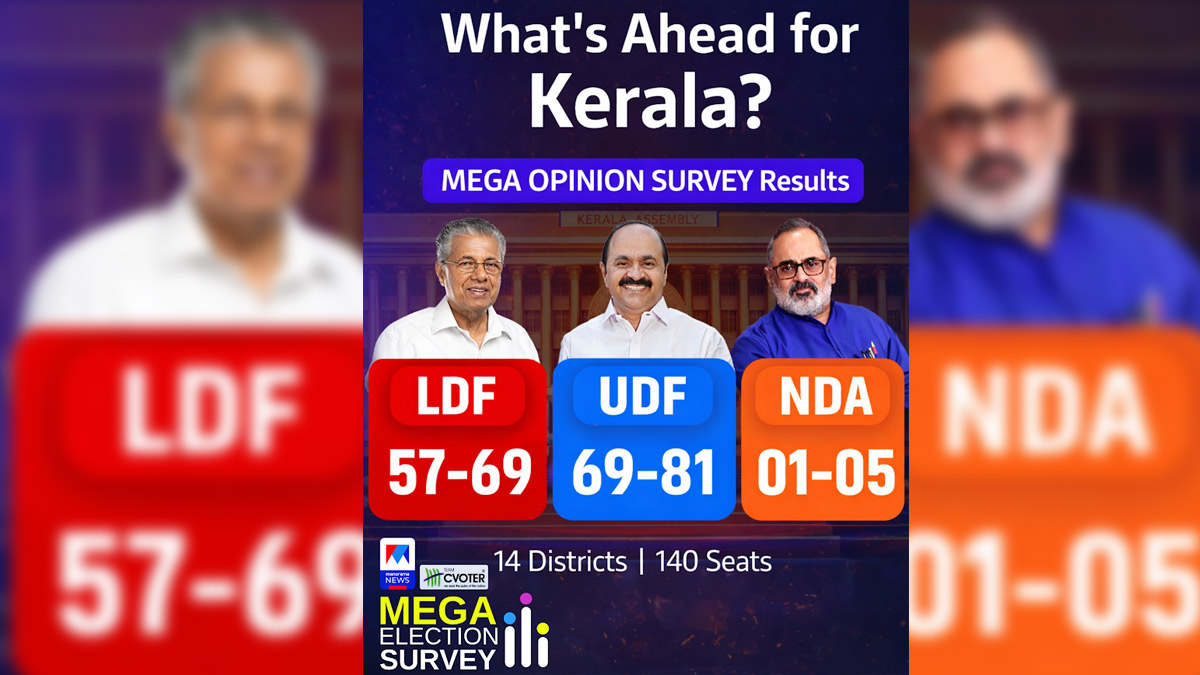
MUMBAI: The winds of change appear to be blowing through Kerala’s political landscape and this time, they seem to favour the United Democratic Front. A comprehensive mega opinion survey conducted by Manorama News in partnership with CVoter projects a potential comeback for the UDF in the upcoming Kerala Legislative Assembly Elections 2026. The survey, covering all 140 constituencies with a massive sample size of nearly 90,000 respondents, predicts the UDF could win between 69 and 81 seats.
The ruling Left Democratic Front (LDF) is expected to secure 57 to 69 seats, a significant drop from the 99 seats it won in the 2021 elections. This would mean the LDF losing 30 to 42 of its sitting seats. Meanwhile, the National Democratic Alliance (NDA), which drew a blank in 2021, is projected to open its account with 1 to 5 seats.
Region-wise, the UDF is expected to make strong gains in Malabar, winning 25 to 34 out of 48 seats, and in Central Kerala, where it could bag 29 to 33 out of 53 seats. In South Kerala, the LDF is likely to retain an edge with 21 to 25 seats, while the UDF may improve to 12 to 16 seats. The NDA could pick up 1 to 3 seats in the southern region.
The survey was conducted between 14 and 26 March 2026, with additional tracker and snap polls carried out from December 2025 to March 2026. A total of 89,693 respondents participated, ensuring representation across all demographics and social segments.
Manorama News has a strong track record of accuracy, with its previous projections closely matching the actual results of the 2019 and 2024 Lok Sabha elections as well as the 2021 Kerala Assembly polls.
In Kerala’s famously fierce political battles, this survey suggests the pendulum may be swinging back. Whether the final verdict matches these numbers or throws up another surprise, one thing is clear, the 2026 Assembly elections are shaping up to be one of the most keenly watched contests in the state’s history.






