News Broadcasting
Cable trade urges broadcasters to ‘educate’ viewer


MUMBAI: The Indian Cable Operators and Broadcasters Federation (ICOBF) representing the distributors/MSOs (multi system operators) and the Mumbai Cable Operators’ Federation (MCOF) representing the last mile operators, have urged broadcasters to flash scrawlers on the channels indicating the prices of the various channels within the bouquets.
ICOBF spokesperson Suvarn G Amonkar says: “Our intention was to educate the majority of consumers who were not aware of the fact that the Zee, Star, Sony and MEN bouquets had several channels in addition to the mainstream mass entertainment channels. We have also urged the broadcasters to continuously flash information related to the individual bouquet prices. I believe that Zee TV has been doing so but we want the others to also carry scrawlers.”
It is reliably learnt that the ICOBF has managed to get an okay in principle from several broadcasters who have agreed to flash on-screen messages on their channels informing viewers to cooperate with their cable operators. The ICOBF was formed one year ago and has been engaged in a continuous dialogue with broadcasters and the last mile operators (LMOs).

The representatives of both the federations (ICOBF and MCOF) claim that the 24-hour shutdown (midnight of Thursday, 20 February 2003 to midnight of Friday, 21 February 2003) of all pay channels was a successful exercise in creating public awareness.
Ever since politicians and consumer activists have coined their “Rs 150 per month” mantra, cable operators have been unable to collect money from the consumers. Industry sources confirm that the collections in the first two months of 2003 had plunged to abysmal levels. This had forced the MSOs and distributors to take action as they would have to pay the broadcasters from their own pockets.
At a meeting held recently in Mumbai’s western suburb Kandivali, the eight-member committee of the ICOBF informed broadcasters’ representatives that they would go ahead with the move of educating the consumers and solicited their support. This task force informed the various cable operators’ associations about their decision to go ahead with the blankout.
InMumbai Network’s senior VP Manoj Motwani adds: “The blackout wasn’t an act of rebellion against the broadcasters but a move which was conducted with their support and co-operation. Customers refuse to pay up and refer to the half-truth campaign initiated by the politicians and consumer activists. But the pay channels and broadcasters expect us (MSOs) to pay them at the end of every month.”
MCOF member Dinesh Devadia laments: “The adamant attitude of the consumers will spell doom for the small cable operators. We have to compulsorily collect and pay the MSOs at the end of every month. Several consumers from the lower strata of society refuse to pay us and collections have been bad.”
Sony CEO and Indian Broadcasting Federation VP Kunal Dasgupta was quoted in The Times of India as saying that consumers need to understand that they need to pay for pay channels. Dasgupta adds that all cable and satellite channels anywhere in the world are pay channels in one form or the other.
Dasgupta also mentioned that broadcasters cannot recover programming costs through advertising recovers and have to resort to extra subscription fee from subscribers.
However, there is a lot of uncertainty prevailing in the trade about the future – especially the 14 July deadline for the roll out of conditional access system (CAS).
“We have started the process of education and we feel that we have taken the first step in the direction. The consumers will be in a better state to understand the implications of CAS once the implementation starts,” says InMumbai’s Motwani.
ICOBF’s Amonkar says: “We are still unclear about the individual prices of pay channels. We are also awaiting guidelines from the I&B ministry. Our maintenance charges work out to Rs 60 per month and if the free-to-air channels are priced (by the government) at Rs 50, then the total monthly charges could reduce to sub-Rs 150 levels after incorporating the taxes. The small cable operators would hardly earn anything but at least there wouldn’t be any collection hassles.”
MCOF members however, disagree with this and claim that the maintenance charges are around Rs 75 per month and it will be difficult to charge less than Rs 150 per month.
MCOF’s Devadia further says that it will be very difficult to convince the slum-dwellers in Mumbai to purchase a set-top-box (STB). Well, only time will tell!


News Broadcasting
News18 India launches Command Centre war explainer with Arya
New show shifts from debates to decoding global conflicts and impacts
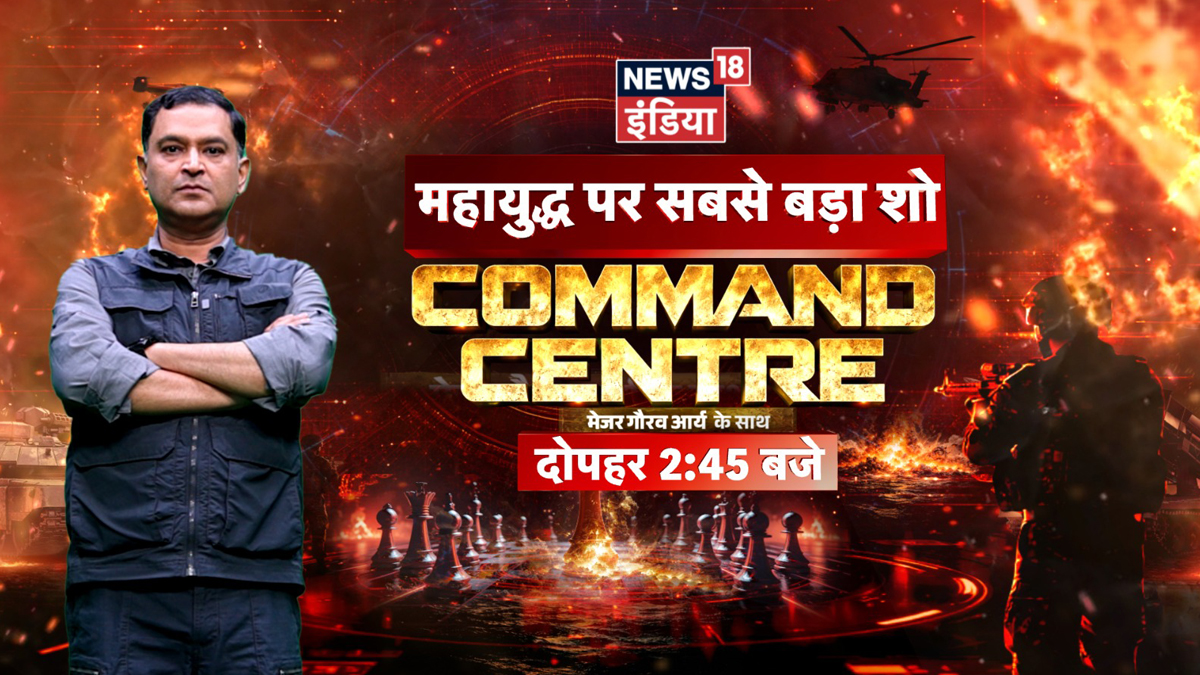
MUMBAI: News18 India has rolled out a new war-focused programme, Command Centre, featuring Gaurav Arya, as it looks to offer viewers a sharper, more grounded take on global conflicts amid rising tensions in West Asia.
Positioned as an “insider war room”, the show moves away from conventional panel debates and instead focuses on explaining military developments, decoding strategy and connecting global events to their everyday impact, from fuel prices to economic shifts.
The format leans heavily on visuals and data. The studio has been designed like a command hub, complete with large LED war maps, real-time graphics and an alert system to track developments as they unfold.
At the centre of it all is Arya, who brings his military background to simplify complex war strategies for viewers. His signature line, “Seedhi baat samjhiye”, anchors the show’s promise of clarity over noise.
News18 India managing editor Jyoti Kamal said, “Command Centre, featuring Major Gaurav Arya is designed to deliver accurate insights and a clear perspective on how evolving conflicts impact everyday life, from household budgets to national security. With expert voices analysing every development in real time, the show goes beyond headlines to decode what’s happening now, what it means, and what could come next.”
Echoing the intent, Gaurav Arya added, “In times of war, confusion is the biggest threat. With News18 India’s Command Centre, we are bringing viewers inside the war room, decoding strategies, tracking every escalation, and explaining, in the simplest terms, what it means for India and for every household. Seedhi baat samjhiye, this is where you understand not just what is happening, but what happens next.”
The weekday show will air in the afternoon slot and will also feature Gaurav Shukla, adding to its editorial depth.
With its mix of analysis, visuals and a clear focus on impact, the show reflects a broader shift in news consumption. Viewers are no longer just watching events unfold, they are looking to understand what those events mean for them.







