Cable TV
Cable digitalisation: Ball in government court says Trai chief

MUMBAI: Digitalisation of cable TV is necessary as analogue receivers can’t accommodate more television channels, said the Telcom Regulatory Authority of India (Trai) chairman Pradip Baijal, while speaking to reporters on the sidelines of the 3rd International Conference on ‘Communication Convergence – The Change Agent’ organised by Indian Merchants’ Chamber.
When queried by Indiantelevision.com on whether the government’s plans to bring complete digitalisation by 2010 would mean a first phase implementation in the metros, Baijal said the regulator had sent in the recommendations and it was up to the government to decide.
But would digitalisation mean a backdoor entry to conditional access system? “CAS has to come, this way or that. And it is not a backdoor entry. CAS is needed for growth. For more channels to be available on cable networks and for viewers to see, CAS has to come,” Baijal said.

Explaining that the regulation in the cable TV and broadcasting sector will take time to mature, Baijal said the Trai has been working on it for only over a year. “It took 5-6 years for the telecom sector regulation to mature,” he added.
Stressing on the need for unified license regime, Baijal said it would bring down the carriage cost for voice, video and data. “There are 80 countries across the world that allow telephony over Internet Protocol. Unified license is nothing but a convergence licence. Convergence of all the services can bring down tariff further. A revolution is waiting to happen.”
Baijal pointed out that India’s tele-density, which had posted a meagre growth at around 1.92 per cent in 1998 from 0.02 per cent posted in 1948 under a vertically integrated sector, is now gaining momentum after liberalisation. “It has grown to 2.92 per cent and had posted a radical increase last year. The entry of highly aggressive players into the market and aggressive rules of competition have led to an explosion in the telecom sector” he said.
Speaking on “Regulatory framework for convergence”, Information & Communications Technology, Ministry of industry, Canada, director general Keith Parsonage said a transparent policy and regulatory framework were key to a successful market. “Much of our success can be attributed to a consultative approach to policy development, including direct input from stakeholders, a transparent policy and regulatory framework, and a market-based approach to support the development and deployment of new technologies, services and industries,” he said.
GTL Limited CEO Michael Clark said networks were beginning to go away from operators in today’s scenario. Explaining the transformation taking place today in the area of convergence, he said networking speed and depth were changing the way business operates.
Clark listed out some of the key objectives of regulation under convergence as flexibility, stimulating growth, fostering innovation, bridging the digital divide, balancing owner and user interests in network interconnection, using competition (not controls) to protect public interests, efficient utilisation of existing infrastructure and investments, improving quality of service, establishing world’s best security standards and recognising that the industry is no longer just operators.
Telecommunications & Computer Information Systems director Mahesh Uppal said regulations must enable convergence’s exploitation and prevent its abuse. He said the role of a regulator is particularly important when government is a major player.
Uppal identified the core issue as functionality. “You regulate functions, not technology,” he said.
Other noted speakers included Supreme Court advocate Pavan Duggal, India Strategy director Ravi Sharma and Nishith Desai Associates associate Vivek Kathpalia.






Cable TV
Hathway Cable appoints Gurjeev Singh Kapoor as CEO
Leadership change comes as cable TV faces shrinking subscriber base and modest earnings pressure
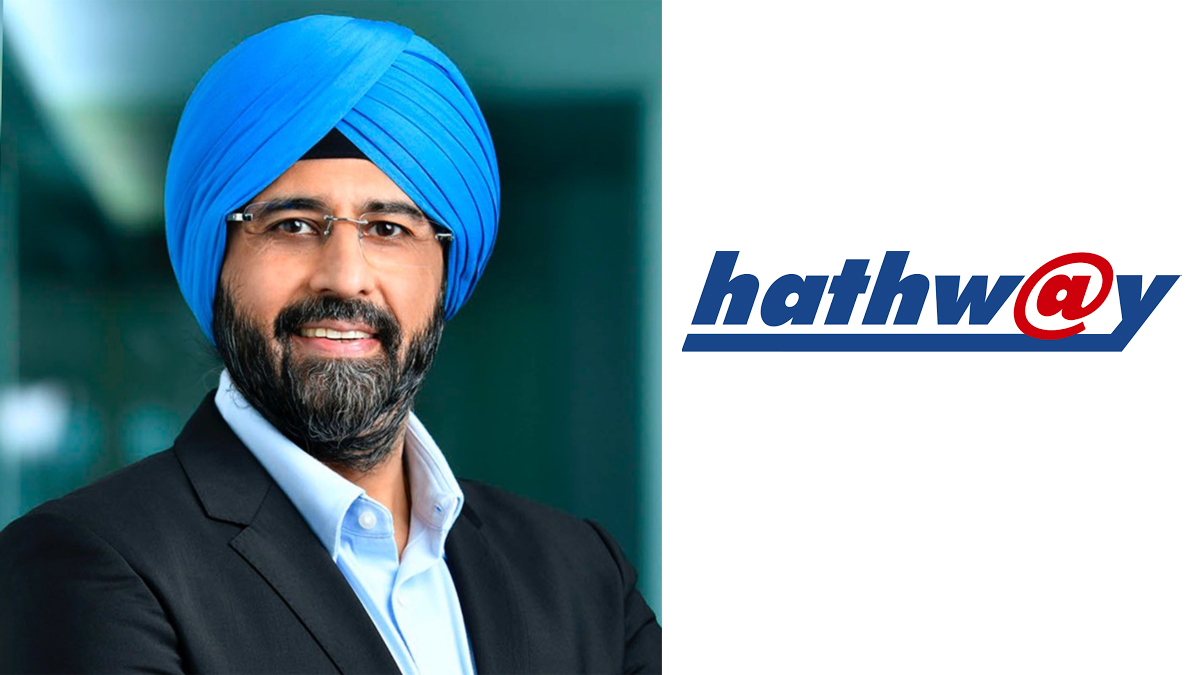
MUMBAI: Hathway Cable and Datacom has tapped industry veteran Gurjeev Singh Kapoor as chief executive officer, marking a leadership pivot at a time when India’s cable television business is under mounting strain.
Kapoor will take over from Tavinderjit Singh Panesar, who is set to retire in August after a long innings with the company. Panesar, chief executive since 2023, has held multiple leadership roles at Hathway, including his latest stint beginning in 2022.
Kapoor brings more than three decades of experience in media and entertainment. He most recently led distribution at The Walt Disney Company’s Star India business, now part of JioStar. His career spans television distribution and affiliate partnerships, with stints at Sony Pictures Networks India, Discovery Communications and Zee Entertainment.
Panesar, with over three decades in the industry, has worked across strategic planning, distribution and business development in media, broadcasting and manufacturing. His past associations include ESPN Star Sports, Star India, Apollo Tyres and JK Industries.
The transition lands as the cable sector grapples with structural disruption. Traditional operators are losing ground to streaming platforms, while telecom and broadband players tighten the squeeze with bundled offerings.
An EY report estimates India’s pay-TV base could shrink by a further 30 to 40 million households by 2030, taking the total down to 71 to 81 million. The slide follows a loss of nearly 40 million homes between 2018 and 2024, a contraction that has already wiped out more than 37,000 jobs in the local cable operator ecosystem.
Hathway’s numbers reflect the strain. The company reported a consolidated net profit of Rs 93 crore for FY25, down from Rs 99 crore a year earlier. Revenue inched up to Rs 2,040 crore from Rs 1,981 crore. As of December 2025, it had about 4.7 million cable TV subscribers and roughly 1.02 million broadband users.
Kapoor steps in with a familiar brief but a shrinking playbook. In a market where viewers are cutting cords faster than companies can reinvent them, the new chief executive inherits a business fighting to stay plugged in.






