Hardware
Cabinet okays uplink and downlink guidelines

NEW DELHI: The Union Cabinet today gave approval to a host of stringent media related issues including mandatory sharing of sports content by private broadcasters with pubcaster Prasar Bharati.
The government has said that such shared content will be telecast by DD on its terrestrial and Direct-to-home (DTH) service.
The above conditions shall apply to all future events including those covered by existing contracts.

However, in case of cricket event whose broadcasting rights have been obtained by sports channels prior to the proposed law coming into effect, DD will get a feed for all matches featuring India and the finals.
The mandatory content sharing is effective for all sporting events held within and outside the country, Information and Broadcasting minister Jaipal Reddy said during a media briefing.
The advertising revenue that accrues from the sale of such events on Doordarshan will be shared in the ratio of 75:25 in favour of rights holders.
Asked by indiantelevision.com whether DD would also share content private sports broadcasters, Reddy that it should be done, but it cannot be mandated.
The proposals relating to uplink and downlink guidelines that were approved today by the cabinet have been reported by indiantelevsion.com in the past. The new proposals have to be notified by the government before they become a law.
The cabinet also approved granting of uplink permission to foreign channels on an annual basis depending on fulfilment of certain conditions.
According to Reddy, foreign news channels would be granted ladling rights in India on a case to case basis, if they have content and advertising specially targeted at the Indian audiences — on the lines of guidelines for printing of facsimile editions of foreign newspapers in the county.
Television channels and teleports have been allowed to uplink in KU-band, apart from C-band, through Indian satellites only, subject to the conditions that this permission is not used to operate a DTH service without proper licence.
The cabinet gave the green signal for amendments in the cable TV network rules 1994 and DTH guidelines to ensure that only those satellite TV channels that have been registered under these guidelines are transmitted / retransmitted through cable networks and/or DTH services.
FIIs and NRI investment have been allowed in news channels uplinking from India, subject to foreign investment cap of 26 per cent.






Hardware
India clears Rs 1.6 lakh crore semiconductor projects under Semicon India
Ten projects cleared as production begins and design ecosystem gathers pace
NEW DELHI: India’s push to become a global electronics powerhouse is gaining momentum, with the Semicon India Programme driving the creation of a full-fledged semiconductor ecosystem from design to manufacturing.
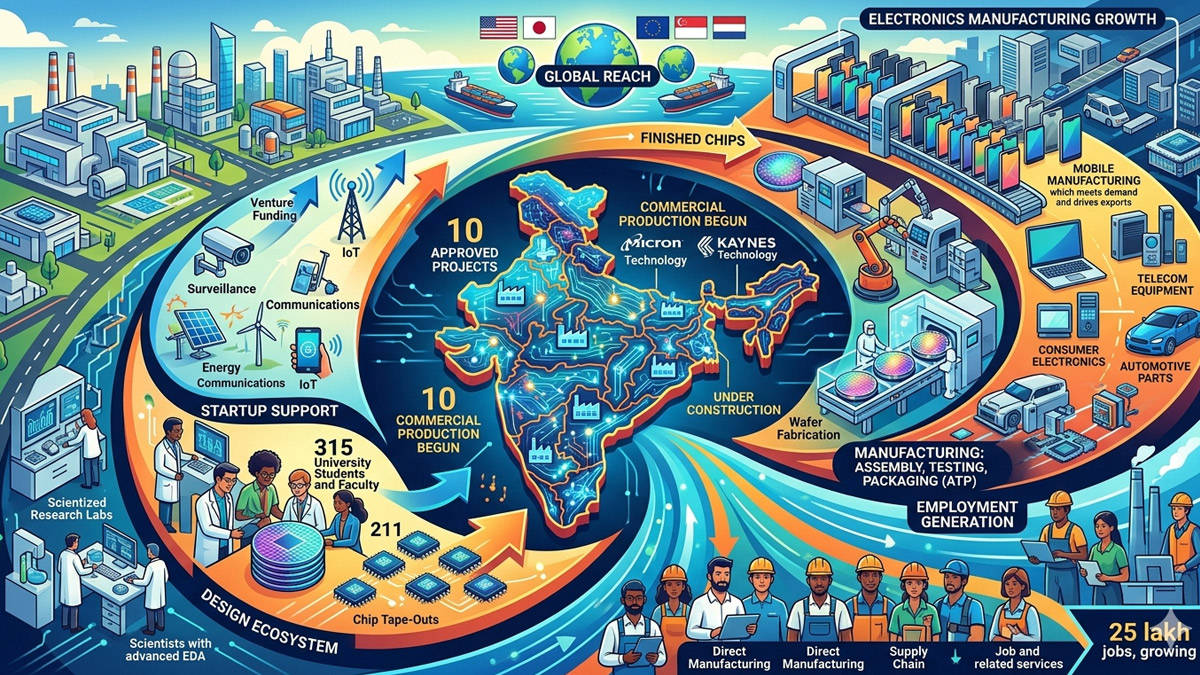
Launched in 2022, the programme aims to build capabilities across the entire value chain, including chip design, fabrication, assembly, testing and packaging. In just four years, the government has approved 10 semiconductor projects with a combined investment commitment of around Rs 1.6 lakh crore.
Two of these facilities have already begun commercial production, including units led by Micron Technology Inc. and Kaynes Technology India Limited. Two more plants are expected to go live later this year, signalling that India’s chip ambitions are moving from blueprint to factory floor.
The broader electronics manufacturing story has also seen sharp growth over the past decade. Production has jumped from roughly Rs 1.9 lakh crore in 2014-15 to about Rs 12 lakh crore in 2024-25, while exports have surged nearly eightfold. Mobile phone manufacturing, once heavily import-dependent, now meets almost all domestic demand and has become a major export driver.
Alongside manufacturing, the government is investing heavily in design capabilities. Through access to advanced chip design tools provided free to 315 universities, students and researchers have clocked over 200 lakh hours of usage. This effort has already resulted in 211 chip tape-outs from 75 institutions.
Support for startups is also picking up pace. Twenty-four chip design projects have been approved, targeting sectors such as surveillance, energy, communications and IoT. Of these, 14 companies have collectively raised over Rs 650 crore in venture funding, while several designs have progressed to fabrication, including at advanced nodes.
To strengthen supply chains, India has also signed semiconductor cooperation agreements with countries including the United States, Japan, the European Union, Singapore and the Netherlands. These partnerships aim to reduce global dependencies while boosting domestic capabilities.
The employment impact is equally significant. The electronics sector now supports an estimated 25 lakh jobs, with mobile manufacturing alone accounting for nearly half. As more semiconductor units come online under the India Semiconductor Mission, indirect job creation across supply chains is expected to rise further.
Sharing these updates in Parliament, Ministry of Electronics and Information Technology minister of state Jitin Prasada underscored the government’s focus on building a resilient, end-to-end semiconductor ecosystem.
With factories taking shape, designs moving to silicon and investments flowing in, India’s semiconductor story is steadily shifting gears from ambition to execution.






