eNews
Budget2022: Govt to set up task force to promote animation, video gaming industry

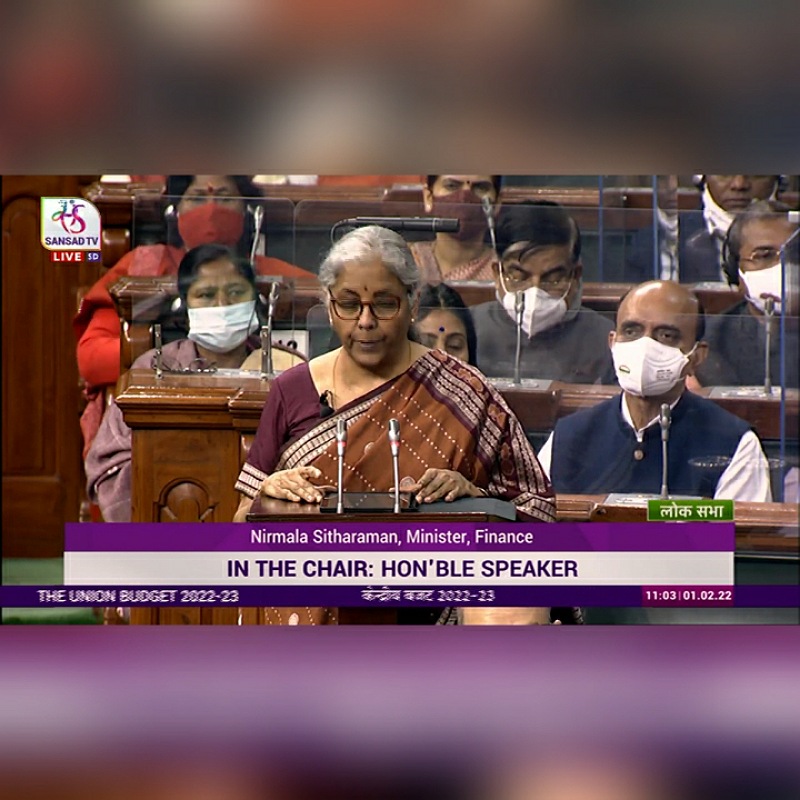
Mumbai: The government has proposed to set up a specialised task force for the promotion of the animation, visual effects, gaming and comics (AVGC) industry. The announcement was made by finance minister Nirmala Sitharaman while presenting the annual budget 2022 on Tuesday.
“Animation, Visual Effects, Gaming and Comics (AVGC) sector offers immense potential to employ youth. An AVGC promotion task force with all stakeholders will be set up to recommend ways to realise this and build domestic capacity for serving our markets and the global demand,” said Sitharaman.
The announcement was welcomed by the industry, with Federation of Indian Chambers of Commerce and Industry (FICCI) hailing it as a big win for the sector.

FICCI chairman – AVGC XR Forum and Punnaryug Artvision founder Ashish SK said that the budget announcement of the formation of task force for AVGC Promotion has come at the most appropriate time. “After setting a strong foundation in the last two decades the Indian AVGC – XR is poised to grow phenomenally in coming decade. The creative skills from India needs nurturing to a great extend to enable the growth of the sector. Setting up of a task force will definitely bring in a great focus on positioning Indian AVGC sector for services exports, co-productions, growth of Indigenous intellectual property and its consumption patterns within India and overseas,” he said.
According to industry representatives, the Indian AVGC – XR sector is expected to have a major share of the media and entertainment industry. The horizon and use cases of AVGC – XR verticals have expanded beyond its day-to-day defined utility in architecture, life science, legal, education, industrial, urban planning, sports, digital universe, metaverse etc apart from media & entertainment.
“The AVGC task force is a huge step by the government to promote the sector. We wholeheartedly welcome it and FICCI AVGC-XR Forum will continue to work closely with the government on various policy initiatives to realise the growth potential of the Industry. This industry vertical has tremendous scope for employment generation and exports,” said FICCI co-chairman – AVGC- XR Forum, and Graphiti Studio founder Munjal Shroff.
In its latest report released last month, the Confederation of Indian Industry (CII) and Boston Consulting Group (BCG) had also projected that India’s media and entertainment industry which is currently valued at around $27 billion is all set to grow at 10-12 per cent CAGR to become a $55-70 billion industry by 2030. The report had also highlighted that the industry’s next phase of growth will be led by OTT, gaming, VFX and animation.
The finance minister said the union budget seeks to lay a foundation and give blueprint of the economy over the next 25 years – from India at 75 to India at 100.






eNews
Piyush Thakur steps down as Inshorts’ chief revenue officer
Former vice president and cro says exit marks a new chapter after close to a decade of building revenue and partnerships at Inshorts Group.

NOIDA: Piyush Thakur has stepped away from Inshorts Group after nearly 10 years with the company, marking the end of a long tenure that culminated in his role as chief revenue officer.
In a farewell note, Thakur said he was “turning a new page” after almost a decade at Inshorts, calling it one of the hardest professional decisions he has made. He added that his exit was not driven by uncertainty about the future, but by reflection on a long association with the company.
Thakur joined Inshorts in October 2016 as vice president and spent around seven years in the role before being elevated to chief revenue officer in April 2024, a position he held until April 2026.
He said his tenure was defined by “thousands of mornings, late nights, product debates and breakthrough moments”, as the company evolved into a large-scale digital news platform used by millions.
In his note, Thakur emphasised that Inshorts’ growth was a collective effort across teams, adding that engineers, designers, sales teams and customer support staff all contributed to building the platform. He said the company’s success was not the result of individuals but of “everyone who stayed, passed through, and left their mark”.
Before Inshorts, Thakur worked across several digital media and business development roles. At ESPN, he served as senior regional manager from October 2015 to October 2016, focusing on growth initiatives, strategic opportunities and video distribution.
At Times Internet, he worked for nearly three years, including as head of business development from April 2015 to September 2015 and chief manager from January 2013 to March 2015. His responsibilities included monetisation of mobile platforms, managing media and developer partnerships, and driving revenue across digital properties such as The Times of India and The Economic Times.
Earlier, he worked at Brandmovers as head of business development from June 2012 to June 2013, handling digital, mobile and social media marketing solutions, client development and strategic consulting. During this period, he also worked on advertising revenue, brand strategy and CRM-based solutions.
At Inshorts, Thakur’s role focused on revenue strategy, mobile and media partnerships, and growth initiatives across platforms. His profile highlights experience in mobile product management, digital business models, partner ecosystems and revenue expansion in high-growth environments.







