News Headline
“Broadcasters still haven’t got the benefit of digitisation”


MUMBAI: It’s been a chaotic couple of years for the media and entertainment industry marked by a lack of clarity – be it digitisation, ad cap or other regulations.
Not surprisingly, this was the subject of a panel discussion on day one of FICCI FRAMES 2014, the 15th chapter of the annual convention.

The panel – comprising Star India CEO Uday Shankar; Viacom18 Group CEO Sudhanshu Vats; FCC commissioner Ajit Pai; MIB secretary Bimal Julka; and Discovery Networks Asia-Pacific senior VP and general manager South Asia and head of revenue, pan-regional ad sales and South East Asia Rahul Johri and moderated by NDTV Group CEO Vikram Chandra – discussed ways and means by which the industry can overcome regulatory hurdles.
The panel felt there should be clarity as to why regulations are needed in the first place and stressed on long-term solutions vis-a-vis short-term remedies. “The regulators need to know that there are certain ailments but immediate fixing is not a solution without knowing what the consequences will be,” said Shankar.
Adding to this, Vats spoke about finding the purpose of regulations. “Media is in the consumer business and needs to run by what the consumer wants. Apart from this, there has to be transparency of data, accountability as well,” he said.
Julka expressed the view that the media has come a long way from ‘license raj’ and is now moving towards partnerships and collaborations. “We must not forget that for us, our core target group is our viewers and listeners and we have to keep them in mind. So, whatever regulations we come up with, they have to benefit them. We don’t want to get into the revenue model or the business model. That’s TRAI’s jurisdiction and I think it is doing a fair job,” he said.
Completing phases I and II of digitisation was a huge challenge considering the country’s demographics, he informed. “Thirty million set top boxes (STBs) have been installed and 110 million are yet to be seeded. It is a huge challenge for the industry as a whole. The government is just a facilitator.”
However, Shankar countered Julka and said, “What is the objective of digitisation? When we started with the process, we all thought that it will increase the bandwidth, giving more space for channels and increase transparency as well. The only thing that has happened is that MSOs have placed boxes in certain households. The broadcasters still haven’t got the benefit of it.”
Pointing out that the carriage fee is too high and the subscription rate too low, Shankar recalled the time he was heading Aaj Tak, “When I was heading AajTak, the carriage fee was zero but today, to run a channel, especially a news channel, one has to pay a huge carriage fee, which in turn harms the content on television.”
Vats seconded Shankar and said, “The fundamental reason is addressability and that is far from over.”
Johri drew attention to the fact that several developments were taking place, all at the same time, which should not be the case. “Digitisation needs to be completed first before other things are looked into,” he said. Readers may recall that indiantelevision.com had earlier reported how several people from the industry had said that matters like ad cap needed to be looked into after completion of the digitisation process by December 2014.
While complimenting the government for pushing hard on finishing phases I and II of digitisation, moderator Chandra asked the panel for suggestions on how the industry can better overcome regulatory hurdles.
To this, Vats suggested looking into the licensing issue first that would help get newer and better content players into the market. Secondly, he said digitisation needs to be completed at the earliest to settle the issue of addressability. Thirdly, he said the industry needs to give a second look to carriage fee. “There has to be transparency regarding the carriage fee and the amount needs to be open,” he said.
Johri highlighted the need for an ecosystem that will nurture innovation. “Once digitisation is over, everything will fall in place,” he assured.







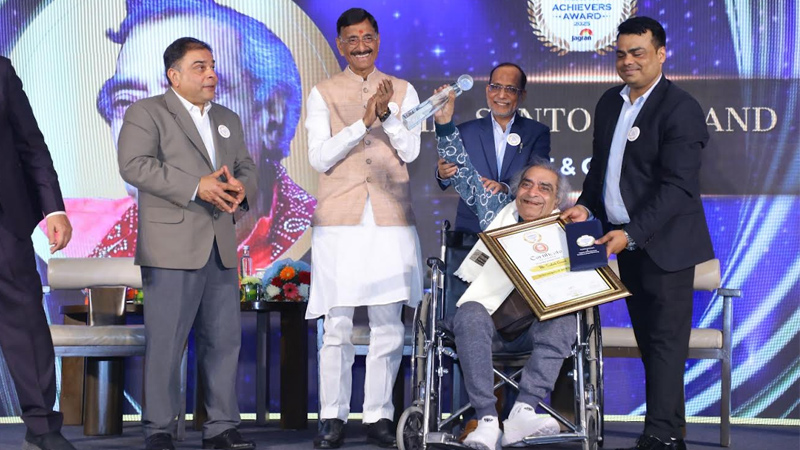
NEW DELHI: Hamdard Laboratories gathered a cross-section of India’s achievers in New Delhi on Friday, handing out the Hakeem Abdul Hameed Excellence Awards to figures who have left their mark across healthcare, education, sport, public service and the arts.
The ceremony, attended by minister of state for defence Sanjay Seth and senior officials from the ministry of Ayush, celebrated individuals whose work blends professional success with a sense of public purpose. It was as much a roll call of achievement as it was a reminder that influence is not measured only in profits or podiums, but in people reached and lives improved.
Among the headline awardees was Alakh Pandey, founder and chief executive of PhysicsWallah, recognised for turning affordable digital learning into a mass movement. On the sporting front, Arjuna Awardee and kabaddi player Sakshi Puniya was honoured for her contribution to the game and for pushing women’s participation onto bigger stages.
The cultural spotlight fell on veteran lyricist and poet Santosh Anand, whose songs have echoed across generations of Hindi cinema. At 97, Anand accepted the honour with characteristic humility, reflecting on a life shaped by perseverance and hope.
Healthcare honours spanned both modern and traditional systems. Manoj N. Nesari was recognised for strengthening Ayurveda’s place in national and global health frameworks. Padma shri Mohammed Abdul Waheed was honoured for his research-backed work in Unani medicine, while padma shri Mohsin Wali received recognition for his long-standing contribution to patient-centred care.
Education and social development also featured prominently. Padma shri Zahir Ishaq Kazi was honoured for decades of work in education, while former Meghalaya superintendent of Police T. C. Chacko was recognised for public service. Goonj founder Anshu Gupta received an award for his dignity-centred rural development initiatives, and the Hunar Shakti Foundation was honoured for empowering women and young girls through skill development.
The Lifetime Achievement Award went to former IAS officer Shailaja Chandra for her long career in public healthcare and governance, particularly in the traditional systems under Ayush.
Speaking at the event, Hamdard chairman Abdul Majeed said the awards were a tribute to those who combine excellence with empathy. “These awardees reflect Hakeem Sahib’s belief that healthcare, education and public service must ultimately serve humanity,” he said.
Minister Seth struck a forward-looking note, saying India’s young population gives the country a unique opportunity to become a global destination for learning, health and wellness by 2047.
The ceremony also featured the trailer launch of Unani Ki Kahaani, an upcoming documentary starring actor Jim Sarbh, set to premiere on Discovery on 11 February.
Instituted in memory of Unani scholar and educationist Hakeem Abdul Hameed, the awards have grown into a national platform that celebrates those building a more inclusive and resilient India. For one evening at least, the spotlight was not just on success, but on service with substance.






