News Broadcasting
BroadcastAsia to highlight digital convergence technologies

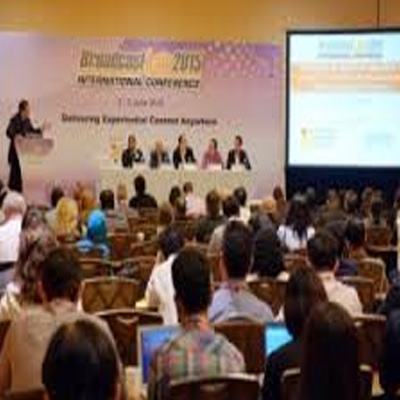
MUMBAI: Asia’s digital multimedia and entertainment technology event, BroadcastAsia, will return to Singapore Expo from 19-22 June 2007 to showcase the latest digital technology, professional equipment and services.
Over 800 exhibiting companies including Harris, Sennheiser, Miranda, Vizrt, Magna, Innoxius, Conax and Qualcomm will demonstrate a full spectrum of products and applications from media content creation to delivery including new technologies birthed as a result of digital convergence.
Strong group participation is also expected at BroadcastAsia2007 with pavilions from Singapore , China , France , Germany , Italy , Korea , USA and UK . More than 80 per cent of the show floor has already been filled.

This year’s BroadcastAsia will also feature a high definition (HD) studio demonstrating a full suite of high definition production workflow – from production to final content output. Industry professionals will be on hand to explain the features and processes of the studio as well as highlight the differences in quality between standard definition and HD transmissions to visitors.
Over the years, BroadcastAsia has proven to be a one-stop sourcing ground for broadcasters, production and post-production companies as well as network with the industry. BroadcastAsia2007 expected to attract over 10,000 industry professionals, decision makers, vendors and buyers from 50 countries.
Adding greater depth to event is the BroadcastAsia International Conference. In partnership with various industry organisations, the conference features a series of sessions focussing on critical industry issues and will bring greater clarity to the new technological and business opportunities within the industry.
Addressing the “how”, “what”, “where” and “why”, the BroadcastAsia2007 International Conference will cover areas in file-based production, media production & development, digital multimedia, IPTV, content delivery to creating new opportunities.
Calvin Koh who is the project manager for communications events with organizer Singapore Exhibition Services “This year’s conference saw over 60 representatives who responded to its call for contribution. The overwhelming response was an indication of the industry’s enthusiasm to use the conference to share and update fellow professionals”.
Spread over a total of eight halls, BroadcastAsia, alongside with CommunicAsia, EnterpriseIT, InteractiveDME and ComputerGraphics Overdrive — will see the gathering of over 2,400 companies as they come together to demonstrate the transforming powers of digital technologies that are redefining the boundaries of traditionally-segmented telecommunications, networks, enterprise solutions and entertainment arenas.
Reflecting the growing importance of the interactive digital media industry in Singapore , which had been identified as a key growth sector for the local economy, interactive and digitised media and entertainment content will be a highlight on the show floor.
The convergence of media, communications and IT has dramatically changed the landscape of the media and entertainment industry, and is revolutionising the way we think, live, work and play. According to industry observers, the estimated size of the global media and entertainment industry in 2009 is expected to hit $1.78 trillion, while the Asia-Pacific market is predicted to reach $431 billion in the same period. Some ‘hot’ converged applications include digital cinema, IP TV, connected digital home devices and online gaming, amongst others.
Some ‘hot’ converged applications that visitors can expect to see include mobile entertainment, IPTV, connected digital home devices, as well as mobile and online gaming, amongst others.
Some of the key enabling technologies that will occupy top prominence on the show floor this year are:
Wireless — covering 3G, HSDPA, WiMax/ WiBro, Fixed-Mobile Convergence (FMC), as well as Radio Frequency Identification (RFID) and Embedded technologies Broadcasting — covering Satellite, Digital Multimedia Broadcasting (DMB) and Digital Video Broadcasting (DVB) Digital Networks — covering Next Generation Networks (NGN), Voice over IP (VoIP) and Information Security.
CG Overdrive will also be held alongside BroadcastAsia for the first time, to answer the growing interest in animation and demand for Asian animated content. Despite being a relatively young trade show, CG Overdrive has built a reputation as a must-see event for computer graphics and animation enthusiasts in the Asia-Pacific region.
One of the main highlights of CG Overdrive is a knowledge-centric conference that will address topics such as character animation techniques, character modelling and production of CG cinematics for gamers. Fringe activities like digital film screenings, digital art gallery and networking parties will be staged to connect CG enthusiasts to the gurus.



News Broadcasting
Business Today MindRush returns to Mumbai, spotlight on India’s edge in a fractured world
Policymakers and corporate heavyweights gather to map supply chains, energy security and markets

MUMBAI: As fault lines widen across global trade and geopolitics, Business Today is doubling down on India’s moment. The 14th edition of Business Today MindRush & Best CEOs Awards lands in Mumbai on March 28, pitching India’s strategic edge at the centre of a fragmenting world.
The day-long summit, presented by PwC, will bring together a tight mix of policymakers, industry leaders and market voices to decode shifting supply chains, maritime strategy, defence priorities, energy security and capital markets—sectors now deeply entangled with geopolitics.
M Nagaraju, secretary, department of financial services, ministry of finance, will headline the event, setting the tone for discussions that aim to track how India is repositioning itself amid disrupted trade routes and volatile energy dynamics.
The speaker slate reads like a cross-section of India Inc’s command centre. Krishna Swaminathan will zero in on sea lanes and supply chains, while Prashant Ruia is set to push the case for self-reliance in oil and gas. Ashish Chauhan will weigh in on capital markets at a pivotal juncture, as a panel featuring Vibha Padalkar, Sanjiv Mehta, Amish Mehta and Sanjeev Krishan debates navigating economic uncertainty.
Leadership under pressure will be another running theme. Madhavkrishna Singhania, Sharvil Patel, Karan Bhagat and Anurag Choudhary will unpack how businesses are steering through disruption. Arun Alagappan will turn the spotlight on fertilisers, Arundhati Bhattacharya will reflect on leadership transitions, while Anish Shah and S Vellayan will outline blueprints for building future-ready conglomerates.
The event will close with Aroon Purie setting the broader editorial lens, before the Best CEOs Awards recognise standout corporate leadership across sectors.
At a time when the global order looks increasingly splintered, MindRush 2026 is positioning itself as more than a conference—it is a signal that India intends not just to navigate the churn, but to shape it.








