News Broadcasting
Broadcast Bill Darbaar raises lively online debate


MUMBAI: The Broadcast Bill needs to adequately address the changing dynamics in a converging world; and the sector regulator (the proposed Broadcast Regulatory Authority of India – Brai) needs to be an autonomous body – one that is neutral and not managed by the government.
These were the key points that came through in an online debate on the proposed Broadcast Bill Draft 2006, organized today by Indiantelevsion.com. “Broadcast Bill Darbaar”, with guest participants Sunil Lulla, CEO, Times Global Broadcasting Company Ltd (Times Now) and Subhashish Mazumdar, head – business development, IMCL/INEL (Hinduja Media Group), saw a lively debate on the vexing issues impacting the industry on account of the Bill. The chat session was conducted between 3 pm and 4 pm this afternoon.
Said Lulla, “The industry has asked the government to have an open dialogue. As the industry and the government have a common interest – growth of the business and protection of consumer interests.”

Both Lulla and Mazumdar stressed on the need for technology neutral regulations and licensing. Referring to content regulations, Lulla pointed out, “So how do you control one and not the other, when content, be it in text, visual or audio form could be on any or all of these platforms (terrestrial, cable – analogue and digital -, DTH, mobile TV, IPTV).”
An issue that constantly came up was about the pressing need for limits being placed, particularly on the kind of content that news channels were dishing out. The general argument being that the maddening race for TRPs has made news channels break quite a few rules of decency. Therefore, why shouldn’t the government regulate such irresponsible behaviour?
Said one participant, “There has to be some broad guidelines and which are flouted day in and day out. If the industry cannot show responsibility, blaming the government seems funny.” To this Lulla responded, “No one is blaming the government for a content code. The code already exists. No one is opposing that. What we ask is for an autonomous body to determine, build, set and regulate the code if it wishes too. That’s all the Industry is stating.”
On the side of the cable industry, the need for a new license regime was an issue that came up frequently. “We should also have competition among cable operators. Suppose I don’t like to shift to DTH or IPTV, which anyway is a distant option,” one participant pointed out. “Circles should be established as is the case in telecom (to break cable monopolies),” said another.
Defending the cable industry, Mazumdar said, “We are not against licensing per se, but licensing should be technologically neutral and the basis of licensing is already there in cable, by the way. The licensing regime needs updation like making sure of PAN etc. But no one would like to have a licensing raj for an industry which is servicing 64 million households.”
Both Lulla and Mazumdar came out strongly against the proposed cross media restrictions. “For looking ahead, we feel these restrictions are meaningless. If someone asks you to limit your market share by law or regulation, that is not acceptable,” Mazumdar said.
Said Lulla: The Indian owned media industry is a fragile industry. It does not have the resources of global giants. In today’s day and age, growth of industry and especially the media industry needs to be encouraged. Hence the potential to apply brakes on what can be a significant business in India, is self limiting. Industrialists who are funding these businesses should be able to leverage their investments; hence cross media restrictions of the kind one is hearing about will not create a growth oriented climate, when the rest of the business climate is oriented towards growth.
Neither could adequately answer this poser though: “Why did the industry accept cross media restrictions in DTH, and are now crying foul over the move?”
In summation, Lulla said, “This country has respected freedom of expression and the industry is seeking it be respected. Regulation with dialogue which is inclusive and is autonomous is always welcome.”


News Broadcasting
UDF poised to return to power in Kerala, says Manorama-CVoter survey
Massive opinion poll projects shift in Kerala politics ahead of 2026 Assembly elections.
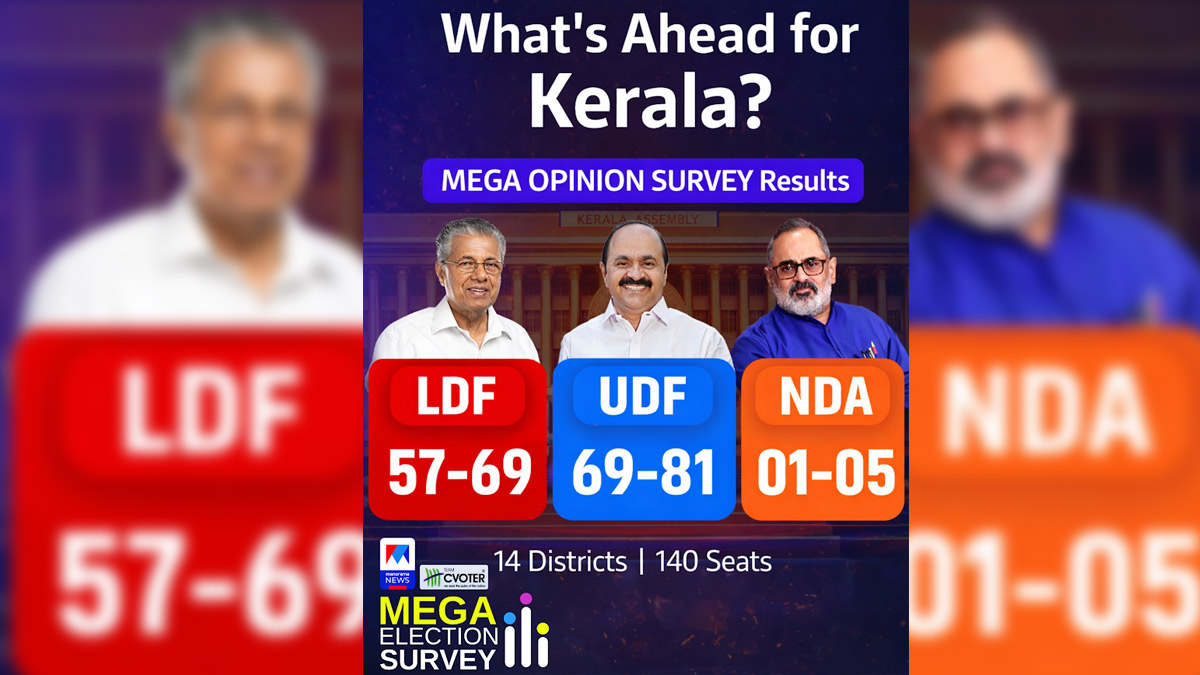
MUMBAI: The winds of change appear to be blowing through Kerala’s political landscape and this time, they seem to favour the United Democratic Front. A comprehensive mega opinion survey conducted by Manorama News in partnership with CVoter projects a potential comeback for the UDF in the upcoming Kerala Legislative Assembly Elections 2026. The survey, covering all 140 constituencies with a massive sample size of nearly 90,000 respondents, predicts the UDF could win between 69 and 81 seats.
The ruling Left Democratic Front (LDF) is expected to secure 57 to 69 seats, a significant drop from the 99 seats it won in the 2021 elections. This would mean the LDF losing 30 to 42 of its sitting seats. Meanwhile, the National Democratic Alliance (NDA), which drew a blank in 2021, is projected to open its account with 1 to 5 seats.
Region-wise, the UDF is expected to make strong gains in Malabar, winning 25 to 34 out of 48 seats, and in Central Kerala, where it could bag 29 to 33 out of 53 seats. In South Kerala, the LDF is likely to retain an edge with 21 to 25 seats, while the UDF may improve to 12 to 16 seats. The NDA could pick up 1 to 3 seats in the southern region.
The survey was conducted between 14 and 26 March 2026, with additional tracker and snap polls carried out from December 2025 to March 2026. A total of 89,693 respondents participated, ensuring representation across all demographics and social segments.
Manorama News has a strong track record of accuracy, with its previous projections closely matching the actual results of the 2019 and 2024 Lok Sabha elections as well as the 2021 Kerala Assembly polls.
In Kerala’s famously fierce political battles, this survey suggests the pendulum may be swinging back. Whether the final verdict matches these numbers or throws up another surprise, one thing is clear, the 2026 Assembly elections are shaping up to be one of the most keenly watched contests in the state’s history.






