News Broadcasting
BPG report recommendations shot down by Jowell


MUMBAI: BBC has received a shot in the arm regarding its uncertainty concerning yesterday’s Broadcasting Policy Group (BPG) report. There were fears that the government might use the report’s charter recommendations to punish the organisation over the recent Iraq dossier, which saw several heads roll last month. The group was asked by the Conservative Party to recommend what should happen when the BBC’s current Royal Charter expires in 2006.
However UK’s secretary of state for culture, media and sport Tessa Jowell gave the thumbs down to suggestions in the report regarding removing the license fee and getting rid of the Beebs governing board.
The report had also recommended splitting the BBC into separate units and also introducing subscription charges for BBC television services. Instead of renewing the Royal Charter, the group had suggested that the BBC’s assets be transferred from 2007 to a new public corporation also called the BBC. However it would be modelled on Channel 4. Ownership would be vested in the communications regulator Ofcom. There would be a mixed board of executive and non-executive directors. The BPG is chaired by former television executive David Elstein.

However a Media Guardian report stated that Jowell felt that the implementation of the Group’s main suggestions were contrary to the vision of a strong and independent BBC. She went on to note that the report was one sided in that it ignored the BBC’s role as a news organisation that constantly strives to maintain accuracy, balance and fairness.
In the report Eistein had said, “We came to the conclusion that this objective could be achieved only through radical change.” The report of the group had been made against the background of Lord Hutton’s observations on supposed weaknesses in BBC journalism, management and governance. Of course Lord Hutton’s report was seen by many as a white wash that sought to completely exonerate the Prime Minister Tony Blair.
The group also stated that it took into account claims that the broadcaster had diluted its role as a public service provider in the rush for higher ratings. It also looked into criticism that the Beeb was abusing its privileged status to compete unfairly with commercial rivals. The group stated that dependence on the licence fee left the BBC at the mercy of the government, which sets the level.
The Group had further noted that the licence fee would in any case become a less reliable source of funding in future because the proliferation of television channels will inevitably reduce the BBC’s audience share. At the same time rapid technological changes would challenge our idea of what constitutes a television set.
From 2007, the Group recommended that some digitally transmitted BBC television services be gradually funded from subscription. It recommended that the licence fee be correspondingly reduced, perhaps from around 130 to 100 in 2007, and eventually down to perhaps 50. This process would encourage, and help fund, the take-up of digital receiving equipment.
It also suggested that from 2007 distribution and television programme production be hived off. Once analogue transmissions cease, television broadcasting should also be separated from the rest of the BBC and freed to operate primarily as a pay-TV business.






News Broadcasting
Network18 channels lead YouTube news viewership in March 2026
CNN-News18, News18 India and CNBC channels top categories with record views
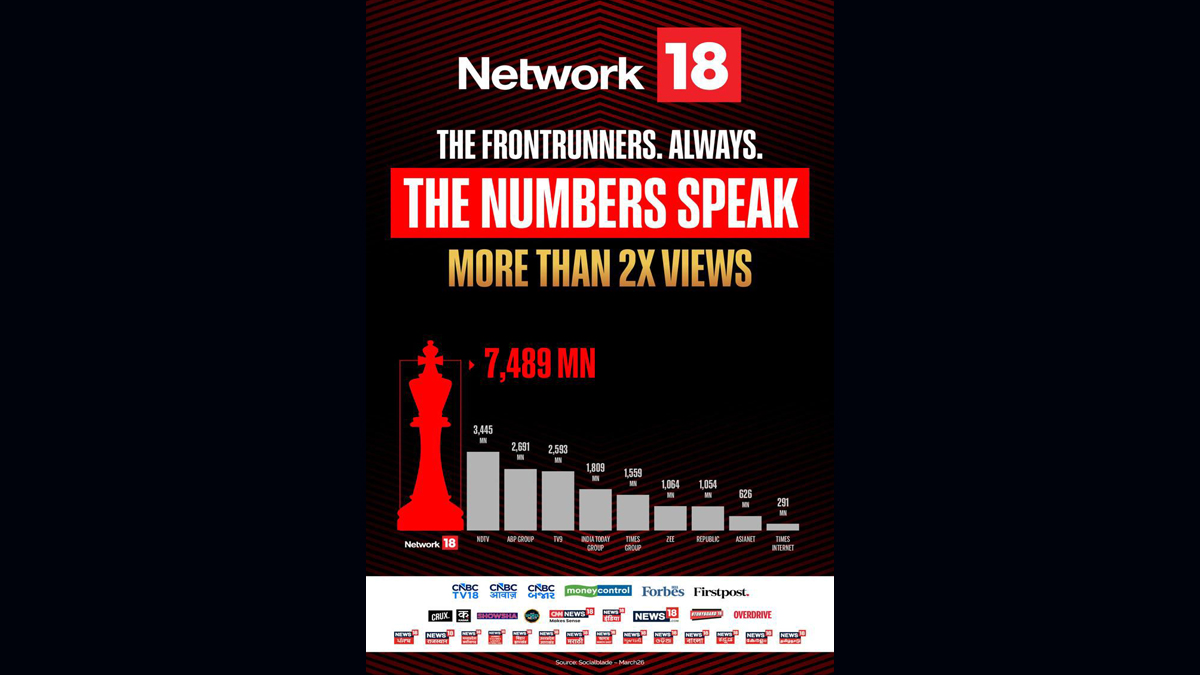
MUMBAI: When the world hit refresh on breaking news, Network18’s channels were already streaming ahead. As geopolitical tensions and war-driven headlines fuelled a surge in global news consumption, the network’s digital playbook delivered big clocking record Youtube viewership across English, Hindi and business news categories in March 2026.
At the forefront was CNN-News18, which emerged as the clear leader in the English news segment with 130 million live and video-on-demand views. The channel edged past competitors such as Times of India (126.5 million), Times Now (101.1 million), India Today (88.2 million) and NDTV (77.5 million), according to Databeings data for March.
In the Hindi news arena, News18 India delivered a commanding performance, racking up a staggering 3,297 million views on YouTube. The channel comfortably outpaced NDTV India, which recorded 3,119 million views, underlining its deep reach and consistent engagement with mass audiences, as per Playboard data.
The network’s dominance wasn’t confined to general news. In the Hindi business segment, CNBC Awaaz topped the charts with 92 million views, narrowly ahead of Zee Business (90 million) and well ahead of ET Now Swadesh (57 million). Meanwhile, its English counterpart CNBC-TV18 posted a strong 58 million views, reinforcing the network’s cross-category strength.
The spike in viewership reflects a broader shift in audience behaviour, with viewers increasingly turning to digital platforms particularly Youtube for real-time updates and in-depth coverage during high-intensity news cycles. For Network18, the numbers signal more than just scale; they underline the effectiveness of a multi-platform strategy that blends speed, credibility and continuous coverage.
In a month where the news never paused, it seems viewers chose to stay tuned where the stream never stopped.






