Hardware
Bose launches new products to enhance sound of home theatre, music

MUMBAI: Bose which seeks to develop sound solutions to meet any audio challenge has announced the launch of new products in India. One them is the Bose Cine4mate Digital home theatre speaker system.
The product consists of two speakers to the left and rights of the television set. This is connected to the Acoustimass module which is hidden. The product comes with a universal remote control which allows one to control the TV and DVD.
Speaking on the launch Bose India Ratish Pandey said, “We did research among consumers. Many of them chose not to go for a home theatre system for several reasons. One is that there are too many wires involved and so it is difficult to set up. It is also expensive. So we designed this sytem for more simplicity. The Cinemate speaker system works with the video components you already own. It does not use any bulky equipment or complicated wiring.”

Bose states that the Cinemate speaker system delivers many of the benefits of a five speaker system. Two enclosed speakers work in tandem with Bose’s Truespace surround digital processing circuitry and the earlier mentioned Acoutimass module to produce a home theatre experience without the need for rear or centre channel speakers. This means that even if one’s room is not large one can still get the home theatre effect.
At a media briefing this morning the company used a clip from the film Toy Story 2 to illustrate the difference between the ordinary television sound and the difference that Bose makes. For instance in a scene where a truck rumbles towards the characters this writer got the feeling of the truck passing from one end of the room to the other.
Meanwhile Bose has also expanded its Bose Lifestyle DVD home entertainment system with the introduction of Bose Link. Through a cable one can have music playing throughout the house. The company states that with the introduction of the Bose AL8 wireless audio link the need for running wires from room to room is eliminated while maintaining the audio quality of a fully wired system.
The Bose Link works with any DVD based lifestyle home entertainment system. It comes with a transmitter (AL8) and a receiver (AR1). The user makes one connection from the AL8 transmitter to the lifestyle media centre in the main room. The transmitter is then plugged in to a wall outlet. If one wants the music to be heard in another room then the user makes another single connection from the receiver to a Bose link enabled speaker system or a Lifestyle amplifier with Bose Speakers. The transmitter and receiver work together automatically by establishing a wireless link once they have been plugged in. They begin transmitting and receiving music as well as control commands through the two way wireless link.
The transmitter is compatible with internal sources like the digitally stored music on a lifestyle system. The system provides for dual stream transmission. In the primaryu room a user can be watching a film through the Lifestyle home entertainment system. Speakers in another room can play the system’s stored music collection. As far as marketing activity is concerned Bose has associated itself with Wimbledon and The Ashes. This was in the form of a silent ad.
The first ad of an interval would be a Bose ad with the message that what one is watching sounds better on a Bose System. On the ground the company runs nine Bose Connect events in a year. Here different technologies are displayed for the public. In the US it does school contact programmes where students through Bose’s technology learn about musical instruments as well as maths and physics. In India plans are being formulated to do similar activity sometime in the future.







Hardware
India clears Rs 1.6 lakh crore semiconductor projects under Semicon India
Ten projects cleared as production begins and design ecosystem gathers pace
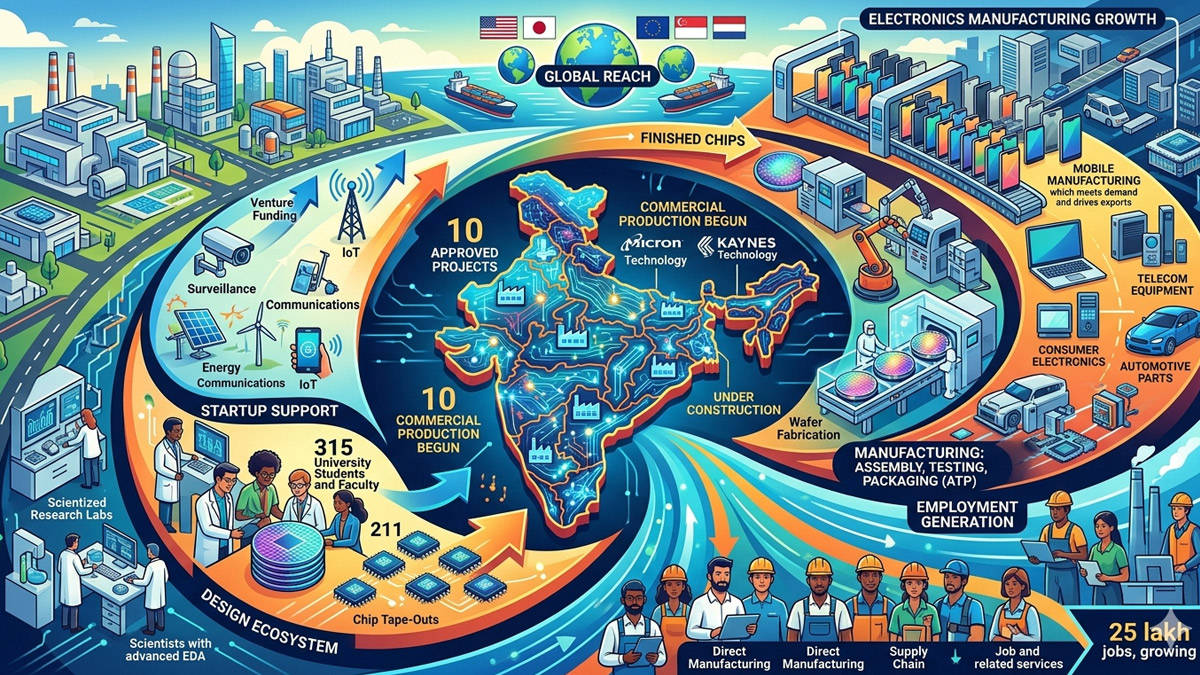
NEW DELHI: India’s push to become a global electronics powerhouse is gaining momentum, with the Semicon India Programme driving the creation of a full-fledged semiconductor ecosystem from design to manufacturing.
Launched in 2022, the programme aims to build capabilities across the entire value chain, including chip design, fabrication, assembly, testing and packaging. In just four years, the government has approved 10 semiconductor projects with a combined investment commitment of around Rs 1.6 lakh crore.
Two of these facilities have already begun commercial production, including units led by Micron Technology Inc. and Kaynes Technology India Limited. Two more plants are expected to go live later this year, signalling that India’s chip ambitions are moving from blueprint to factory floor.
The broader electronics manufacturing story has also seen sharp growth over the past decade. Production has jumped from roughly Rs 1.9 lakh crore in 2014-15 to about Rs 12 lakh crore in 2024-25, while exports have surged nearly eightfold. Mobile phone manufacturing, once heavily import-dependent, now meets almost all domestic demand and has become a major export driver.
Alongside manufacturing, the government is investing heavily in design capabilities. Through access to advanced chip design tools provided free to 315 universities, students and researchers have clocked over 200 lakh hours of usage. This effort has already resulted in 211 chip tape-outs from 75 institutions.
Support for startups is also picking up pace. Twenty-four chip design projects have been approved, targeting sectors such as surveillance, energy, communications and IoT. Of these, 14 companies have collectively raised over Rs 650 crore in venture funding, while several designs have progressed to fabrication, including at advanced nodes.
To strengthen supply chains, India has also signed semiconductor cooperation agreements with countries including the United States, Japan, the European Union, Singapore and the Netherlands. These partnerships aim to reduce global dependencies while boosting domestic capabilities.
The employment impact is equally significant. The electronics sector now supports an estimated 25 lakh jobs, with mobile manufacturing alone accounting for nearly half. As more semiconductor units come online under the India Semiconductor Mission, indirect job creation across supply chains is expected to rise further.
Sharing these updates in Parliament, Ministry of Electronics and Information Technology minister of state Jitin Prasada underscored the government’s focus on building a resilient, end-to-end semiconductor ecosystem.
With factories taking shape, designs moving to silicon and investments flowing in, India’s semiconductor story is steadily shifting gears from ambition to execution.






