Hindi
Bombay Talkies : A montage of cinema

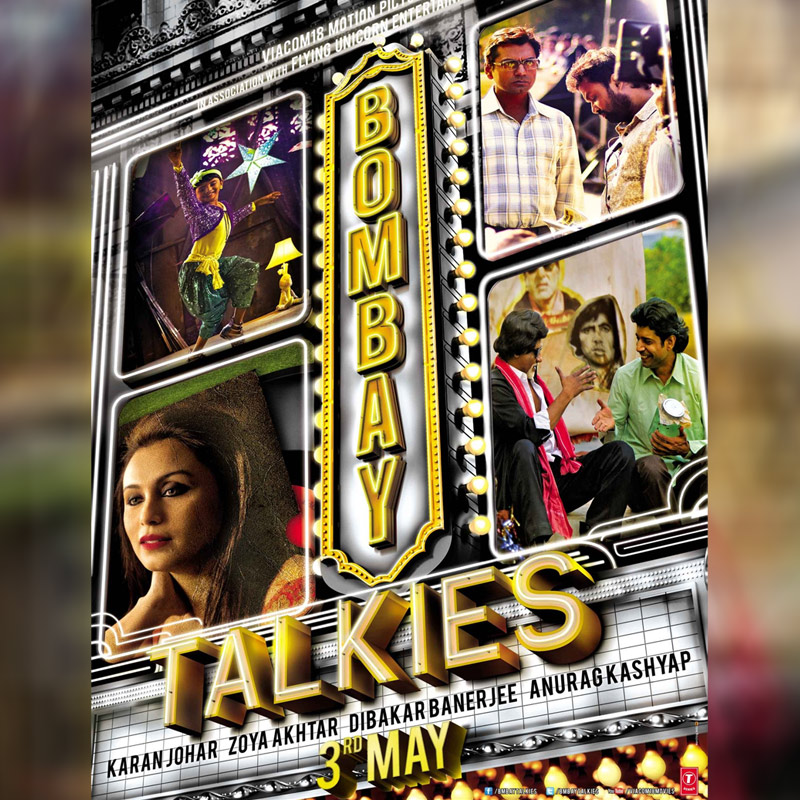
MUMBAI: Bombay Talkies is a 128-minute film made to pay tribute to the Indian film industry on its completing 100 years. The film tells four stories directed by four filmmakers: Karan Johar, Dibakar Banerjee, Zoya Akhtar and Anurag Kashyap. These are followed at the end by the use of a montage created with the participation by all the top artistes from past and present through a song.
 |
|
Producers:Viacom 18 Motion Pictures, Ashi Dua. |
The first feature by Johar (27 minutes) is about a long-married couple, both professionals in the media, Rani Mukerji and Randeep Hoooda, and co-starring Saqib Saleem. Saleem is a fresh intern at the newspaper where Mukerji is the associate editor. She prefers to sit among her colleagues rather than boxed in a cabin and is an amiable kind. Saleem befriends her instantly and informs her that he is gay. He has a way with words and is full of wit. He is invited over for dinner at Mukerji‘s for his birthday where Hooda is first indifferent to him but later feels that there is more to Saleem than his wisecracks. The story of a happily married couple and their lives changes after that day.
This is an interesting story thanks to its humour and with restrained performances by Mukerji and Hooda and a sparkling one by Saleem.

The feature by Banerjee (26 minutes) is about a failed Marathi stage actor, Nawazuddin Siddiqui, whose only connection now with acting is telling his daughter film stories while enacting parts of them. This one is based on a short story, Patol Babu, Film Star, by Satyajit Ray. One day, Siddiqui is on his way for a job of a building security man. He is late and the job has been taken. On his way back, he
watches a film being shot on the streets. As he penetrates the crowd of onlookers to come ahead for a better view, he is offered a passing shot in the film. He has to pass the star and bang into him and then react with ‘Aeeeeeeee‘. While imagining his dialogue to be all the powerful ones from past films he has mouthed a hundred times he has an encounter with the soul of his father, Sadashiv Amrapurkar, and gets into a debate. He comes out enlightened, suggests to the crew that it made no sense him walking straight and banging into the star. Instead, it would make more sense if he was reading a paper as he walked and banged. His suggestion is welcomed. Shot is okay in one go. Excited that finally he has a new story to tell his daughter that of his own success, he does not even wait to collect his remuneration for that one shot and rushes home.
This one is a showcase of Nawazuddin‘s versatility as he shows his comfort with the Marathi language as well as character.
In the feature directed by Akhtar (24 minutes), 12-year-old Naman Jain is out watching a movie with his parents and sister, Khushu Dubey. There comes a song performed by Katina Kaif, ‘Sheila ki jawaani‘, and the boy is absorbed as he watches all the moves made by Kaif. Back home, he gets into his sister‘s clothes and starts to mimic the steps only to be caught by his father, Ranvir Shorey. Shorey wants his son to play football and be athletic, not dance in girls‘ clothes. Then Kaif is on TV telling her viewers to be determined and keep one‘s desires to oneself. Shorey shows a clear gender bias as he would rather pay Rs 3000 for his son‘s football coaching which he hates than spend Rs 2000 on his daughter‘s school picnic. Since Jain has shared his passion for dancing with his sister, he decides to do something about her school trip. After opening piggy banks, they are still Rs 250 short. A show of Naman‘s dances is organised in the building backyard. ‘Shiela ki jawaani‘ saves the day.
An eternal debate about parents forcing own aspirations on children and their bias towards boy child.
The last feature, directed by Kashyap (30 minutes) stars Sudhir Pande and is about a dying man‘s last wish to have Amitabh Bachchan taste a piece of murabba from his jar and return the rest so that he may taste a bit everyday and have a longer life. The man‘s father had desired Dilip Kumar to do the same with a jar of honey which Pande was made to carry from Allahabad to Mumbai to meet Dilip Kumar and ask him to do the needful. Pande‘s emotional and obedient son, Vineet Kumar Singh, proceeds to Mumbai to meet Bachchan. After days of trying, he finally meets Bachchan who obliges, no questions asked.
This purposeless story seems more about a tribute to Bachchan and his popularity.
The montage tribute song that marks the end of the film is the most watchable.
|
Shootout At Wadala: A gory encounter |
MUMBAI: Shootout At Wadala is a chapter chronicled in S Husain Zaidi‘s book on Mumbai underworld about the rise of Dawood Ibrahim Kaskar. However, the film is not really about Dawood Ibrahim as the book is. Not only did Dawood neutralise many reigning dons like Haji Mastan and Karim Lala on his way up, he also created some and met some on the way. Two such people were Manohar Surve aka Manya Surve. This film aspires to make a Deewaar out of Shootout At Wadala using Manya Surve‘s story. But Manya Surve is just a chapter in Dawood story and remains just that. Deewaar was a dramatised version of the rise of Haji Mastan, who was a living mystery for many at the time. He was linked to film stars as well as other city elite and hence had his own glamour. In comparison, to today‘s generation, Manya Surve comes out of the blue.
 |
|
Producers: Sanjay Gupta, Anuradha Gupta, Shobha Kapoor, Ekta Kapoor. |
John Abraham (Manya Surve), a Mumbai youth and diligent student, is honest to the core and with only one aim: to graduate and bring his mother, Soni Razdan, out of the misery his stepfather has put her through all her life. He has a steady girlfriend, Kangna Ranaut, whom he refuses to help during exams as he does not want to get caught doing any wrong which may derail his plan. Abraham‘s step-brother, though debarred from the city, lands up at home. His enemies soon follow him and are about to kill him. Abraham, a simple, non-violent lad, intervenes on the goading of Ranaut and during that time his brother grabs the opportunity and stabs the last of his enemies attacking him.
It is the day of the result and Abraham is on the way to check how he did via his mandatory visit to the temple when the police too reach his college. After being beaten in front of the entire college crowd, he is taken in custody for the murder his brother committed. That there is a conspiracy to frame Abraham is revealed only much later. Abraham‘s life does a cartwheel. His future plans of a secure job, marriage and happy life for his mother all end as he is sentenced to life imprisonment along with his brother. The brothers are attacked in jail and while his brother is killed, Abraham is saved by Tusshar Kapoor. Abraham knows there is no turning back now but to rise on the path he has been forced on, that of crime.
A bond is formed between Abraham and Kapoor and both escape from jail. It has been nine years and that time has taught the duo all the tricks of the crime world and of survival. They need to join some group and decide on Kaskar brothers, Manoj Bajpai and Sonu Sood, though here they are referred to as different names instead of Sabir and Dawood. But instead of joining them, they come back as enemies of these brothers who lead the most dreaded gang in South Bombay at the time because of which no other gang will accept them anymore.
Abraham decides to form his own gang with the ultimate aim of ruling Bombay, becoming ‘Bambai ka Baap‘. Soon a gang is formed, adding some expert criminals on its roster, like Siddhant Kapoor, a sharpshooter etc. Meanwhile, Ranaut has also returned to his life, duly widowed. As the Surve saga unfolds and meets its inevitable end, there is gore, violence, bullets flying, use of foul words, some sex and item numbers. There are also known faces for cameos like Akbar Khan playing Haji Mastan, Ranjeet as a dada whose conspiracy it was to frame Abraham and Jackie Shroff playing the commissioner of police. His gang members are either killed by the Kaskars or taken in by the police. Left alone, Abraham is holed up at a safe location. But he is bored and wants to break out and leave the city with Ranaut. Ranaut is deceived into believing that police wanted to save Abraham‘s life from the Kaskar gang. Anil Kapoor, the cop chasing Abraham learns about his plan to meet her at Wadala College the next day. A posse of policemen led by Anil Kapoor, Ronit Roy and Mahesh Manjrekar rains bullets on Abraham to carry out the first acknowledged encounter by Mumbai police.
The narration of Shootout At Wadala is in flashbacks. Abraham is shot fatally and in the pretext of taking him to hospital, Anil Kapoor whiles away time as he dies while listening to the story of Manya Surve. Thus the story proceeds in a number of flashbacks, often confusing the viewer about the time factor. Also, though it may be the first encounter, it is not the first gang world film and hence no novelty including the deception of Ranaut which is similar to a recent film. This also makes the flow of the film suffer. Sanjay Gupta shows some enterprise in shot taking. While the Sunny Leone item number is good, the one on Priyanka Chopra has no appeal and Ala re ala…. is good for front bench masses. Attempts at creating claptrap dialogue have worked a few times but often the result is a blunt nothing. Photography is good. Despite a crowded screen, it is John Abraham‘s show all the way and he does justice to the character of Manya Surve. Tusshar Kapoor is an excellent foil to the protagonist. Ranaut is incidental to the story. Anil Kapoor, Manoj Bajpai, Sonu Sood, Ronit Roy, Mahesh Manjrekar are good in support.
Shootout At Wadala has its best prospects in the Bombay circuit, especially the Maharashtra belt and its single screens are expected to do better than multiplexes.







In a music industry that often rewards speed, spectacle, and instant recall, Navjot Ahuja’s journey feels refreshingly different. His story is not built on noise. It is built on patience, discipline, emotional honesty, and a quiet commitment to becoming better with every passing year. After 14 years of struggle, learning, performing, and writing, Navjot stands today as an artist whose success has not changed his centre. If anything, it has only made his purpose clearer.
For Navjot, music has never been about chasing fame alone. It has always been about expression. It is about writing more truthfully, singing more skillfully, understanding himself more deeply, and becoming a kinder human being in the process. That rare clarity is what gives his journey its beauty.
Where It All Began: A Writer Before a Singer
Indian singer and songwriter Navjot Ahuja’s musical journey began in the most familiar of places: school assemblies. But even then, what was growing inside him was not only the desire to sing. It was the need to write.
Long before he saw himself as a performer, he had already discovered the emotional release that writing offered him. For Navjot, words became the first true channel for feeling. Songwriting came before singing because writing was the only way he could let emotions flow through him fully. That inner pull shaped his artistic identity early on.
Like many young musicians, he sharpened his craft by creating renditions of popular songs.
Those experiments became his training ground. But the turning point came in 2012, when he wrote his first original song. That moment did not just mark the beginning of songwriting. It marked the beginning of self-definition.
A Calling He Did Not Chase, But Accepted
What makes the latest Indian singer-songwriter Navjot’s story especially compelling is the way he describes his relationship with music. He does not frame it as a career he aggressively pursued. In his own understanding, music was not something he chose. It was something that chose him.
There was a time when he imagined a very different future for himself. He wanted to become a successful engineer, like many young people shaped by ambition and conventional expectations. But life had a different script waiting for him. During his college years, around 2021, music entered his life professionally and began taking a firmer shape.
That shift was not driven by image-building or industry ambition. It came from acceptance. Navjot embraced the fact that music had claimed him in a way no other path could. That sense of surrender continues to define the artist he is today.
An Artist Guided by Instinct, Not Influence
Unlike many singers who speak openly about idols, icons, and musical role models, Navjot’s creative world is built differently. He does not believe his music comes from imitation or inherited influence. He listens inward.
He has never considered himself shaped by ideals in the traditional sense. In fact, he admits that he does not particularly enjoy listening to songs, especially his own. His decisions as a songwriter and singer come from instinct. He writes what feels right. He trusts what his inner voice tells him. He positions his music according to what he honestly believes in, not what trends demand.
That creative independence gives his work a distinct emotional sincerity. His songs do not feel calculated. They feel alive.
The Long Years of Invisible Struggle

Every artist carries a chapter of struggle, and Navjot’s was long, demanding, and deeply formative. One of the biggest challenges he faced was building continuity as the best new indian singer songwriter in an era where musical collaboration is increasingly fluid.
For emerging singers, especially those trying to build with a band, consistency can be difficult. Instrumentalists today have more opportunities than ever to freelance and perform with multiple artists. While that growth is positive and well deserved, it can make things harder for singers who are still trying to establish a steady team and sound around their work.
For Navjot, one of the most difficult phases came during 2021 and 2022, when he was doing club shows almost every day. It was a period of relentless performance, but not always personal fulfillment. He was largely singing covers because clubs were not open to original songs that audiences did not yet know.
For a new Indian singer and songwriter, that can be a painful compromise. To perform constantly and still not have the freedom to share your own voice requires not just resilience, but restraint.
“Khat” and the Grace of Staying Unchanged
After 14 years of effort, Navjot’s new love song Khat became a defining milestone. Professionally, he acknowledges that the song changed how society viewed him as a musician. It strengthened his place in the public eye and altered his standing in meaningful ways.
Yet personally, he remains unchanged.
That is perhaps the most striking part of his story. Navjot says his routine is still the same. His calm is still the same. His writing process is still the same. He does not want success or failure to interfere with the purity of his art. For him, emotional detachment from public outcomes is essential because the moment an artist becomes too attached to validation, the writing begins to shift.
His joy comes not from numbers, but from the attempt. If he has tried to improve his skill today, if he has written his heart out more honestly than before, then he is at peace.
Growth, Not Glory, Remains the Real Goal
Even now, Navjot is not consumed by labels such as singles artist, performer, or digital success story. His focus remains deeply personal. He wants to sing better. He wants to play instruments better. He wants to understand himself more. And he wants to become a kinder person.
That is what makes Navjot Ahuja’s journey so moving. It is not simply the story of a musician finding recognition. It is the story of an artist who continues to grow inward, even as the world begins to look outward at him. In an age obsessed with applause, Navjot reminds us that the most meaningful success often begins in silence, honesty, and the courage to remain true to oneself.






