Movies
Binge-worthy movies, web series, & podcasts for Independence Day

Mumbai: With the echoes of patriotism and the fervor of freedom setting in, it’s the perfect time to indulge in some inspiring tales that celebrate the spirit of independence. Whether through films, audio, or web series, there’s a treasure trove of entertainment on your phones and TVs waiting to be explored. This Independence Day, we have put together a special selection of titles that will take you on a captivating journey that will not only entertain but also evoke a profound sense of national pride. Let’s spend a day in remembrance of the fighters who sacrificed their lives for the nation and their unyielding spirit that defines the essence of freedom.
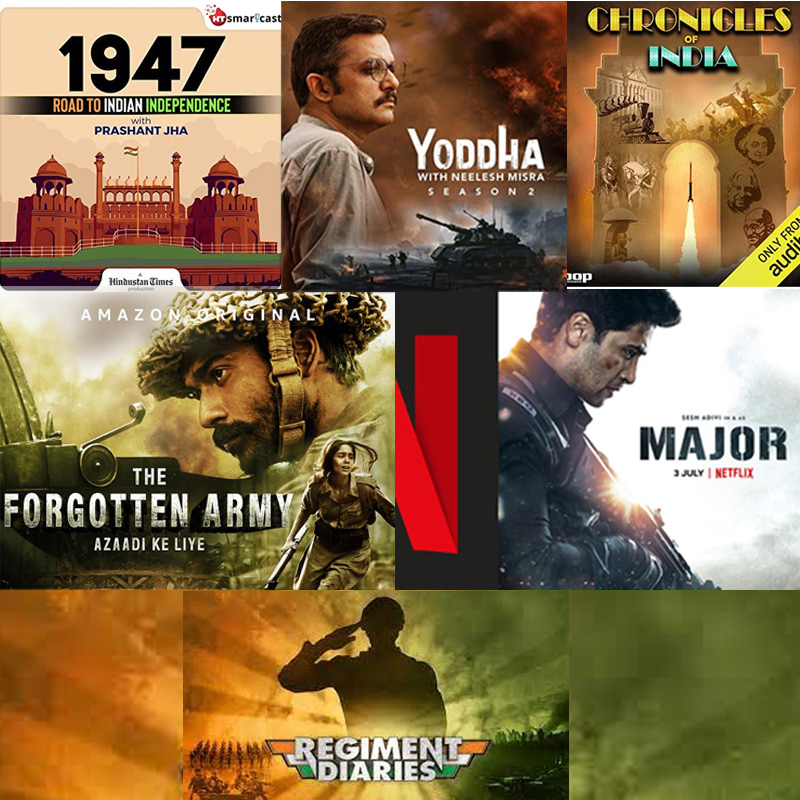
1947: Road to Indian Independence
Platform: Audible

1947: Road to Indian Independence on Audible narrated by journalist Prashant Jha traces back to how India became one of the first countries in Asia to get freedom from colonial rule to attain freedom. The 13-episode podcast documents the important events that shaped the freedom struggle, the becoming of a nation named ‘India’, and imminent personalities who have left their immortal footprint on the nation.
Platform: Audible
It is indeed said we are not makers of history instead, we are made by history. Chronicles of India is informative, deep dives into the depths of ancient Indian history, and celebrates the golden pages of our country’s lost history, which has helped India become what it is today. It beautifully depicts how this nation has proven its significance to the rest of the world. It also narrates how we freed ourselves from the shackles of slavery and violent winds after withstanding the test of time.
Platform: Audible
Both the seasons of this show created and performed by Neelesh Mishra – celebrate the bravery of the Indian Armed Forces in the most uncertain and terrifying circumstances. Documenting the valiant real-life experiences of war heroes, troopers, and army veterans who served in the Indo-Pakistan war, the 26/11 terror attacks, the Sino-Indian war of 1962, and ambush operations in Jammu Kashmir. The stories also give insights into their personal lives the sacrifices they made and the courage of their family members.
Platform: Netflix
Regiment Diaries on Netflix series offers a peek into the various regiments of the Indian Army, their training, their traditions, history, contributions, and their journey from civilian to joining the Indian Army. For those enthusiastic about gaining insights into the regiments of the Indian Army and important military events, what’s better than a docu-series chronicling the lives of these army men who are following the illustrious example of their predecessors to protect the nation and their countrymen.
Platform: Netflix
This Netflix biopic ‘Major’ is based on Major Sandeep Unnikrishnan, documenting his life right from his childhood to his valiant endeavor during the 2008 Mumbai attacks. Major Sandeep Unnikrishnan was the team commander of 51 Special Action Groups (51 SAG) deployed in the hotel to rescue the hostages and died during his mission. This biopic capturing the inspiring story of the Ashoka Chakra awardee story deserves to be watched this Independence Day.
The Forgotten Army – Azaadi Ke Liye
Platform: Prime Video
The militant uprising in colonial India is not honored enough though it has a pivotal role in attaining Independence. The Forgotten Army – Azaadi Ke Liye on Prime Video does exactly the needful by capturing the efforts made by the Azad Hind Fauj who marched 3,884 kilometers from Singapore to Delhi to free their country from the British. The Fauj was led by Netaji Subash Chandra Bose who fought against their size and scale but were labelled by the then ruling establishment as traitors. Relive this momentous period in Indian history with this action-packed true war series on Amazon Prime.
Platform: Prime Video
The story of Sardar Udham is directed by Shoojit Sircar and was shot in the beautiful locales of India, the United Kingdom, and Ireland. Sardar was a man gravely impacted by the Jallianwala Bagh massacre and sought revenge on the perpetrator of the incident Micheal O’Dwyer, Punjab’s former lieutenant governor. After the massacre, Sardar Udham fled the mountains of Afghanistan and traveled through the USSR reaching London in 1933-34. He spent the most decisive 6 years of his life, re-igniting the revolution, and in 1940, after 21 years of carrying the unhealed wound, Udham Singh assassinated Michael O’Dwyer.

Hindi
YRF Entertainment appoints Saugata Mukherjee as head of content
Former SonyLIV content head to steer films and series at streaming arm

MUMBAI: YRF Entertainment, the streaming arm of Yash Raj Films, has appointed Saugata Mukherjee as head of content, signalling a strong push to scale its original films and series slate.
Mukherjee joins the company following a successful three-and-a-half-year stint at SonyLIV, where he served as executive vice president and head of content. In his new role, he will report to CEO Akshaye Widhani and lead the creative direction and commissioning strategy for YRF Entertainment’s growing slate.
The appointment comes on the back of YRF Entertainment’s recent global success with titles such as The Romantics, The Railway Men and Mandala Murders, which have helped position the studio as a serious player in the streaming space.
At SonyLIV, Mukherjee played a key role in shaping the platform’s identity as a premium content destination. Under his leadership, the service delivered acclaimed originals across genres, building a reputation for storytelling depth and creative risk-taking. His exit was described as “one of the harder goodbyes”, reflecting both the impact of his tenure and the strength of the team he leaves behind.
Mukherjee brings with him a wide-ranging career that spans publishing, television and streaming. Before SonyLIV, he led content initiatives at HBO Max under Warner Bros. Discovery, where he was instrumental in shaping the platform’s India strategy. His earlier roles include senior leadership positions at Hotstar and Star TV, where he worked on building original content pipelines and collaborating with top creative talent.
With a career that began in publishing at firms like HarperCollins and Pan Macmillan, Mukherjee’s journey reflects a deep-rooted understanding of storytelling across formats and platforms.
His move to YRF Entertainment comes at a time when the battle for streaming audiences is intensifying, with studios doubling down on high-quality originals to stand out in a crowded market.
For YRF, the appointment is more than just a leadership hire. It is a clear signal that the studio is ready to scale its streaming ambitions, with Mukherjee expected to play a central role in shaping its next chapter.






