e-commerce
Beyond 3D: What virtual commerce industry expects from technology

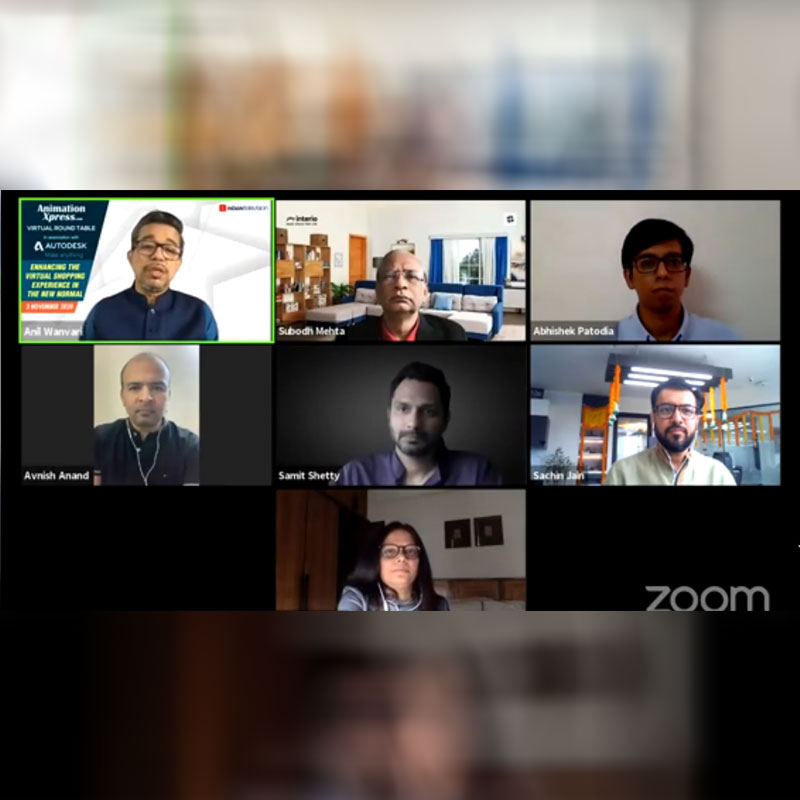
NEW DELHI: The new-age Indian consumer wants the ease of shopping coupled with the element of traditional look and feel. To cater to this, technology players need to curate solutions that can seamlessly merge the online and offline worlds, as per industry leaders at AnimationXpress.com’s virtual roundtable in association with Autodesk.
Moderated by Indiantelevision.com founder, CEO, and editor-in-chief Anil Wanvari, the panel discussed how to enhance the virtual shopping experience in the new normal and comprised stalwarts like Carwale SVP (used cars) Abhishek Patodia, Caratlane co-founder and online head Avnish Anand, Hometown CMO Medha Tawde, De Beers India MD Sachin Jain, Autodesk India senior technical sales specialist – media and entertainment Samit Shetty, and Godrej Interio SVP (B2C) Subodh Mehta.
Tawde noted that in the furniture industry, it is very important to help consumers visualise the pieces in physical spaces and that’s where the mock rooms in their stores are playing a key role in conversions. She is expecting the technology will bring these visual experiences to life virtually.

Mehta suggested, “I would like to tell the technology players that if you really want to create the best virtual experiences, you need to chart out a platform-agnostic customer journey, including the physical experiences, and then pick up those touch-points and create a similar virtual experience. For example, we have store walkthroughs and we have noticed that people themselves like to touch and feel the furniture, they want to open the drawers themselves and see how much space is in there; so we need to replicate it virtually too. The control should be in the hands of the customer.”
He added that ultra-advanced technologies like scanning physical spaces to take measurements and then using 3D imagery to show how a particular piece of furniture would look in that area, whether it will fit or not, etc, need to be taken care of.
Speaking about the jewellery industry, Anand observed that the stumbling block they encounter is how to maintain the authenticity of size and material when using 3D rendering. This is the area where he is counting on some support from tech players.
Elaborating the pain points, he said, “It is hard to shoot jewellery because it is shiny. You have to manually edit each piece to make it look hard and the problem with that is that it starts looking fake. Another issue, especially for brands like us operating in the sub-30 category, is with the size of the jewellery. We sell very small pieces but in imagery, it has to be made to look bigger. And that’s also one of the biggest reasons why the return-rate is high in this segment because people are expecting some other size. That is the fundamental problem that needs to be addressed today.”
However, what has been working really well for the e-commerce industry is the video feature that has solved a lot of problems for the sellers as well as the buyers.
Patodia shared that they recently introduced the option for sellers of second-hand cars to upload a video of the vehicle on their platform, which has driven up their number of online consumers.
Anand and Tawde also agreed that video calling features and assistance has helped them greatly in scaling their businesses online, especially during the Covid2019 lockdown.
Taking cognisance of all the suggestions coming from e-commerce players, Shetty stated that Autodesk is already working on enhancing the experience of virtual selling for both the buyers and the sellers. He highlighted that their focus remains on maintaining and improving the speed and efficiency of their solutions.
“To give you an example, we are working with a jewellery client abroad, who is using our solutions to tweak the design of a particular piece virtually, helping customers to customise their piece and see in real-time how it will look,” he stated.
During the lockdown, there have been a number of interventions from Autodesk to support the virtual commerce community and Shetty is further trying to improve on those aspects as well. “We made our group conversation tool Shotgun free for all our clients who were working from home to accelerate the communication process. Then, our software like Maya and Max are helping a lot of our clients in real-time 3D rendering processes. We are continuously trying to improve on those offerings,” he concluded.




e-commerce
Flipkart cuts around 300 jobs in annual performance review
E-commerce giant trims ~1.5 per cent of workforce as IPO preparations continue.
MUMBAI: Flipkart just gave performance the pink slip because when the annual review bell rings, even the biggest cart sometimes needs to lighten its load. Flipkart has let go of approximately 300 employees as part of its annual performance management cycle, Moneycontrol reported on 7 March 2026, citing people familiar with the matter. The exits represent roughly 1.5 per cent of the company’s total workforce of around 20,000 people across its businesses.
The move follows Flipkart’s standard practice of asking employees placed in lower performance bands to leave during yearly reviews, a process the company has carried out periodically in recent years. A similar exercise in early 2024 saw around 1,000 employees (nearly 5 per cent of the workforce) exit.
The latest round comes amid Flipkart’s continued push for operational efficiency and cost discipline, mirroring broader trends across the Indian startup ecosystem where funding slowdowns have shifted focus toward profitability.
The development also arrives as Flipkart advances preparations for a potential domestic IPO. The company has held early discussions with investment banks including Goldman Sachs, Morgan Stanley, JP Morgan and Kotak Mahindra Capital to explore feasibility. Industry sources indicate a possible listing timeline of late 2026 or early 2027, though the final size and schedule remain undecided.
In December 2025, Flipkart received National Company Law Tribunal approval to shift its holding company domicile from Singapore back to India. a key regulatory step that simplifies the group structure ahead of a public market debut.
Controlled by Walmart, Flipkart remains one of India’s largest e-commerce platforms, locked in fierce competition with Amazon. In a market where every rupee counts and every headcount is scrutinised, the latest cuts aren’t just housekeeping, they’re part of a bigger balancing act between growth ambitions and the road to listing.