News Broadcasting
BCCI invites DD to bid for telecast rights of Indo-Pak series


NEW DELHI: Even as the Supreme Court is hearing cricket-related cases, the Indian cricket board has asked Indian pubcaster Doordarshan to make a bid for the telecast rights of the forthcoming India-Pakistan series.
A senior official of Prasar Bharati, which manages DD and All India Radio, today admitted that a request has come from the Board of Control for Cricket in India (BCCI) urging DD to bid for the Indo-Pak series.
The official indicated that considering the controversy telecast rights have got entangled in, the pubcaster stands a good chance of bagging the rights; albeit by default.

Though the official confirmed that DD would put in a bid, after doing some revenue projections, he refused to indicate any figures.
The Prasar Bharati official also said that from the just-concluded cricket series featuring India,South Africa and Australia and the lone one-dayer against Pakistan, revenues worth approximately Rs 1 billion had been mopped up by DD.
Considering that BCCI would be paid Rs 820 million as a rights fee — after taking into account reduced number of actual playing days due to truncated Tests on some controversial pitches — DD claims to have ended up making some profit.
SC RESUMES HEARINGS IN BCCI CASE
Meanwhile, the Supreme Court today observed that election of president for BCCI should be held in such a manner that it should be acceptable to the general public considering the importance of the Board.
According to a Press Trust of India (PTI) report, this observation came from a bench headed by N Santosh Hegde, which was hearing a petition filed by the BCCI challenging a Madras High Court order restraining the newly elected Board from functioning, and appointing Justice S Mohan as an interim administrator.
The apex court had stayed the Madras High Court order allowing BCCI president Ranbir Singh Mahendra to resume function, but had restrained former president Jagmohan Dalmiya from becoming the patron-in-chief.
BCCI counsel A M Singhvi argued that Board had committed no irregularities by preventing certain so-called representatives of the state cricket associations as their legally nominated representatives took part in the election held at Kolkata.
Earlier, BCCI informed the Supreme Court that Dalmiya is discharging functions as the president of the Board as the old Board headed by him has not ended its tenure.
Appearing for BCCI, senior advocate A M Singhvi said as the AGM of the Board at Kolkata on September 29 and 30 could not be concluded due to an interim order by a Chennai civil court, the old Board under Dalmiya still continues to function.
The bench said “that means de jure today Ranbir Singh Mahendra is not the president of BCCI,” PTI reported.
The bench also told the counsel: “When we permitted the new office bearers’ functioning, you had not brought this to our notice.”
Arguments relating to this case are likely to continue tomorrow also.






News Broadcasting
Network18 channels lead YouTube news viewership in March 2026
CNN-News18, News18 India and CNBC channels top categories with record views
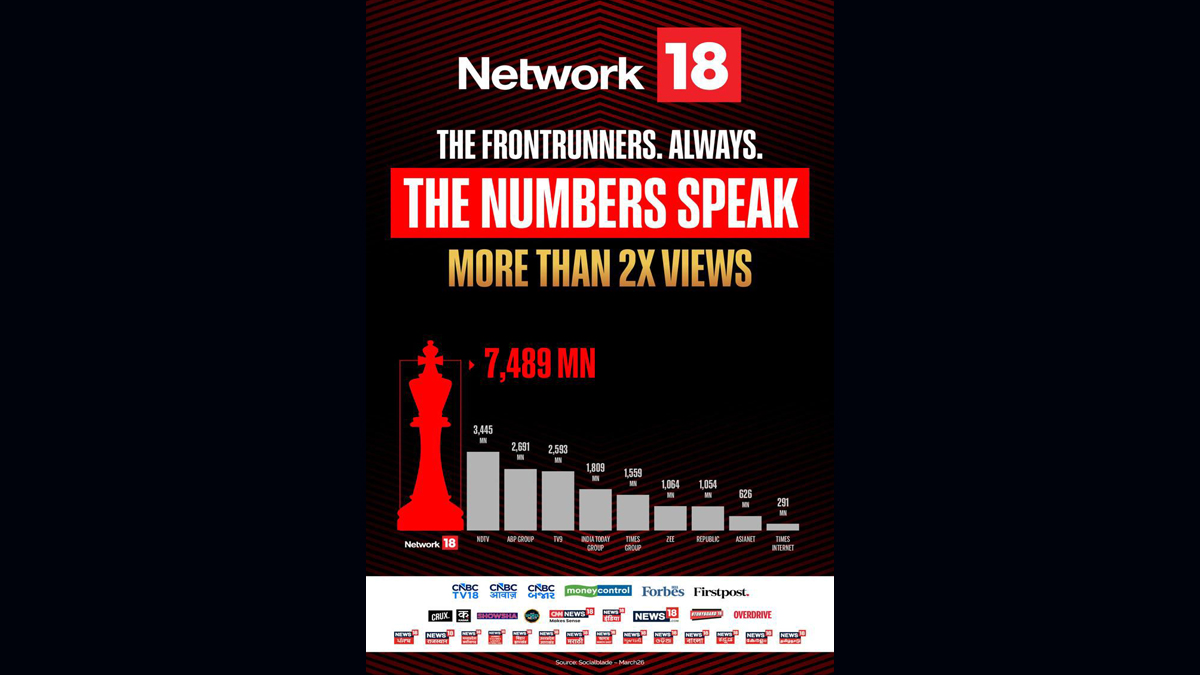
MUMBAI: When the world hit refresh on breaking news, Network18’s channels were already streaming ahead. As geopolitical tensions and war-driven headlines fuelled a surge in global news consumption, the network’s digital playbook delivered big clocking record Youtube viewership across English, Hindi and business news categories in March 2026.
At the forefront was CNN-News18, which emerged as the clear leader in the English news segment with 130 million live and video-on-demand views. The channel edged past competitors such as Times of India (126.5 million), Times Now (101.1 million), India Today (88.2 million) and NDTV (77.5 million), according to Databeings data for March.
In the Hindi news arena, News18 India delivered a commanding performance, racking up a staggering 3,297 million views on YouTube. The channel comfortably outpaced NDTV India, which recorded 3,119 million views, underlining its deep reach and consistent engagement with mass audiences, as per Playboard data.
The network’s dominance wasn’t confined to general news. In the Hindi business segment, CNBC Awaaz topped the charts with 92 million views, narrowly ahead of Zee Business (90 million) and well ahead of ET Now Swadesh (57 million). Meanwhile, its English counterpart CNBC-TV18 posted a strong 58 million views, reinforcing the network’s cross-category strength.
The spike in viewership reflects a broader shift in audience behaviour, with viewers increasingly turning to digital platforms particularly Youtube for real-time updates and in-depth coverage during high-intensity news cycles. For Network18, the numbers signal more than just scale; they underline the effectiveness of a multi-platform strategy that blends speed, credibility and continuous coverage.
In a month where the news never paused, it seems viewers chose to stay tuned where the stream never stopped.






