News Broadcasting
bbcurdu.com poll predicts slim win for PPP


MUMBAI: A BBC World Service commissioned pre-election poll in Pakistan forecasts a narrow lead for the Pakistan People’s Party (PPP) in the forthcoming general elections
Mian Azhar of the Pakistan Muslim League (PML) (Quaide Azam) (Q) is expected to be the next prime minister. The opinion poll commissioned for bbcurdu.com is the biggest of its kind in Pakistan and was conducted in advance of the general elections on 10 October 2002.
The poll demonstrates major regional differences on issues such as allegations of pre-election rigging, the ban on militant organisations and the performance of the military government. It was conducted in 99 cities and towns and more than 100 villages throughout Pakistan. A total of 2,827 Pakistanis of voting age were asked their opinion about the elections in face-to-face interviews. A clear majority of respondents did not believe the elections would be completely free and fair, however 24 per cent of those interviewed said they either didn’t know or didn’t want to comment.

A majority of voters in Sindh province believed that the PPP would win while the PML (Q) enjoys much greater support in Punjab and Balochistan. According to the survey, the PML Nawaz Group (N), which once enjoyed a strong support in urban Punjab, appears to be losing its mass appeal. Only 12 per cent of respondents thought that it would win a majority of seats, with only 18 per cent of Punjabis predicting its win.
In response to the question of who is going to be the next prime minister of Pakistan, Mian Azhar emerged as the front runner with 17 per cent lead, followed closely by Makhdoom Amin Fahim, Farooq Laghari and Imran Khan. Women respondents put Imran Khan as the front runner to form a new government. He also enjoyed more support in Sindh than Mian Azhar and Farooq Laghari.
The survey also revealed the continuing strength of traditional political allegiances. Benazir Bhutto was rated both the best and the worst prime minister over the last two decades. Nawaz Sharif emerged as both the second best and the second worst prime minister over the same period. 54 per cent of the respondents believed that Benazir Bhutto should have been given permission to return and participate in elections. Nawaz Sharif scored slightly lower with 50 per cent.
General Pervez Musharraf enjoyed considerable support in the North West Frontier Province (NWFP) with 60 per cent saying his tenure has proved good for the country. When asked to compare General Zia and Musharraf, Punjabis found General Zia a better ruler than Pervez Musharraf. However, 55 per cent of respondents in Balochistan preferred Musharraf to General Zia.




News Broadcasting
Network18 channels lead YouTube news viewership in March 2026
CNN-News18, News18 India and CNBC channels top categories with record views
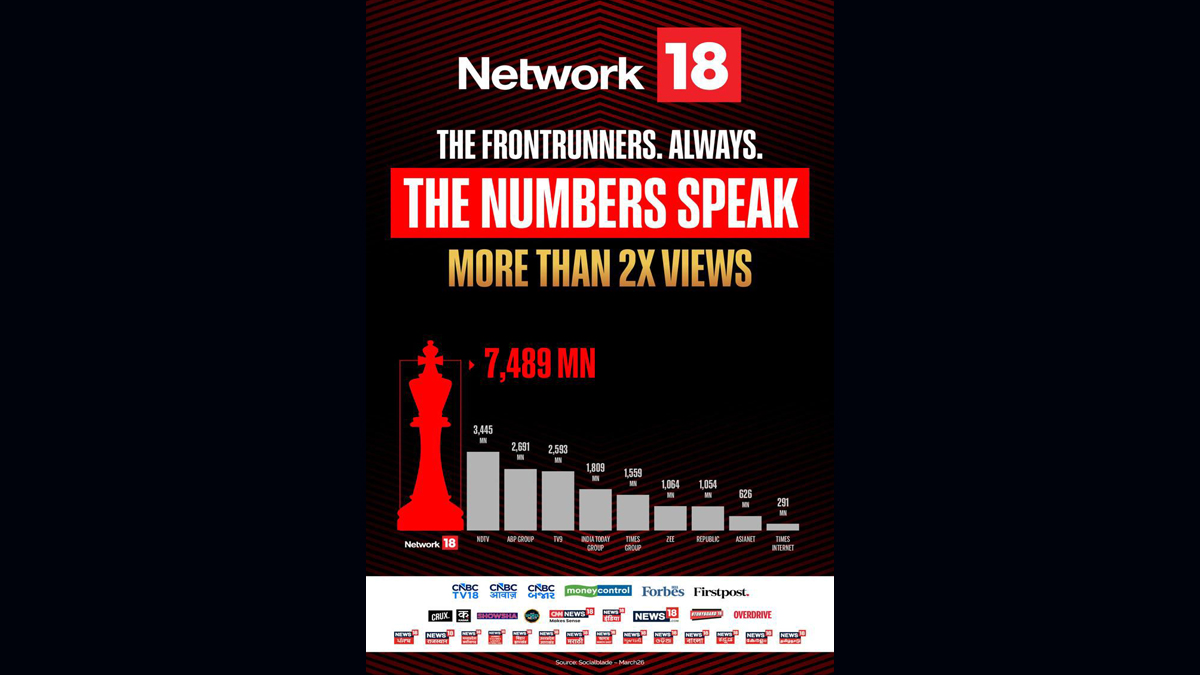
MUMBAI: When the world hit refresh on breaking news, Network18’s channels were already streaming ahead. As geopolitical tensions and war-driven headlines fuelled a surge in global news consumption, the network’s digital playbook delivered big clocking record Youtube viewership across English, Hindi and business news categories in March 2026.
At the forefront was CNN-News18, which emerged as the clear leader in the English news segment with 130 million live and video-on-demand views. The channel edged past competitors such as Times of India (126.5 million), Times Now (101.1 million), India Today (88.2 million) and NDTV (77.5 million), according to Databeings data for March.
In the Hindi news arena, News18 India delivered a commanding performance, racking up a staggering 3,297 million views on YouTube. The channel comfortably outpaced NDTV India, which recorded 3,119 million views, underlining its deep reach and consistent engagement with mass audiences, as per Playboard data.
The network’s dominance wasn’t confined to general news. In the Hindi business segment, CNBC Awaaz topped the charts with 92 million views, narrowly ahead of Zee Business (90 million) and well ahead of ET Now Swadesh (57 million). Meanwhile, its English counterpart CNBC-TV18 posted a strong 58 million views, reinforcing the network’s cross-category strength.
The spike in viewership reflects a broader shift in audience behaviour, with viewers increasingly turning to digital platforms particularly Youtube for real-time updates and in-depth coverage during high-intensity news cycles. For Network18, the numbers signal more than just scale; they underline the effectiveness of a multi-platform strategy that blends speed, credibility and continuous coverage.
In a month where the news never paused, it seems viewers chose to stay tuned where the stream never stopped.






