News Broadcasting
BBC World’s Asia audience growing: report


NEW DELHI: The sixth Pan Asia Cross Media Survey (PAX) has found that unlike other news channels, BBC World has held onto the audience it gained in 2001 as well as showing annual growth in some of Asia’s biggest urban centres.
BBC World’s monthly audience grew by 14 per cent year-on-year to 993,000 – the fastest growth for any of the top ten international channels, according to a press release from BBC. BBC World enjoyed particularly large growth in Kuala Lumpur – up 79 per cent, Bangkok – up 41per cent, Hong Kong – up 17 per cent and Taipei – up 16 per cent.
According to the study, BBC World also attracts a further 590,000 monthly viewers in Seoul and in India which combined with the rest results in a total panel viewership of 1.58 million. This confirms the trend seen in the recent IATS survey among air travellers, the only other recent survey in Asia which even attempts to measure viewership amongst such business audiences.

In particular, BBC World’s investment in business programming is attracting a loyal audience of senior business people. Findings show that more than 44,000 ‘Top Management’ in Asia tune into BBC World ‘Every day/ Almost every day’ – more than any sports or business news channel. Among those in such senior positions in medium and larger firms (50+ employees), BBC World’s 21,000 regular viewers makes it the fourth largest international channel and the eighth largest among all the channels across Asia, including terrestrials (and among the top five outside Korea).
BBC World’s overall audience profile also remains enviably upscale. Among the largest ten international channels which business decision-makers in Asia-Pacific watch, BBC World’s audience includes the highest proportion of top management (34 per cent) and opinion formers involved in more than three business activities (30 per cent).
The PAX 2002 survey was conducted from July to September 2002 among 3,976 respondents in nine markets in South East Asia and India. This release is based on the full nine-markets (Hong Kong, Singapore, Bangkok, Taipei, Jakarta, Kuala Lumpur, Manila, Seoul, and India).




News Broadcasting
WITT Summit 2026 concludes in New Delhi
Babar Azam’s comical diving attempt goes viral as league introduces anti-dew measures.
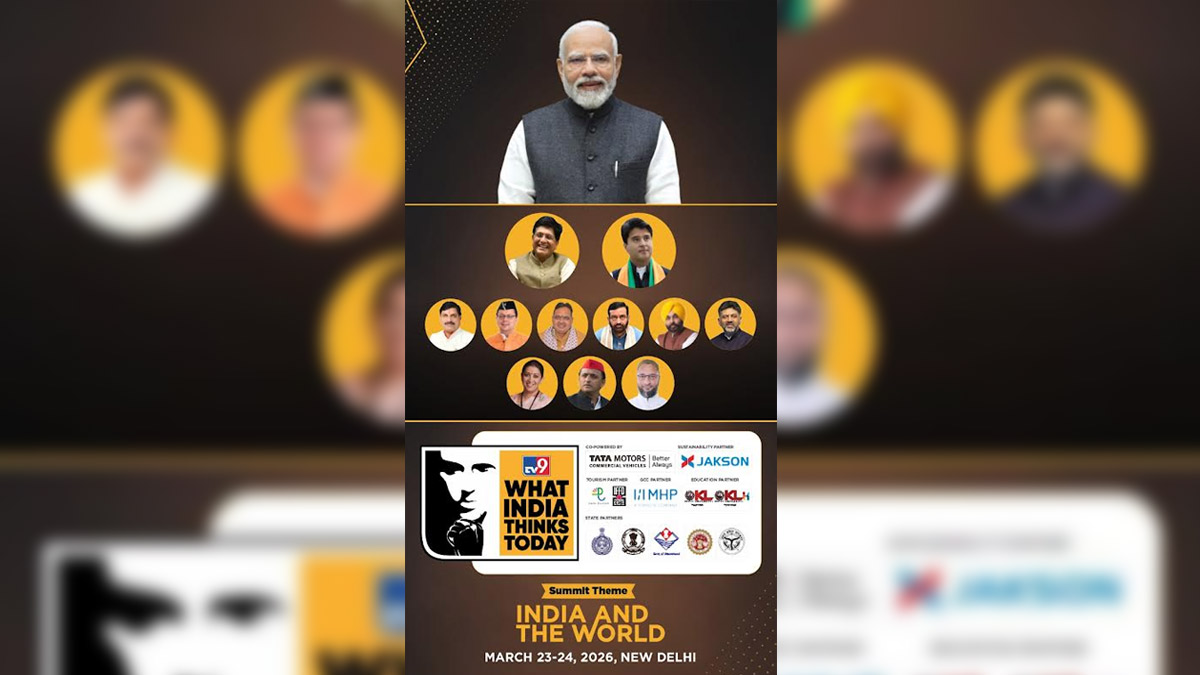
MUMBAI: The WITT Summit just wrapped up with enough big ideas to fill a policy playbook because when India’s leaders, thinkers and icons gather under one roof, even the conversations hit sixes. The eighth edition of TV9 Network’s flagship What India Thinks Today (WITT) Summit 2026 concluded on Saturday after two days of dynamic discussions at its New Delhi venue. India’s largest multi-domain public policy and culture summit brought together political leaders, policymakers, sports icons, artists and technology innovators to examine the forces shaping contemporary India and its global standing.
Prime minister Narendra Modi delivered the keynote address on the theme “India and the World” for the third consecutive year. In a wide-ranging speech, he addressed the ongoing conflict in West Asia, calling for restraint and compassion while highlighting India’s continued development trajectory despite global turmoil.
The summit featured candid conversations with state leaders. Telangana Chief Minister A. Revanth Reddy articulated a people-first governance model and contrasted it with other development approaches. Madhya Pradesh Chief Minister Mohan Yadav declared that Left-wing extremism had been effectively eliminated in his state and highlighted preparations for the upcoming Kumbh Mela. Punjab Chief Minister Bhagwant Mann defended his government’s record, citing the closure of 19 toll plazas and creation of the Sadak Suraksha Force. Karnataka Deputy Chief Minister D.K. Shivakumar expressed confidence in Congress prospects in Assam and addressed recent allegations against him.
On geopolitics and national security, Union Minister Jyotiraditya Scindia outlined India’s ambition to become a builder of trusted digital infrastructure for the world, citing the rapid 5G rollout and village-level 4G connectivity.
Cricket received significant attention. Former India captain Sourav Ganguly praised player freedom and trust as hallmarks of great leadership and named MS Dhoni as the greatest captain due to his World Cup successes. India women’s team bowling coach Aavishkar Salvi credited the BCCI and Women’s Premier League for building a pipeline of world-class talent behind the team’s recent ODI World Cup triumph.
The summit also hosted the inaugural AI² Awards 2026, celebrating the convergence of human creativity and machine intelligence in storytelling and content creation. Poet and kathavachak Kumar Vishwas delivered a nuanced take on India’s concept of Dharma and criticised the recent arrest of an 80-year-old Shankaracharya. Veteran lyricist Sameer Anjaan and storyteller Neelesh Misra reflected on changing music trends and artistic responsibility in the wake of a recent controversy involving Nora Fatehi.
In a country where conversations often run as deep as the Ganges, the WITT Summit proved once again that when leaders, thinkers and storytellers come together, the real winner is public discourse lively, layered and refreshingly unafraid to tackle the big questions shaping India’s tomorrow.








