News Broadcasting
BBC World targets profits by decade-end

NEW DELHI: BBC World, the commercial arm of the British Broadcasting Service, is evolving with the times. It’s not only in the process of unleashing a new branding strategy, but also preparing to deliver content on newer platforms, including live broadcasts in flights, to tap additional revenue options.
Simultaneously, BBC World is putting in place a game plan aimed at turning profitable “by the end of the decade,” which has been described by company executives as a “pay back strategy.”
“The branding strategy is part of our plans to do some soul searching and make ourselves more relevant to the (news) audiences round the world, which are definitely getting younger,” BBC World COO Anne Barnard told indiantelevision.com.

Dubbed the biggest brand campaign in the channel’s 10-year history, putting news first, goes live in India, almost simultaneously as in other parts of the globe, in April with extensive promotions across print, television, online and on-ground platforms and interactive contests targeting the channel’s core audience.
The brand promotion spearheads a new look and feel for the channel, with a new studio set, on-screen graphics and technical improvements.
The idea behind the campaign is to connect with the new age viewer without loosing out on the traditional audiences of BBC World, which, according to a survey, was not associated with adjectives like slick and sexy.
Focus groups were held across various countries – including India – to learn more about international news viewers and their perceptions of the BBC World brand. The results highlighted core strengths that viewers valued: the quality of journalism, great depth of coverage, a wide geographical spread and a variety of topical programming.
There was a remarkable consistency in the focus group responses around the world when participants were asked what they valued most about BBC World. The response from India, in particular, was very positive. One particular quote from the focus groups reflects the unique selling point: ‘CNN is reporting, BBC World is journalism.’
Pointing out that the new branding exercise would not mean compromising on content — something that has been a highpoint of the BBC World — Barnard said, “It’s all about being more light and being more interactive
(with the viewer).”
As an example, she says, scripts are being written in a more chatty fashion,weaving in liberal references to the programme following the on-air fare with an aim to lighten up the whole feeling of presentation. “It’s an
accepted norm these days (with news channels). But we’ll have to see how people respond,” Barnard points out.
The creative treatment of the new branding exercise, which illustrates stories behind some of the most extraordinary assignments undertaken by BBC correspondents and cameramen, demonstrates the exceptional commitment of the teams that contribute to BBC World’s output.
The campaign features the real-life experiences of award-winning journalists such as the BBC’s veteran World Affairs Editor, John Simpson; its South Africa Correspondent, Hilary Andersson; and cameraman Fred Scott. It uses objects to illustrate the lengths to which the newsgathering team behind BBC World will go to deliver the news.
For example, one print advertisement features a mobile phone belonging to cameraman Vaughan Smith, which saved him when a sniper’s bullet in Serbia passed through the contents of his pocket and lodged in the handset’s
casing. The campaign creative was developed in London by Abbott Mead Vickers BBDO, and was based on the results of an extensive research study commissioned by the channel.
KEEPING IN TUNE WITH TIME
Asked about other initiatives BBC World is undertaking, Barnard said that the channel is exploring various ways to “reach out to the audiences” and this includes delivering content on various platforms that are more technology driven.
Mobile phones and similar hand-held devises are one outlet for BBC World to deliver news. “There re some rights issue involved, but in some parts of Europe we do have agreements with telecom companies,” Barnard explained.
According to the BBC World COO, who has been holding this post since 2003, the company is also negotiating with various airlines to have live broadcasts during flights, straight from the satellite. Though Barnard, a trained chartered accountant, did admit that the airlines business is not entirely new to the channel, giving live broadcasts adds a new dimension, which is expected to be put in place with the first “commercial agreement” with an airline later this year.
Learning from past experience and viewers’ taste, BBC World has also invested in technology that would help it go in for increased regionalization and airing of big ticket programming at “more convenient time” for each of the regional market.
Quizzed on the vital statistics of the company, both Barnard and her colleague, Jane Gorard, director of marketing and communication, took refuge behind such revelations being against company policy.
However, Gorard relented a bit to add that the investments being made in the branding strategy and similar such other initiatives —- “in millions of pounds” —are being done with an eye on “return on investments.”
On cue, Barnard added that there was definitely a business plan in place, which targets to turn BBC World profitable “by the end of the decade.” Was pruning jobs — some 1,500 announced recently by BBC —- a way to shore up the bottomline? Barnard dismisses such cuts as part of “investing for the future,” pointing out that most of the job cuts were in the domestic service of the BBC.
THE HIGH VOLTAGE INDIAN LAUNCH OF CAMPAIGN
From 4 April, for eight weeks a print campaign will feature in many of India’s leading publications, including Outlook, India Today, Business Today, The Week, and Brand Equity.
There are five press advertisements in total, which feature John Simpson, World Affairs Editor in Iraq; Fred Scott, cameraman, at the G8 Summit in Genoa; Emily Buchanan, World Affairs Correspondent, in Zimbabwe; Stephen Evans, North America Business Correspondent, at the World Trade Centre in New York and Vaughan Smith, cameraman, in Serbia.
On screen, the campaign focuses on the experiences of John Simpson, Emily Buchanan and the BBC’s South Africa Correspondent, Hilary Andersson. The commercials will also shortly appear on National Geographic Channel.
In addition, a month-long promotion will run in premium cinema halls across India’s top six metros. Interactive contests across online, print and on-ground platforms will offer participants a chance to experience the new
campaign and win a trip for two to the BBC World studios in London plus other exciting prizes, such as handy-cams and mobile phones.
Talking about the India launch of the campaign, Gorard, said: “As India is such an important market for us, we have adopted an extensive integrated approach to launch the new brand campaign here. Also, this is the only
market where we are using an interactive campaign across different platforms to communicate with our core audience.”
As part of the on-ground promotions for the campaign, real-time contests at prominent bookstores across Delhi, Mumbai, Bangalore, Kolkata, Hyderabad, Pune and Chennai will give people a chance to view the Putting News First commercials and enter the contest on the spot.
The trade marketing campaign will target media planners and advertisers through direct mailers, advertisements in trade publications, plus banners and branding associations on various websites.





News Broadcasting
Network18 channels lead YouTube news viewership in March 2026
CNN-News18, News18 India and CNBC channels top categories with record views
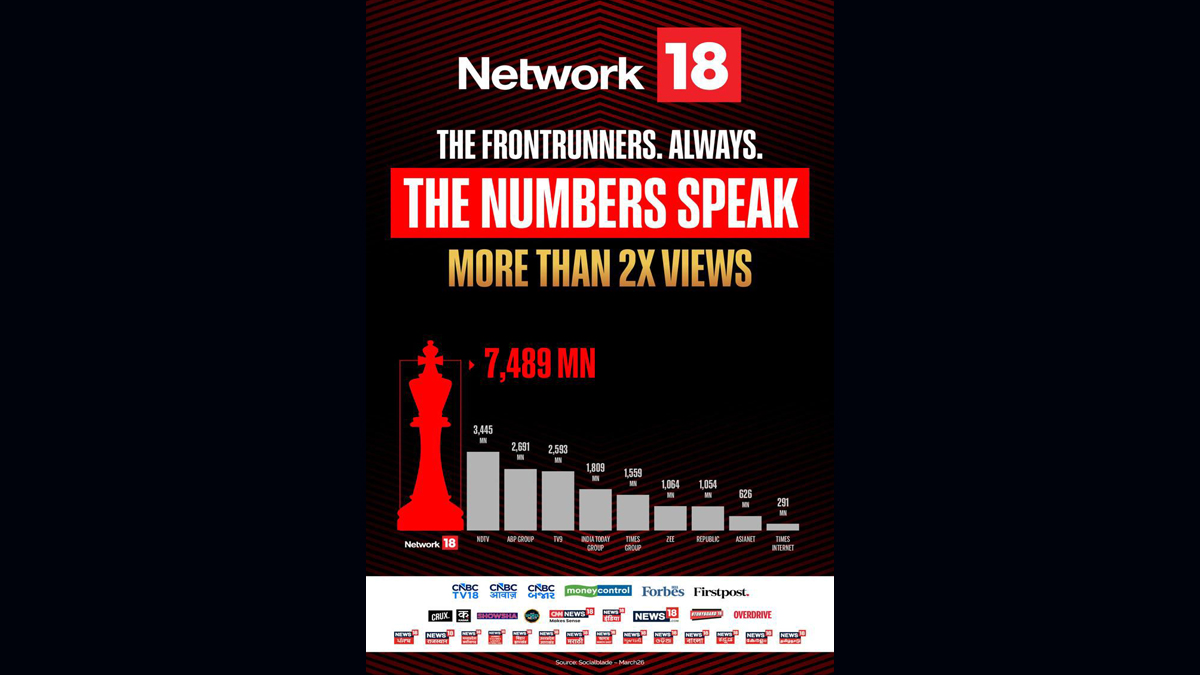
MUMBAI: When the world hit refresh on breaking news, Network18’s channels were already streaming ahead. As geopolitical tensions and war-driven headlines fuelled a surge in global news consumption, the network’s digital playbook delivered big clocking record Youtube viewership across English, Hindi and business news categories in March 2026.
At the forefront was CNN-News18, which emerged as the clear leader in the English news segment with 130 million live and video-on-demand views. The channel edged past competitors such as Times of India (126.5 million), Times Now (101.1 million), India Today (88.2 million) and NDTV (77.5 million), according to Databeings data for March.
In the Hindi news arena, News18 India delivered a commanding performance, racking up a staggering 3,297 million views on YouTube. The channel comfortably outpaced NDTV India, which recorded 3,119 million views, underlining its deep reach and consistent engagement with mass audiences, as per Playboard data.
The network’s dominance wasn’t confined to general news. In the Hindi business segment, CNBC Awaaz topped the charts with 92 million views, narrowly ahead of Zee Business (90 million) and well ahead of ET Now Swadesh (57 million). Meanwhile, its English counterpart CNBC-TV18 posted a strong 58 million views, reinforcing the network’s cross-category strength.
The spike in viewership reflects a broader shift in audience behaviour, with viewers increasingly turning to digital platforms particularly Youtube for real-time updates and in-depth coverage during high-intensity news cycles. For Network18, the numbers signal more than just scale; they underline the effectiveness of a multi-platform strategy that blends speed, credibility and continuous coverage.
In a month where the news never paused, it seems viewers chose to stay tuned where the stream never stopped.






