News Broadcasting
BBC World & Newsweek tie up returns with World Challenge 2006


MUMBAI: Following the success of The World Challenge competition in 2005, BBC World and Newsweek are joining with Shell to search for, highlight and reward individuals or groups that have used enterprise and innovation to the benefit of local communities.
A panel of expert judges will shortlist the 12 entries that show the best examples of community-based business, development or environmental projects. BBC World will then produce six 30-minute programmes on each nominee, examining how the initiative began, its inspiration and why it is socially and environmentally successful.
BCC World will telecast six programmes, featuring two finalists per programme to its global audience in October and November 2006, and the channel’s viewers will be invited to vote online for the most commendable and inspirational project.

Newsweek will mirror the programmes’ content in a six-part series of advertorials on the 12 nominees, aimed at driving its readers to the online voting site. The campaign will reach 1.5 million weekly readers across Europe, Asia and Latin America.
Once voting has closed, the winner of World Challenge 2006 will be announced at an awards ceremony in The Hague in December 2006. The winner will again receive a US$20,000 grant from Shell to invest in their project, plus the two runners-up will each receive US$10,000.
BBC World director airtime sales Jonathan Howlett says: “We’re confident that BBC World’s enterprising and entrepreneurial viewers will again be interested in following the global developments of this highly successful competition. World Challenge 2006 offers another opportunity for us to promote outstanding global initiatives in the field of sustainable development.”
Newsweek worldwide publisher Gregory J Osberg adds: “The World Challenge was an incredibly enlightening experience for all those involved last year, whether as nominees, voters or judges, and Newsweek is delighted to continue its association with the competition, Shell and BBC World in 2006.”
There are various stages to World Challenge 2006:
Nomination Stage
You can nominate your project from 6 March until 4 June 2006. Entries must be received by 5 pm (GMT) 04 June 2006. BBC World and Newsweek will be profiling the 12 finalists from the World Challenge competition held in 2005 which highlight the sort of projects that could be nominated.
Judging Stage
Once the judging panel has made its decision the 12 finalists will be announced on this website in July 2006. Between the months of July and September BBC World will film and produce profiles for each of the 12 finalists.
Voting Stage
From 7 October to 12 November the finalists will be profiled on this website, shown in 6 dedicated World Challenge 30 minute programmes on BBC World and in a special advertising series in Newsweek. You can vote during this period for your favourite project. Voting will close at 5pm (GMT) on 19 November 2006.
Winner Announcement
The winning project will be announced at the awards event to be held at The Hague, The Netherlands in December 2006. The awards ceremony will be broadcast on BBC World on 16 December 2006 and will appear in Newsweek the same week. The winning project will be announced on the ww.theworldchallenge.co.uk shortly after the awards ceremony takes place.




News Broadcasting
Network18 channels lead YouTube news viewership in March 2026
CNN-News18, News18 India and CNBC channels top categories with record views
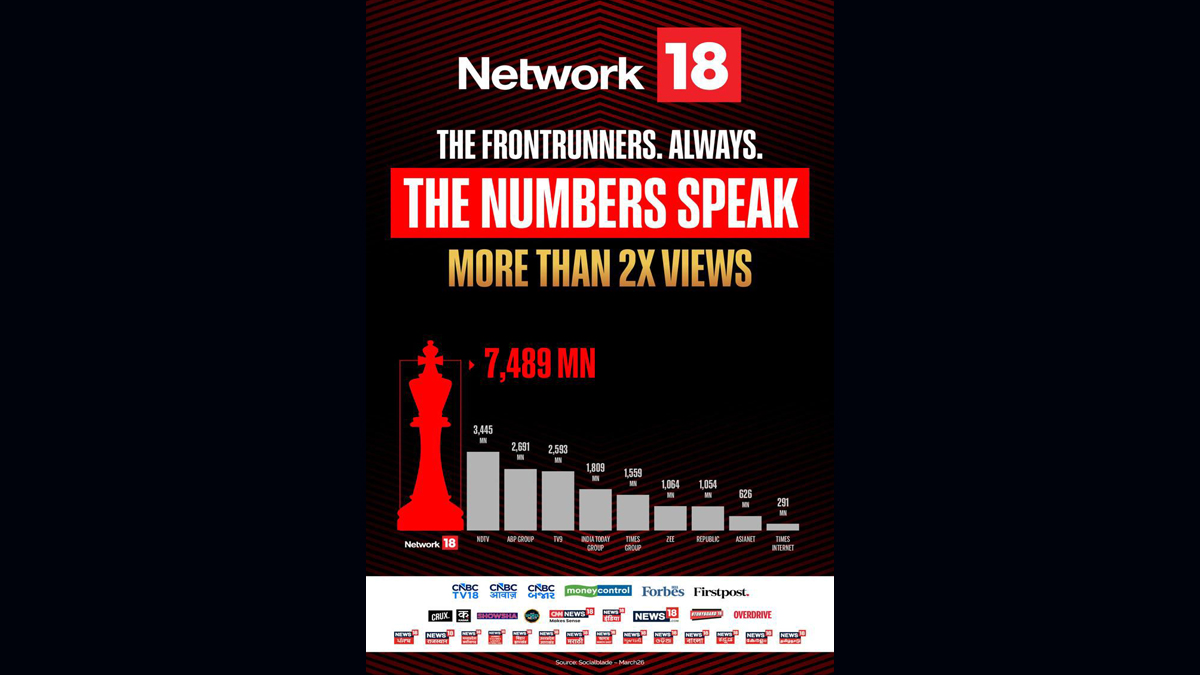
MUMBAI: When the world hit refresh on breaking news, Network18’s channels were already streaming ahead. As geopolitical tensions and war-driven headlines fuelled a surge in global news consumption, the network’s digital playbook delivered big clocking record Youtube viewership across English, Hindi and business news categories in March 2026.
At the forefront was CNN-News18, which emerged as the clear leader in the English news segment with 130 million live and video-on-demand views. The channel edged past competitors such as Times of India (126.5 million), Times Now (101.1 million), India Today (88.2 million) and NDTV (77.5 million), according to Databeings data for March.
In the Hindi news arena, News18 India delivered a commanding performance, racking up a staggering 3,297 million views on YouTube. The channel comfortably outpaced NDTV India, which recorded 3,119 million views, underlining its deep reach and consistent engagement with mass audiences, as per Playboard data.
The network’s dominance wasn’t confined to general news. In the Hindi business segment, CNBC Awaaz topped the charts with 92 million views, narrowly ahead of Zee Business (90 million) and well ahead of ET Now Swadesh (57 million). Meanwhile, its English counterpart CNBC-TV18 posted a strong 58 million views, reinforcing the network’s cross-category strength.
The spike in viewership reflects a broader shift in audience behaviour, with viewers increasingly turning to digital platforms particularly Youtube for real-time updates and in-depth coverage during high-intensity news cycles. For Network18, the numbers signal more than just scale; they underline the effectiveness of a multi-platform strategy that blends speed, credibility and continuous coverage.
In a month where the news never paused, it seems viewers chose to stay tuned where the stream never stopped.






