News Broadcasting
Awaaz gets into over-drive mode, lines up five shows


MUMBAI: Consumer business news channel Awaaz, CNBC TV18’s new sibling, is going into over-drive with some new programming initiatives. The channel has lined up a total of five shows that will be unleashed in the course of this month.
Keeping in line with the basic positioning of the channel, the shows to be launched will help viewers make better decisions on investing, saving and spending wisely. Apart from that, with shows touching on genres like health and fitness and the entertainment industry; the newly launched channel also hopes to widen its viewership base, apart from being more interactive.
To begin with, the channel has lined up Glamour Bazaar (3 April at 12.30 pm) a weekly show that offers updates on the entertainment business. Segments in the show include Filmi Karobar (the business of film making in India), Filmi Chaat (Bollywood snippets) and Ek Mulaqat (a one – to – one with a Bollywood bigwig).

The second week will see the launch of two shows, Parda Faash and Tax Guru. A weekly show, Parda Faash (Saturdays 10.30 am) will track economic/corporate crime and violation of consumer rights. The show will have hard-hitting stories that will be followed by a discussion aimed at helping consumers / investors to fight back. The other show Tax Guru will have tax expert Subhas Lakhotia answering call-in queries by viewers.
Towards the end of the month, the channel will have Jiyo Zindagi, a weekly health and lifestyle show with inputs from leading experts in the medical profession and Chalti Ka Nam Gadi, a weekly guide to the world of automobiles, from buying guides to availability of after sales services available in the two, three and four wheeler industry.
Explaining the thought behind the shows, Awaaz marketing head Ajay Chacko says, “We hope to reach out to newer audiences with these shows. The aim is also to capture the women TG as well as the younger non-metro audiences with shows like Jiyo Zindagi. Then, shows like Glamour Bazaar give an inside view of the working of the entertainment industry which is definitely a value add for consumers.”
As of now, the three-month old channel broadly focuses on programs related to personal finance and markets, guidance on careers, education and consumer based programming which will help them make more intelligent choices.
Shedding further light on the channel’s programming, Awaaz editor Sanjay Pugalia says, “The aim is to address the needs of the consumer. Apart from this, the overall treatment of the shows is very interactive.”






News Broadcasting
UDF poised to return to power in Kerala, says Manorama-CVoter survey
Massive opinion poll projects shift in Kerala politics ahead of 2026 Assembly elections.
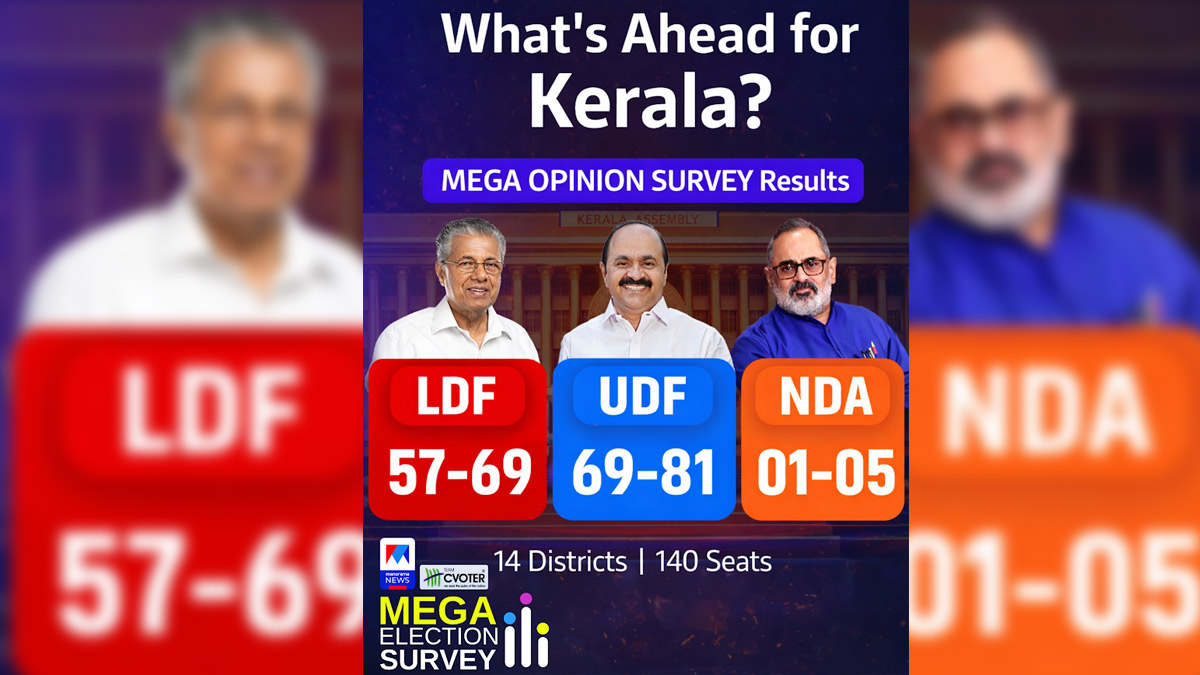
MUMBAI: The winds of change appear to be blowing through Kerala’s political landscape and this time, they seem to favour the United Democratic Front. A comprehensive mega opinion survey conducted by Manorama News in partnership with CVoter projects a potential comeback for the UDF in the upcoming Kerala Legislative Assembly Elections 2026. The survey, covering all 140 constituencies with a massive sample size of nearly 90,000 respondents, predicts the UDF could win between 69 and 81 seats.
The ruling Left Democratic Front (LDF) is expected to secure 57 to 69 seats, a significant drop from the 99 seats it won in the 2021 elections. This would mean the LDF losing 30 to 42 of its sitting seats. Meanwhile, the National Democratic Alliance (NDA), which drew a blank in 2021, is projected to open its account with 1 to 5 seats.
Region-wise, the UDF is expected to make strong gains in Malabar, winning 25 to 34 out of 48 seats, and in Central Kerala, where it could bag 29 to 33 out of 53 seats. In South Kerala, the LDF is likely to retain an edge with 21 to 25 seats, while the UDF may improve to 12 to 16 seats. The NDA could pick up 1 to 3 seats in the southern region.
The survey was conducted between 14 and 26 March 2026, with additional tracker and snap polls carried out from December 2025 to March 2026. A total of 89,693 respondents participated, ensuring representation across all demographics and social segments.
Manorama News has a strong track record of accuracy, with its previous projections closely matching the actual results of the 2019 and 2024 Lok Sabha elections as well as the 2021 Kerala Assembly polls.
In Kerala’s famously fierce political battles, this survey suggests the pendulum may be swinging back. Whether the final verdict matches these numbers or throws up another surprise, one thing is clear, the 2026 Assembly elections are shaping up to be one of the most keenly watched contests in the state’s history.






