I&B Ministry
AVGC task force proposes national AVGC-XR mission with budgetary outlay

Mumbai: The Animation, Visual Effects, Gaming, and Comic (AVGC) task force released a report on creation of a national AVGC-XR mission with a budget outlay for the integrated promotion and growth of the sector. The task force also recommended a “Create in India” campaign with exclusive focus on content ‘In India, For India & For World.’
The task force, which was established under the ministry of information and broadcasting and includes representatives from academia and business, was first mentioned in the union budget earlier this year. Its goal was to identify interventions to increase domestic capacity in the sector in order to meet both domestic and global demand.
Four sub-task forces were constituted for devising growth strategies through targeted interventions in education, industry & policy, skilling, and gaming. The task force is an attempt to realise the prime minister’s vision that the AVCG-XR sector can provide enormous employment opportunities to youth who can serve the global market and that Indian talent can lead the way in this sector.

The information and broadcasting minister Anurag Singh Thakur has determined that the AVGC sector has the potential to be a significant growth driver for the media and entertainment industries in India. He also stressed that, in addition to the high economic impact of this sector’s expansion, it also has the potential to better disseminate and promote Indian culture around the world, strengthen ties between the Indian diaspora and India, create direct and indirect high-quality employment opportunities, and benefit the tourism industry and other allied industries.
The main recommendations of the task force categorised broadly under four categories are:
Domestic industry development for global access
A national AVGC-XR mission with a budget outlay needs to be created for integrated promotion and growth of the AVGC sector. The “Create in India” campaign will be launched with an exclusive focus on content creation “In India, For India and The world.”
With a goal to make India the global hub for AVGC, an international AVGC platform needs to be formed along with a gaming expo with a focus on FDI, co-production treaties, and innovation.
A national centre of excellence (COE) for the AVGC sector has to be established to become an international reference point across skilling, education, industry development and research & innovation for the AVGC sector. Regional COEs could be instituted in collaboration with the state governments to provide access to local industries and to promote local talent and content.
Developing talent ecosystem to realise demographic dividends
Need to leverage NEP to develop creative thinking with dedicated AVGC course content at school levels, to build foundational skills, and to create awareness about AVGC as a career choice.
AVGC-focused UG and PG courses with a standard curriculum and globally recognised degrees need to be launched. There shall be standardised admission tests for AVGC-related courses (viz., MECAT by MESC). With an eye on the demand for 20 lakh skilled professionals in the AVGC sector in this decade, augmenting skilling initiatives will be taken for the AVGC sector under MESC.
The government needs to enhance Industry participation to ensure employment opportunities and absorption for students from non-metro cities and NE states. Establish AVGC accelerators and innovation hubs in academic institutions, along the lines of Atal Tinkering Labs.
Enhancing technology & financial viability for Indian AVGC industry
Democratisation of AVGC technologies is necessary by promoting subscription-based pricing models for MSME, start-ups and institutions. Made in India for AVGC technologies has to be created through incentive schemes for R&D and IP creation. Evaluate PLI scheme to incentivise AVGC hardware manufacturers.
There is a need for enhanced ease of doing business in the AVGC sector i.e tax benefits, import duties, curbing piracy, etc. Leverage start-up India to provide technical, financial and market access assistance to AVGC entrepreneurs to promote culture of R&D and local IP creation.
Raising India’s soft power through an inclusive growth
Establishment of a dedicated production fund for domestic content creation from across India to promote Indian culture & heritage globally. Evaluate the reservation for high-quality indigenous content by broadcasters.
For an Inclusive India, target skilling and industry outreach for youth in tier two & three towns and villages in India. Establishment of special incentives for women entrepreneurs in the AVGC sector.
Promotion of local children’s channels could benefit in raising awareness of the rich culture and history of India among children and youth. Frameworks to ensure child rights protection in the digital world need to be established.

I&B Ministry
CBFC speeds up film certification; average approval time cut to 22 days
Over 71,900 films cleared in five years as digital system shortens approval timelines
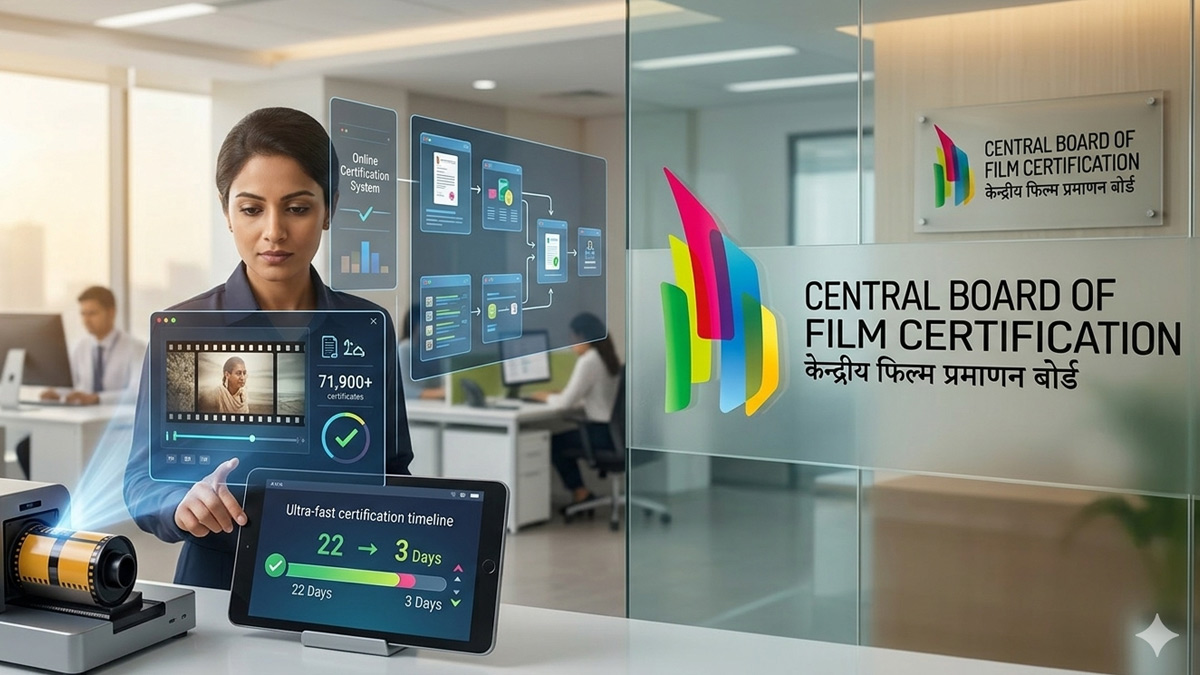
MUMBAI: The Central Board of Film Certification (CBFC) has significantly reduced the time taken to certify films, with the average approval timeline now down to 22 working days for feature films and just three days for short films.
Operating under the Ministry of Information and Broadcasting, the statutory body certifies films for public exhibition in line with the Cinematograph Act, 1952 and the Cinematograph (Certification) Rules, 2024. The rules prescribe a maximum certification period of 48 working days, though the adoption of the Online Certification System has sharply accelerated the process.
Over the past five years, from 2020-21 to 2024-25, the board certified a total of 71,963 films across formats. Of these, the majority fell under the U category with 41,817 titles, followed by UA with 28,268 films and A with 1,878 films. No films were certified under the S category during the period.
Film approvals have also steadily risen in recent years. The CBFC cleared 8,299 films in 2020-21, a figure that peaked at 18,070 in 2022-23 before settling at 15,444 films in 2024-25. During the same period, 11,064 films were certified with cuts or modifications.
Despite the high volume of certifications, outright refusals remain rare. Only three films were denied certification over the last five years, with one refusal recorded in 2022-23 and two in 2024-25.
The board may recommend cuts or modifications if a film violates statutory parameters relating to the sovereignty and integrity of India, security of the state, friendly relations with foreign states, public order, decency or morality, defamation, contempt of court or incitement to an offence.
Filmmakers can challenge CBFC decisions in court. Data shows that such disputes remain limited but have seen some fluctuation. Between 2021 and 2025, a total of 21 certification decisions were challenged before High Courts, with the number rising to 10 cases in 2025.
Responding to a question in the Rajya Sabha, minister of state for information and broadcasting L. Murugan shared the data. The question was raised by Mallikarjun Kharge.
With faster timelines and a largely digital workflow, the certification process appears to be moving at a far brisker pace, signalling a shift towards quicker clearances for India’s growing film output.