I&B Ministry
Automatic renewal of TV channels subject to fee and ten-year validity

NEW DELHI: The Government, which had said that payment of annual permission fee sixty days before the due date will by itself be sufficient permission for continuation of a channel for a further period of one year, has clarified that all the TV channels and Teleports are likely to benefit from this decision provided the validity of 10-year permission is available.
Minister of State for Information and Broadcasting Rajyavardhan Rathore said that broadcasters which hold valid permission for uplinking and/or downlinking will not be required to obtain annual Renewal Permission from the Ministry in conformity with the policy guidelines for uplinking and downlinking of TV channels.
He told Parliament that the Ministry had taken initiatives to promote the ease of doing business in view of commitment to the vision of the Government and Prime Minister:

The Government had also done away with the restrictions imposed under clauses 2.1.4 and 3.1.15 of the Uplinking Guidelines dated 5 December 2011 and clause 1.10 of the Downlinking Guidelines dated 5 December 2011 regarding appointment at top management position with minimum 3 years of prior experience in a media company (media companies) operating News/Non-News and Current Affairs TV Channels. .
It has also been decided that in view of the exemption mentioned in Master Circular of RBI dated 1 July 2014, regarding the Exchange Earner’s Foreign Currency (EEFC) account holders, the broadcasters and Teleport Operators who have EEFC account, may now make payment in foreign exchange towards availing transponder services on foreign satellite for uplinking of TV channels/Teleports/DSNG Vans, to the Satellite service providers without approval of the Ministry.

I&B Ministry
Doordarshan, ICCR sign MoU to boost global reach of Indian culture
Pact taps TV, radio and digital platforms to take cultural content worldwide
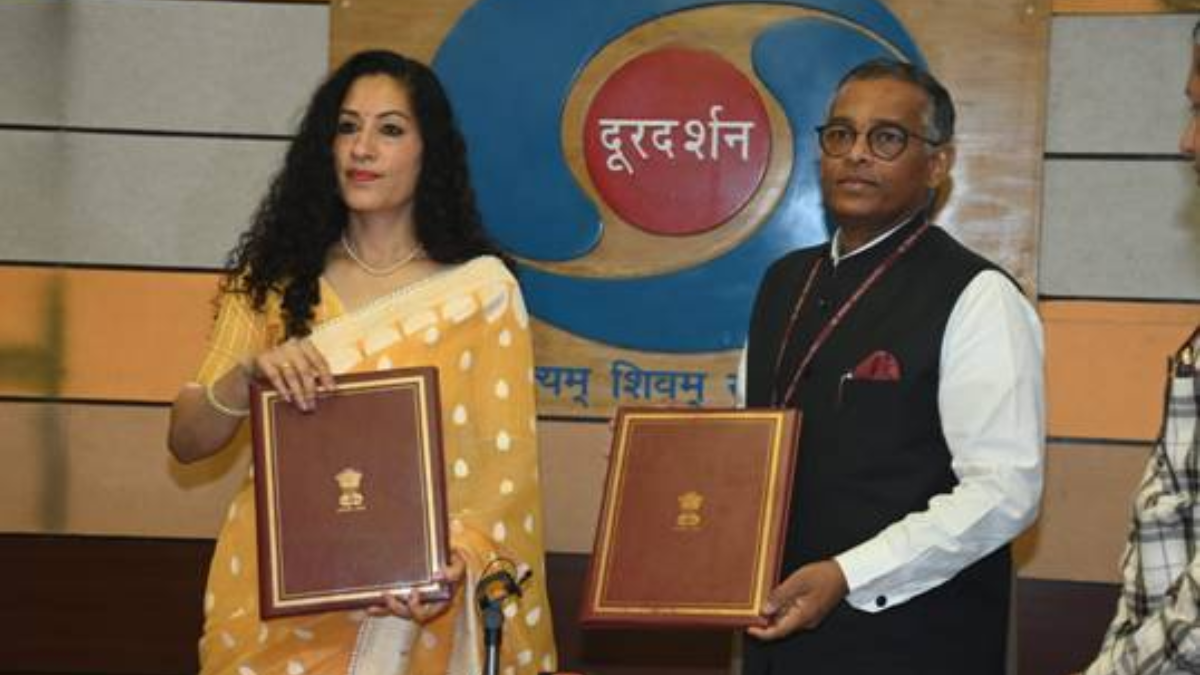
NEW DELHI: In a move aimed at taking India’s cultural story further across borders, Doordarshan under Prasar Bharati has signed a memorandum of understanding with the Indian Council for Cultural Relations to expand the global reach of Indian cultural content.
The agreement, signed on April 7 at Doordarshan Bhawan, brings together the content strength of ICCR and the wide broadcast network of Doordarshan, spanning television, radio and digital platforms.
Under the partnership, ICCR will provide a steady stream of cultural programming, including performances and events organised by Indian missions abroad such as embassies, consulates and cultural centres. Doordarshan will handle production, coverage and distribution, ensuring that these programmes find audiences not just in India but across the world.
The collaboration also opens the door for recorded cultural content from overseas missions to be aired across multiple platforms, including OTT and social media, making Indian art, music and heritage more accessible to global viewers.
A notable feature of the MoU is joint ownership of content rights in perpetuity, including digital rights. This allows both organisations to archive and reuse material over time, building a long-term cultural repository while maximising reach. Doordarshan will also support pre-event promotion and cross-platform visibility to drive engagement.
Speaking at the signing, Doordarshan director general K. Satish Nambudiripad and Indian Council for Cultural Relations director general K. Nandini Singla highlighted the potential of the partnership to strengthen India’s cultural diplomacy through modern media channels.
The agreement, initially valid for three years, also allows Doordarshan to explore monetisation opportunities from the content generated, adding a commercial layer to cultural broadcasting.
As India looks to blend tradition with technology, this partnership signals a clear intent to make its cultural voice not just heard, but seen and streamed across the globe.






