News Broadcasting
Audiences realise that they need to pay for quality news: Alistair McEwan


NEW DELHI: 2020 has been an interesting year for news organisations, their journey marked by various peaks and troughs. It was no different for the global news outlet BBC, too. From gaining the highest spike in audience numbers on both TV and digital format to struggling with lower ad revenues, the firm managed to clock in a rather productive year. In a recent chat with Indiantelevision.com founder, CEO, and editor-in-chief Anil Wanvari, at the recently concluded Pubnation (print & digital), BBC Global News SVP – commercial development for Asia & ANZ Alistair McEwan talked in details about the same. Edited excerpts follow:
On how BBC tackled the Covid2019 lockdown
Our experience was, probably, not dissimilar to many publishers around the world, where we have been on a roller coaster. I think there is a sweet irony in the fact that we’ve never seen bigger audiences coming to our platforms, whether that’s television or digital. And that has pretty much sustained through the year. We saw about a 180 million unique visitors coming to BBC.com in March and we have just beaten the figure in November with the US elections.

But whilst the audience flocked to BBC in millions, advertisers who were deeply impacted by the lockdown remained cautious. So, in ordinary times, you would hope to be able to monetise that effectively but of course, at the moment, that has not been the case.
On how they managed to deliver to the audiences
We have seen massive audio and digital growth this year. For us, TV production remained a challenge with lockdown norms and
health hazards. Albeit, one good thing that this crisis promoted was the agility and the ability of the people to pivot into new processes. And that’s what we have exactly done at BBC. It has driven high levels of productivity.
For example, on the news side, we’ve been creating a lot of Covid-related content. And it is not just reporting but also solutions-oriented stories and non-news reporting. That’s where we have seen, probably, the biggest growth levels coming across all the verticals. So, from a consumer consumption perspective, we have grown immensely.
On Indian audiences
Indian audiences have stayed very true and loyal to us, certainly through the early stages of Covid. We saw significant growth on both television and BBC.com. We saw a 5X growth in our audience. We have 18 to 20 million unique audiences on our digital side and through our television channels. We have over 300 journalists across the BBC World Service Group, including our Delhi bureau. We prioritise our investment into India as a market – we now publish in eight different languages in India in addition to our English language output.
On virality and its rules
My personal line on virality is that it's almost completely unpredictable anywhere in the world. There are so many different levellers that are variables to it but there are certain sort of formats that you can use to try to encourage it; for example, ensuring the format fits the devices, the context is right, and you are having a singular message across the products. With respect to BBC, we are globally producing world-class output that becomes highly emotive and highly shared.
It is much more difficult to achieve that kind of virality effect with branded content, which is why we always sort of try to pin our branded content style right back to what we do in the editorial.
On offerings to the advertisers
For advertisers, we bundle and package our offerings across TV, radio and digital media. All of these have a fundamentally important part in the way you bring a holistic solution to an advertiser. And, of course, audiences exist independently in all of those different areas. So for us on the commercial side, it's really all about where the target audience is, discovering those audience insights and then being able to deliver to those custom targets across group assets and really utilising all of the data insights.
The media industry, so far, has not been able to drive empirical measurement of the content it produces; how the audience feels about it and how it impacts society. We are using a variety of neuroscience technology, eye-tracking, and facial decoding to be able to track emotional engagement. That's actually allowed us to measure all the different suites of platforms that we have there.
On taking news industry behind the paywall
The industry has reached a tipping point and it has been a while back that we have consumer acceptance towards paying for quality news content. Take the New York Times, for instance. They have been the benchmark international news organisation in this space. They started way back in 2008 and the initial commentary was that they would struggle to survive post this move. But today, they are earning 64 per cent of their revenues from paid subscriptions. So that boat has sailed. Audiences have been conditioned to understand and accept the need to pay for quality news. We have to fund it. You can be the Guardian and ask people to fund it out of goodwill and love for the brand or whether you are requiring people to pay through a paywall; you need to figure out a sustainable way to go ahead. In India, it will take some time to evolve.







News Broadcasting
Network18 channels lead YouTube news viewership in March 2026
CNN-News18, News18 India and CNBC channels top categories with record views
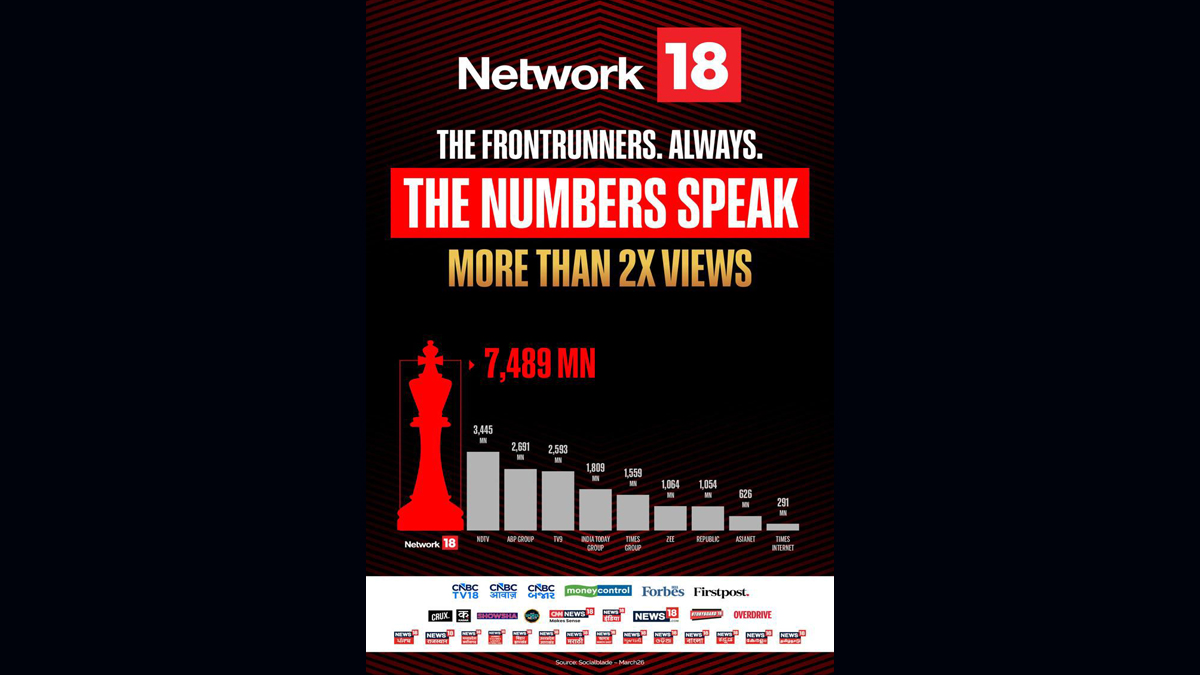
MUMBAI: When the world hit refresh on breaking news, Network18’s channels were already streaming ahead. As geopolitical tensions and war-driven headlines fuelled a surge in global news consumption, the network’s digital playbook delivered big clocking record Youtube viewership across English, Hindi and business news categories in March 2026.
At the forefront was CNN-News18, which emerged as the clear leader in the English news segment with 130 million live and video-on-demand views. The channel edged past competitors such as Times of India (126.5 million), Times Now (101.1 million), India Today (88.2 million) and NDTV (77.5 million), according to Databeings data for March.
In the Hindi news arena, News18 India delivered a commanding performance, racking up a staggering 3,297 million views on YouTube. The channel comfortably outpaced NDTV India, which recorded 3,119 million views, underlining its deep reach and consistent engagement with mass audiences, as per Playboard data.
The network’s dominance wasn’t confined to general news. In the Hindi business segment, CNBC Awaaz topped the charts with 92 million views, narrowly ahead of Zee Business (90 million) and well ahead of ET Now Swadesh (57 million). Meanwhile, its English counterpart CNBC-TV18 posted a strong 58 million views, reinforcing the network’s cross-category strength.
The spike in viewership reflects a broader shift in audience behaviour, with viewers increasingly turning to digital platforms particularly Youtube for real-time updates and in-depth coverage during high-intensity news cycles. For Network18, the numbers signal more than just scale; they underline the effectiveness of a multi-platform strategy that blends speed, credibility and continuous coverage.
In a month where the news never paused, it seems viewers chose to stay tuned where the stream never stopped.






