News Broadcasting
ATN bags exclusive Canadian rights for Indo-Pak cricket series


MUMBAI: South Asian broadcaster Asian Television Network (ATN) has won exclusive Canadian rights for the India Pakistan Cricket Series 2004, which gets off in right earnest Saturday.
ATN international limited announced it has bagged the exclusive Canadian rights to all forms of video and broadcast distribution live and delayed basis for the upcoming India – Pakistan cricket series. The rights also include television, wireless and all forms of alternative distribution, excluding the Internet, without limitation.
The cricket series consisting of five one day Internationals (ODIs) and three test matches for a total of 20 days, commences tomorrow on 12 March and goes on till 17 April 2004, says a company release.

“We hope this will be bigger than the last world cup and we are absolutely proud to bring this to cricket fans across Canada. We will make it available live on a pay per view basis to all Canadians through cable and Star Choice via Viewer’s Choice and through Bell Express VU Pay Per View. One hour highlights will be shown exclusively on the ATN channel, ” says ATN president and CEO Shan Chandrasekar.
Besides the Indo-Pak cricket series, ATN announced that it has an option to acquire the exclusive Canadian rights from ARYdigital to broadcast all Pakistani home matches vs India, England, Sri Lanka, Australia, Zimbabwe, West Indies and South Africa through 2008.
It was for the 1987 World Cup that ATN first beamed cricket in Canada and has since been a regular television distributor of the game in Canada.
ATN has programming alliances with leading South Asian broadcasters such as Zee TV, B4U, Sony Entertainment Television Asia, Alpha Punjabi and ARY Digital TV. It has won additional digital licenses from the Canadian Radio Television and Telecommunication Commission (CRTC) for broadcasting to Canada’s multicultural communities, adds the release.







News Broadcasting
News18 India launches Command Centre war explainer with Arya
New show shifts from debates to decoding global conflicts and impacts
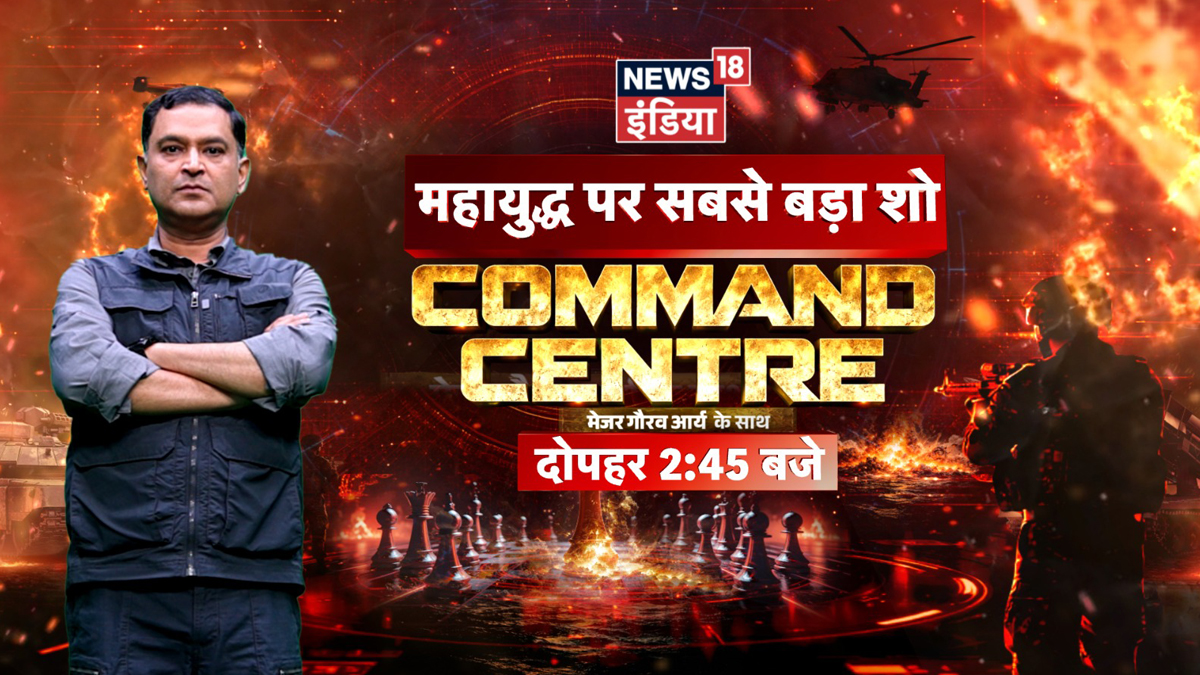
MUMBAI: News18 India has rolled out a new war-focused programme, Command Centre, featuring Gaurav Arya, as it looks to offer viewers a sharper, more grounded take on global conflicts amid rising tensions in West Asia.
Positioned as an “insider war room”, the show moves away from conventional panel debates and instead focuses on explaining military developments, decoding strategy and connecting global events to their everyday impact, from fuel prices to economic shifts.
The format leans heavily on visuals and data. The studio has been designed like a command hub, complete with large LED war maps, real-time graphics and an alert system to track developments as they unfold.
At the centre of it all is Arya, who brings his military background to simplify complex war strategies for viewers. His signature line, “Seedhi baat samjhiye”, anchors the show’s promise of clarity over noise.
News18 India managing editor Jyoti Kamal said, “Command Centre, featuring Major Gaurav Arya is designed to deliver accurate insights and a clear perspective on how evolving conflicts impact everyday life, from household budgets to national security. With expert voices analysing every development in real time, the show goes beyond headlines to decode what’s happening now, what it means, and what could come next.”
Echoing the intent, Gaurav Arya added, “In times of war, confusion is the biggest threat. With News18 India’s Command Centre, we are bringing viewers inside the war room, decoding strategies, tracking every escalation, and explaining, in the simplest terms, what it means for India and for every household. Seedhi baat samjhiye, this is where you understand not just what is happening, but what happens next.”
The weekday show will air in the afternoon slot and will also feature Gaurav Shukla, adding to its editorial depth.
With its mix of analysis, visuals and a clear focus on impact, the show reflects a broader shift in news consumption. Viewers are no longer just watching events unfold, they are looking to understand what those events mean for them.







