News Broadcasting
Asia puts on a good show at MIPTV 2002

MIPTV 2002 (International Television Program Market), which claims to be the spring’s leading international television programme market, saw the Asian region – particularly Japan and Korea – put up a strong showing. They were the 4th and 8th largest exhibiting nations. The event took place at Cannes from 15-19 April.
Asia was also a strategic region for international sales. CCTV picked up BBC Worldwide’s The Blue Planet and Walking with Beasts and renewed an agreement for RDF’s challenge series Scrapheap Challenge. Korean broadcaster Daekyo Network Broadcasting acquired exclusive rights to EMTV’s Junior branded programmes for three years and committed to buy a minimum of 468 half-hours from the Junior library.
China’s newcomer Tanglong International Media and HBO Korea acquired rights to E! Networks shows and blocks. Japan’s NHK, UBC Thailand and SBS Korea picked up Sesame Workshop and Pepper’s Ghost Productions CGI series Tiny Planets. Sony Japan took all rights to Hit Entertainment’s stop-motion animated series Pingu. MBC Korea and HBO Asia acquired rights to Alliance Atlantis series and films and Malaysia’s Astro TV picked up rights to World Wrestling Federation Entertainment specials.

Canada was represented by 114 exhibiting companies (80 last year), Japan brought 46 exhibiting companies (37 last year), and 33 companies came from South Korea (13 last year). The number of exhibiting companies from Asia Pacific grew by 17.4 per cent this year (135 companies). A third of MIPDOC’s top 30 buyers (those who viewed the largest amount of programs) came from Asia.
However, the overall figures showed a marginal decline from last year which an official release partly attributed to the dotcom crash. In all, 10,200 delegates representing 2,715 companies from 97 countries participated at the market. Last year 11,049 delegates from 2,827 companies and 90 countries attended. A total 1,209 exhibiting companies attended from 56 countries, while last year 1,228 companies from 55 countries took part in the market.
Documentaries were prevalent among the deals made at MIP TV as well as MIPDOC, where buyers made a record 9,037 viewings. After the events of 11 September top-budget factual programming is increasingly scheduled into prime-time slots. At MIPTV Channel 4 and ZDF announced a major partnership to create and distribute a high-end documentary The Private Life of Pompeii. Beyond and S4C teamed up to produce a $900,000 three-part series about the Stone Age. BBC Worldwide sold over 200 hours of documentaries to Finland, Israel, and Portugal.







News Broadcasting
Network18 channels lead YouTube news viewership in March 2026
CNN-News18, News18 India and CNBC channels top categories with record views
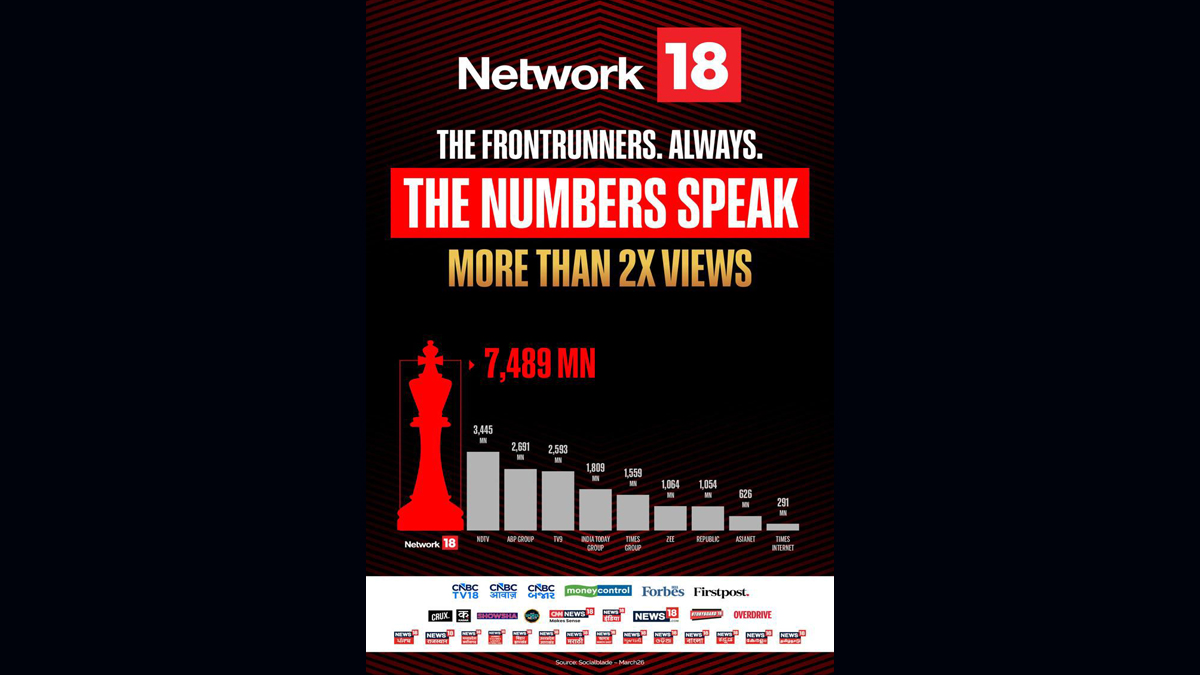
MUMBAI: When the world hit refresh on breaking news, Network18’s channels were already streaming ahead. As geopolitical tensions and war-driven headlines fuelled a surge in global news consumption, the network’s digital playbook delivered big clocking record Youtube viewership across English, Hindi and business news categories in March 2026.
At the forefront was CNN-News18, which emerged as the clear leader in the English news segment with 130 million live and video-on-demand views. The channel edged past competitors such as Times of India (126.5 million), Times Now (101.1 million), India Today (88.2 million) and NDTV (77.5 million), according to Databeings data for March.
In the Hindi news arena, News18 India delivered a commanding performance, racking up a staggering 3,297 million views on YouTube. The channel comfortably outpaced NDTV India, which recorded 3,119 million views, underlining its deep reach and consistent engagement with mass audiences, as per Playboard data.
The network’s dominance wasn’t confined to general news. In the Hindi business segment, CNBC Awaaz topped the charts with 92 million views, narrowly ahead of Zee Business (90 million) and well ahead of ET Now Swadesh (57 million). Meanwhile, its English counterpart CNBC-TV18 posted a strong 58 million views, reinforcing the network’s cross-category strength.
The spike in viewership reflects a broader shift in audience behaviour, with viewers increasingly turning to digital platforms particularly Youtube for real-time updates and in-depth coverage during high-intensity news cycles. For Network18, the numbers signal more than just scale; they underline the effectiveness of a multi-platform strategy that blends speed, credibility and continuous coverage.
In a month where the news never paused, it seems viewers chose to stay tuned where the stream never stopped.






