News Broadcasting
Anuj Singhal – Fuelling CNBC Awaaz’s Unrivalled Success


Mumbai: CNBC Awaaz is a prominent Indian business news channel that primarily broadcasts in the Hindi language. It is a subsidiary of CNBC, which is known for its comprehensive coverage of business, finance, and economic news.
CNBC Awaaz focuses on delivering business and financial news in a format that is accessible to Hindi-speaking audiences in India. The channel provides real-time updates on the stock market, business developments, economic trends, and investment insights. It features discussions, interviews with industry experts, and analysis of market conditions to help viewers make informed decisions regarding their finances and investments.
The channel also covers a wide range of topics, including entrepreneurship, personal finance, and consumer-related issues. CNBC Awaaz’s programming is designed to cater to both seasoned investors and individuals looking to enhance their financial literacy. CNBC Awaaz plays a vital role in keeping viewers informed about the ever-evolving world of business, finance, and economics.

Anuj Singhal, the managing editor of CNBC-Awaaz, reflected on the journey of being a pioneer in the Hindi business news segment 18 years ago and discussed the opportunities as well as challenges in the genre today.
In the early days, CNBC was one of the few serious players in the field, with English channels like NDTV Profit attempting to enter the market. The decision to launch CNBC-Awaaz, a Hindi business channel, was based on the belief that Hindi was a growing and potentially significant market. While English was the primary language for business, the management seemed to foresee the increasing domestic investment in the market. What started as a hopeful endeavour has now become a major trend.
In terms of expansion into regional languages, CNBC-Awaaz has already established a foothold in the Gujarati language. Singhal mentioned that business news in vernacular languages will likely evolve over time, and regions like Kerala could represent a significant market. However, the decision to launch a channel in a new language would be made at the network level, considering the market’s size and potential.
When asked about what sets CNBC-Awaaz apart as the biggest player in the market, he highlighted the network’s strong reach and leverage as part of India’s top news network. “CNBC-Awaaz benefits from the research and management interviews conducted by CNBC TV18. Moreover, CNBC-Awaaz’s consistent leadership in the field and its legacy have contributed to its continued success.”
Singhal also stated that CNBC-Awaaz has a Hindi-specific strategy and a top-tier Hindi team. “Our team excels in covering policies and is among the first to report breaking news. While they may pick up some reports from CNBC TV18, they produce substantial original content, particularly related to markets.”
Regarding the influx of new investors and influencers during the COVID-19 pandemic, Anuj emphasized the importance of accuracy over speed. “CNBC-Awaaz prioritizes verification and ensures that all of the channel’s investment advisors are SEBI-licensed. This adds a level of accountability and trust for viewers,” he added.
He also noted that Mumbai is the biggest market for CNBC-Awaaz, which also includes suburban regions of the city. The channel serves traders in various parts of the city, and its viewership extends to the southern regions where Hindi business news is consumed.
Singhal highlighted the importance of the channel’s role, which includes providing feedback on industry responses to policies, which may influence government decisions.
In conclusion, Anuj Singhal’s reflections on CNBC-Awaaz’s remarkable journey in the Hindi business news segment over the past 18 years underscore the network’s pivotal role in shaping and catering to the evolving needs of India’s diverse and dynamic business landscape. With a growing interest in regional languages and the potential for further expansion, CNBC-Awaaz is poised to continue its journey of informing, educating, and influencing the business community in India. Its role in providing valuable insights and facilitating policy discussions underscores its importance as a trusted source of information and a key influencer in the realm of business news in the country.






News Broadcasting
UDF poised to return to power in Kerala, says Manorama-CVoter survey
Massive opinion poll projects shift in Kerala politics ahead of 2026 Assembly elections.
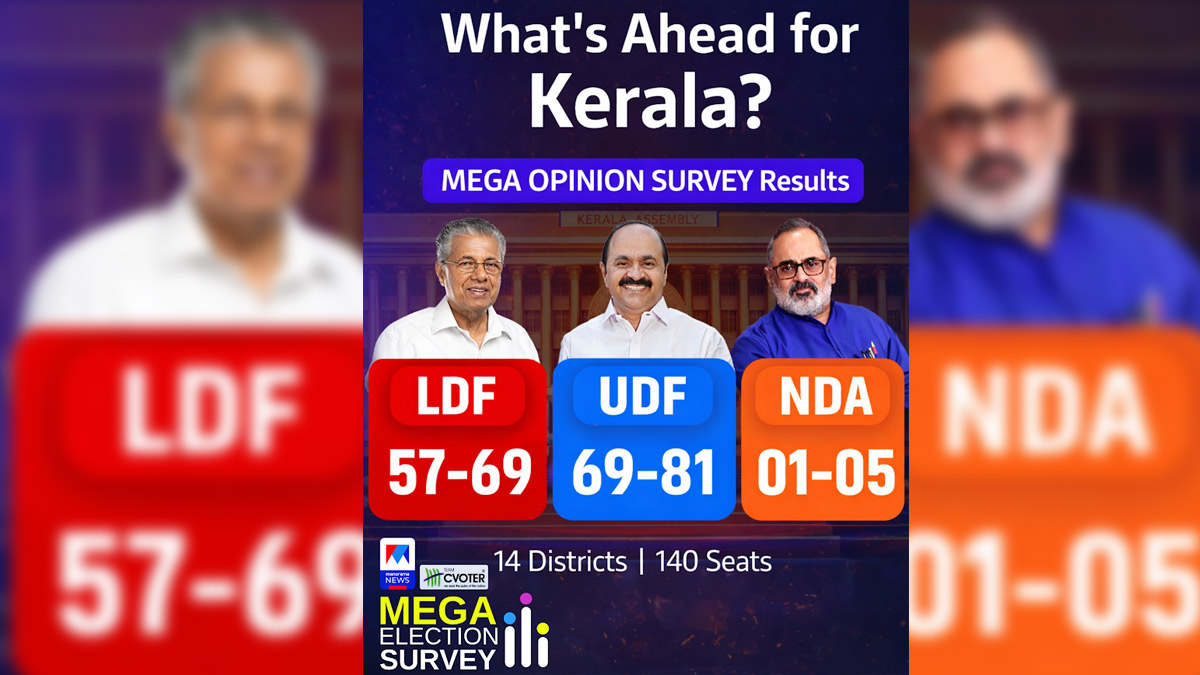
MUMBAI: The winds of change appear to be blowing through Kerala’s political landscape and this time, they seem to favour the United Democratic Front. A comprehensive mega opinion survey conducted by Manorama News in partnership with CVoter projects a potential comeback for the UDF in the upcoming Kerala Legislative Assembly Elections 2026. The survey, covering all 140 constituencies with a massive sample size of nearly 90,000 respondents, predicts the UDF could win between 69 and 81 seats.
The ruling Left Democratic Front (LDF) is expected to secure 57 to 69 seats, a significant drop from the 99 seats it won in the 2021 elections. This would mean the LDF losing 30 to 42 of its sitting seats. Meanwhile, the National Democratic Alliance (NDA), which drew a blank in 2021, is projected to open its account with 1 to 5 seats.
Region-wise, the UDF is expected to make strong gains in Malabar, winning 25 to 34 out of 48 seats, and in Central Kerala, where it could bag 29 to 33 out of 53 seats. In South Kerala, the LDF is likely to retain an edge with 21 to 25 seats, while the UDF may improve to 12 to 16 seats. The NDA could pick up 1 to 3 seats in the southern region.
The survey was conducted between 14 and 26 March 2026, with additional tracker and snap polls carried out from December 2025 to March 2026. A total of 89,693 respondents participated, ensuring representation across all demographics and social segments.
Manorama News has a strong track record of accuracy, with its previous projections closely matching the actual results of the 2019 and 2024 Lok Sabha elections as well as the 2021 Kerala Assembly polls.
In Kerala’s famously fierce political battles, this survey suggests the pendulum may be swinging back. Whether the final verdict matches these numbers or throws up another surprise, one thing is clear, the 2026 Assembly elections are shaping up to be one of the most keenly watched contests in the state’s history.






