Broadband
Amazon’s Kuiper Project to launch first full satellite batch for global broadband

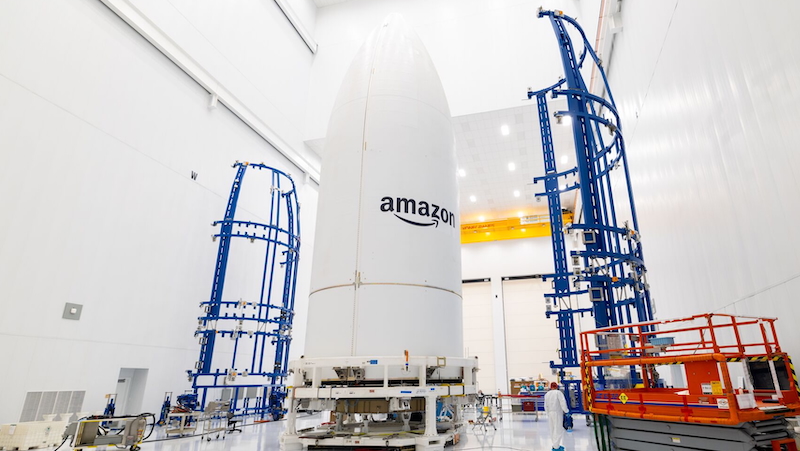
MUMBAI: Amazon’s Project Kuiper is launching its first full batch of satellites into orbit. The “KA-01” mission, scheduled for no earlier than 12 pm EDT on Wednesday, 9 April will deploy 27 satellites via a United Launch Alliance (ULA) Atlas V rocket from Cape Canaveral Space Force Station, Florida.
The mission aims to establish a low-latency, high-speed internet service accessible globally. The first-generation satellite system will consist of over 3,200 low Earth orbit satellites. The KA-01 launch is a critical step in deploying this constellation.
The satellites deployed in the KA-01 mission feature improvements over previous prototypes, including enhanced phased array antennas, processors, solar arrays, propulsion systems, and optical inter-satellite links. A dielectric mirror film has been applied to the satellites to minimize reflected sunlight, addressing concerns from ground-based astronomers.

The satellite payload is the heaviest ever carried by a ULA Atlas V rocket, requiring the rocket to fly in its most powerful configuration with five solid rocket boosters. The payload fairing measures 77 feet (23.5 meters) in height and 16.4 feet (5 meters) in width.
Following launch and initial deployment by ULA, Kuiper’s mission operations center in Redmond, Washington, will manage the constellation. The satellites will use electric propulsion to ascend to their operational orbit of 392 miles (630 km), traveling at speeds exceeding 17,000 miles per hour.
The mission’s primary objective is to achieve safe satellite deployment and establish end-to-end network connectivity. Future launches, including seven more on the Atlas V and 38 on ULA’s Vulcan Centaur, are planned to expand the constellation. Additional launches will occur with Arianespace, Blue Origin, and SpaceX.
Amazon plans to begin delivering Kuiper internet services to customers later this year. The company is currently hiring to support the project’s development and deployment.







Broadband
ACT Fibernet elevates Aditya Singh to chief customer experience officer
Former senior vp to drive service, retention and delivery revamp

BENGALURU: ACT Fibernet has elevated Aditya Singh to chief customer experience officer, effective 1 January, 2026, as the broadband provider seeks to tighten its grip on service quality in an increasingly competitive market.
Singh, who previously served as senior vice-president – customer experience and loyalty at group level, will now join the executive committee and lead the company’s end-to-end customer transformation agenda.
The move gives him oversight of customer service, customer retention and service delivery, alongside a broader mandate to strengthen network resilience and field operations. The company said the reshuffle underlines its intent to deliver a “consistent, seamless and superior” experience to its 2.3m subscribers across more than 30 cities.
Headquartered in Bengaluru, ACT Fibernet, the consumer-facing brand of Atria Convergence Technologies Limited, is one of India’s largest wired internet service providers. It has built its pitch on high-speed connectivity and responsive customer support, at a time when fibre roll-outs and price wars are redrawing the broadband map.
In a statement, Singh said he was “deeply honoured” to take on the expanded brief and join the executive committee as the company sharpens its focus on simplifying customer touchpoints and turning subscribers into brand advocates.
The elevation signals a clear priority: in a crowded fibre market, customer experience is fast becoming the decisive battleground.






