Applications
Alphabake launches AI-powered virtual try-ons to reshape online fashion shopping

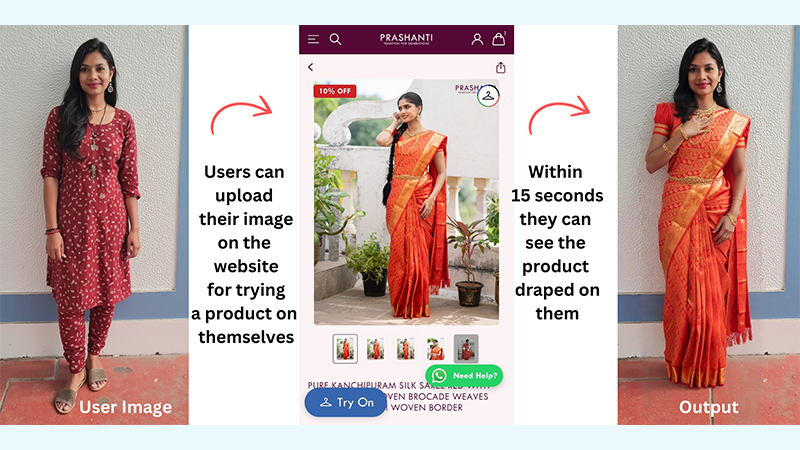
MUMBAI: In a bid to rewire the way fashion is bought online, Alphabake has launched a generative AI-powered virtual try-on feature for digital-first clothing brands. Touted as a leap over earlier mirror-kiosk-style tech, the solution blends Alphabake’s proprietary models with foundational generative AI to deliver photorealistic, hyper-personalised try-on experiences for shoppers.
Already live on platforms like Prashanti Sarees, Jade Blue, and Maatshi, the tech allows users to upload real-world images and view how garments appear in different lighting and settings—indoor, outdoor, day, or night. The goal: to mimic real-life dressing room conditions, reduce purchase hesitation, and bridge the online-offline shopping divide.
“In today’s fast-paced world, virtual try-ons are a boon helping customers see how clothes look on them in different settings”, said Alphabake founder & CEO Krishna Sumanth. “Close to 40 per cent of try-ons are shared on WhatsApp or Instagram and 15 per cent are added to carts. We’re on a mission to enable a trillion try-ons in the next three years”.

Integrated with Shopify and available via API for non-Shopify platforms, the tool is built to scale quickly across D2C retailers. The result: higher conversions, improved top-of-funnel traffic, and lower customer acquisition costs.
Prashanti Sarees CEO Anand Krishnamoorthy hailed the innovation. “Since we integrated Alphabake into our platform, the results have been very impressive. Engagement is up, and so are conversions. It genuinely feels like magic when you see the try-on outputs—realistic, intuitive, and easy to use”, he said.
As fashion brands look to differentiate in an increasingly crowded e-commerce landscape, Alphabake’s technology promises a more immersive, interactive shopping journey that keeps users coming back. With machine learning models evolving fast, the company believes virtual try-ons will become the default experience for fashion e-tail.

Applications
With 57 per cent single new users, Ashley Madison rebrands as discreet dating platform
Platform says majority of new members now identify as single

INDIA: Ashley Madison is shedding the “married-dating” label that defined it for two decades, repositioning itself as a platform for discreet dating in what it calls the post-social media age.
The rebrand, unveiled in India on 27 February, 2026, marks a structural shift in business model and identity. Once synonymous with married dating, the company now describes itself as the “premier destination for discreet dating” under a new tagline: Where Desire Meets Discretion.
The pivot is data-driven. Internal figures show that 57 per cent of global sign-ups between 1 January and 31 December, 2025 identified as single: a notable departure from the platform’s married core. The company argues that its community has already evolved beyond its original positioning.
“In an age where our lives have been constantly put on public display, privacy has become the new luxury,” said Ashley Madison chief strategy officer Paul Keable. He framed the platform’s offering as “ethical discretion” for singles, separated, divorced and non-monogamous users seeking private connections.
The shift also taps into wider digital fatigue. A global survey conducted by YouGov for Ashley Madison, covering 13,071 adults across Australia, Brazil, Canada, Germany, India, Italy, Mexico, Spain, Switzerland, the UK and the US, found mounting discomfort with hyper-public online lives.
Among dating app users, 30 per cent cited constant swiping and messaging as a source of fatigue, while 24 per cent pointed to pressure to curate public-facing profiles and early personal disclosure. Some 27 per cent said fears of screenshots or information being shared contributed to exhaustion; an equal share cited unwanted attention.
The retreat from oversharing appears broader. According to the survey, 46 per cent of adults actively try to keep most aspects of their life private online. Only 8 per cent feel comfortable sharing most aspects publicly, while 35 per cent say they are becoming more selective about what they disclose.
Ashley Madison is betting that this cultural recalibration towards controlled visibility can be monetised. By doubling down on privacy infrastructure and reframing itself around discretion rather than infidelity, the company is attempting to convert reputational baggage into a premium proposition.






