News Broadcasting
Alpha Marathi opinion poll anticipate Congress-NCP to win


MUMBAI: The second phase of an opinion poll on Maharashtra Assembly Elections conducted between 19 to 23 September, found Congress-NCP is anticipated to sweep a clear majority by winning 163 to 169 seats, while Sena-BJP alliance is expected to win 98 to 102 seats.
The outcome of the poll was revealed in a special programme Janadesh on Alpha Marathi channel on Saturday night. The programme will be repeated on Alpha TV on 26 September at 1 pm.
The opinion poll was conducted by Alpha Marathi and Taleem, Ahmedabad based organisation, where 3475 voters from 36 constituencies were interviewed for the poll. However, the study signifies 28 per cent of voters are still undecided on whom to vote or may not vote at all. This number has increased by three per cent over the first phase of the poll, informs the official release.

Alpha Marathi business head Nitin Vaidya says, “The second phase of opinion poll is self explanatory that the voters are looking forward to the Congress-NCP alliance government. It is clearly indicative that the voter’s decision is evolving. Alpha Marathi, decided to undertake this opinion poll with the prime objective of understanding the main issues which the electorate wants to be addressed. Whether the voters are inclined towards INC / NCP ruling party and the likelihood of their returning them to power or to BJP / Shiv Sena alliance.”
The election issues, which concerned the respondents, ranked the order of concern on development (87 per cent), farmers’ related issues (85 per cent), unemployment (84 per cent) and good governance (78 per cent), criminalisation of politics is concerned for 46 per cent respondents, separate Vidarbha 27 per cent and Savarkar controversy 25 per cent. While only 51 per cent respondents have favoured reservations in jobs, only 23 per cent respondents have opined that it was proper to launch Tiranga Yatra, informs the official communiqué.
The poll also highlights that 30 per cent of the respondents favoured chief minister Susheelkumar Shinde over the other contenders, followed by BJP’s Gopinath Munde having support of nine per cent and Uddhav Thacekray having eight per cent. However 34 per cent respondents were unable to say who they would prefer as next chief minister.
According to the poll results, as much as 27 per cent voters plan to vote for Congress followed by 15 per cent for NCP; BJP -Shiv Sena have been favoured by only 12 per cent and 13 per cent respectively. The remaining five per cent voters are distributed among various regional parties, the visible being the Bahujan Samaj Party with two per cent voters opting for it.
When asked on the formation of the next government, around 41 per cent of respondents favoured Congress/NCP, followed by with 26 per cent BJP/Shiv Sena combine will come to power. Here too, the percentage of cannot say is huge 31 per cent.
In the first phase of the opinion poll conducted last month, Congress-NCP combine expected to win 144 seats and Sena-BJP expected to win 128. Other parties and independents were predicted to win 16 seats.






News Broadcasting
Network18 channels lead YouTube news viewership in March 2026
CNN-News18, News18 India and CNBC channels top categories with record views
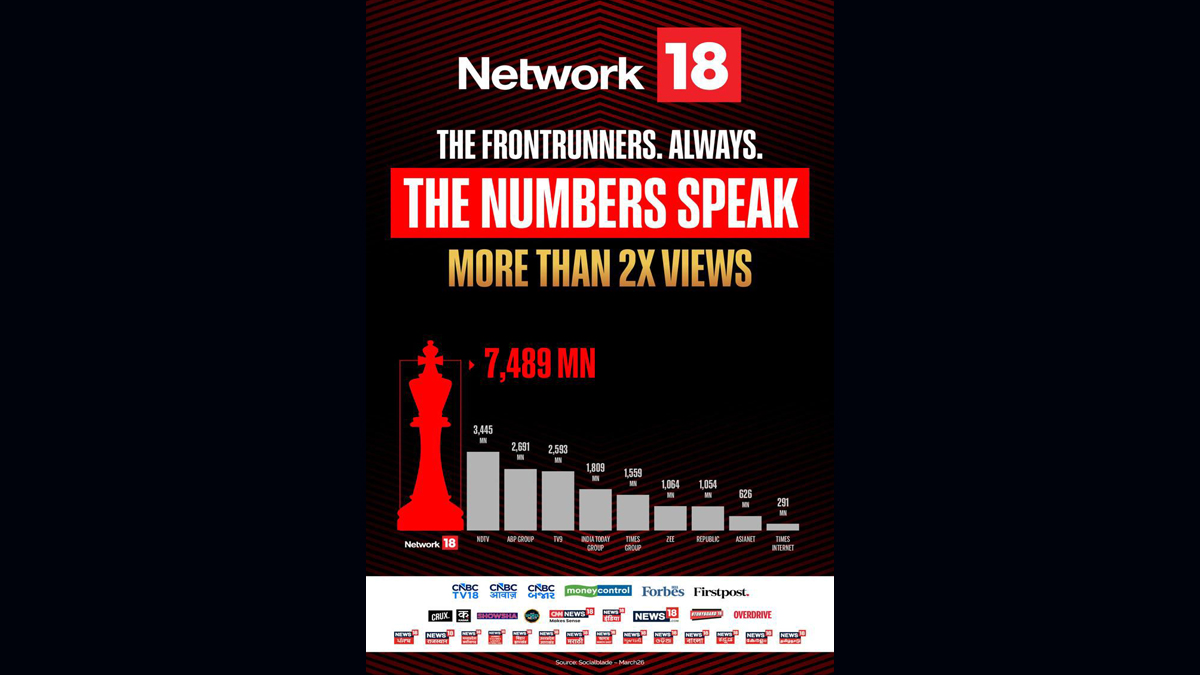
MUMBAI: When the world hit refresh on breaking news, Network18’s channels were already streaming ahead. As geopolitical tensions and war-driven headlines fuelled a surge in global news consumption, the network’s digital playbook delivered big clocking record Youtube viewership across English, Hindi and business news categories in March 2026.
At the forefront was CNN-News18, which emerged as the clear leader in the English news segment with 130 million live and video-on-demand views. The channel edged past competitors such as Times of India (126.5 million), Times Now (101.1 million), India Today (88.2 million) and NDTV (77.5 million), according to Databeings data for March.
In the Hindi news arena, News18 India delivered a commanding performance, racking up a staggering 3,297 million views on YouTube. The channel comfortably outpaced NDTV India, which recorded 3,119 million views, underlining its deep reach and consistent engagement with mass audiences, as per Playboard data.
The network’s dominance wasn’t confined to general news. In the Hindi business segment, CNBC Awaaz topped the charts with 92 million views, narrowly ahead of Zee Business (90 million) and well ahead of ET Now Swadesh (57 million). Meanwhile, its English counterpart CNBC-TV18 posted a strong 58 million views, reinforcing the network’s cross-category strength.
The spike in viewership reflects a broader shift in audience behaviour, with viewers increasingly turning to digital platforms particularly Youtube for real-time updates and in-depth coverage during high-intensity news cycles. For Network18, the numbers signal more than just scale; they underline the effectiveness of a multi-platform strategy that blends speed, credibility and continuous coverage.
In a month where the news never paused, it seems viewers chose to stay tuned where the stream never stopped.






