International
Alex Garland’s ‘Civil War’: Provocative action epic unveils turmoil in near-future America

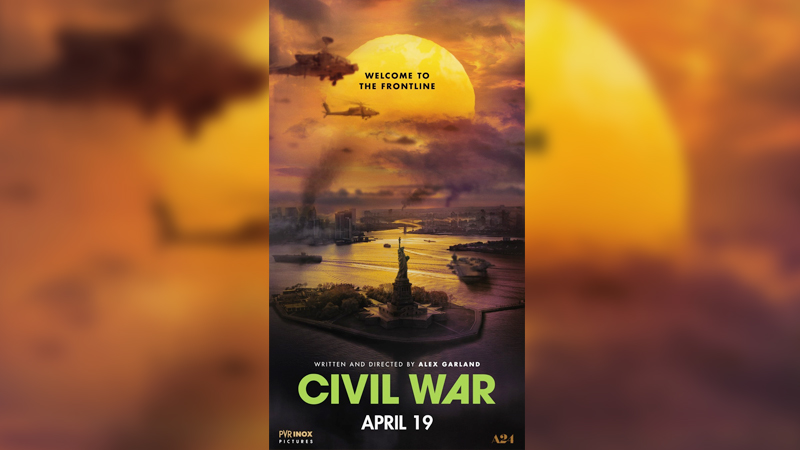
Mumbai: Alex Garland’s latest endeavor seeks to engage audiences worldwide in 2024, a year marked by significant political milestones. The film presents the USA at war with itself, in which ordinary citizens take up arms against each other and blood runs in the streets. ‘Civil War’ imagines America’s worst-case scenario right around the corner.
In India, amidst a surge of political cinema (i.e. The Kashmir Files, The Kerala Story, Article 370, JNU, etc), ‘Civil War’ promises to fuel a thought-provoking conversation as we approach the 18th Lok Sabha elections.
America is in a rough place right now — Right vs. left, blue vs. red, blind faith vs. biased truth. What was once an ideological divide now seems like an unbridgeable chasm. Imagining a not-so-distant future that you might accidentally mistake it for the present, in which the USA is once more at war against itself. The premise is a perfect opportunity to take a cold, hard, genre-inflected look at the American experiment’s current slouching toward self-destruction.

By exploring the unwavering commitment to truth through the lens of journalism, “Civil War” has the potential to spark vital discourse and inspire viewers to critically evaluate the information they encounter.
Alex Garland’s latest which is a wholly consuming thought-provoking war epic, is a deeply fascinating intimate piece that uses the experience and motivations of a group of military-embedded journalists to highlight the chilling reality of living in a world that never learns.
Academy Award nominee Kirsten Dunst plays a jaded photojournalist documenting the end of democracy as we know it in what’s sure to be one of the year’s most controversial films. This gritty, war-torn film boasts an impressive ensemble cast, including Wagner Moura, Cailee Spaeny, Stephen McKinley Henderson, and Jesse Plemons.
One of the most anticipated movies in a contentious Red vs. Blue election year, A24‘s Civil War made its grand splash Thursday night in the Texas democratic stronghold of Austin.
If one is to engage honestly with “Civil War,’ one must also engage with the state of journalism. It is impossible not to in a country that has seen fascism rear its ugly head and reactionary conspiracies take hold in response to cascading existential crises. In the case of “Civil War” it culminates in violence that consumes the country.
The dystopian future movie depicting the harrowing & senseless realities of war is set in the U.S. in which a three-term demagogue president rules (sound scary familiar? He’s played by Nick Offerman). Civil War follows a war journalist, played by Kirsten Dunst, as she traverses a very hostile America.
Given the election year we’re in and the feeling that we’re about to reprise a truly contentious contest for the country’s highest office, however, it’s hard not to think we’re on the brink of a second conflict between citizens on our own soil. It can happen here. It can happen again.
There Garland said he wanted to make journalists the heroes in Civil War because in “every democracy they aren’t a luxury, but a necessity.”
“Civil War” follows a group of journalists. At the center of this is veteran war photographer Lee, played by an understated yet completely enthralling Kirsten Dunst, who has seen more death than many would in a lifetime. Now, she must cover a conflict in her own country and grapple with what this means. She takes aspiring young photographer Jessie (Cailee Spaeny) under her wing as she plans to travel across the country with her colleagues Joel (Wagner Moura) and Sammy (Stephen McKinley Henderson) to interview the president (Offerman) before what is believed to be the violent end of his regime.
While political films often touch upon pressing social issues, they frequently oversimplify the role of journalists. However, Alex Garland’s “Civil War,” backed by A24 as their most ambitious project yet, courageously confronts this flawed narrative.
The film delivers a raw portrayal of the physical and psychological hardships journalists endure in conflict zones – risking their lives amidst bullets, shelling, kidnappings, and death threats to uncover the unvarnished truth.



International
Russia-India cinematic spectacle Persimmon of My Love set for grand Moscow debut
Hindi cinema style musical revives Indo-Soviet cinema ties for today

MUMBAI: A new chapter in cross-border storytelling is set to unfold as Persimmon of My Love gears up for its premiere in Moscow on 1 April 2026, marking the first large-scale cinematic collaboration between Russia and India in decades.
Positioned as a modern nod to the cultural exchange that once brought Indian classics to Soviet audiences, the film blends Hindi cinema flair with Russian storytelling, aiming to rekindle a long-standing cinematic friendship.
Directed by Marius Weisberg, the musical comedy follows two brothers navigating a lively world of music, family and romance. The lead roles are played by Demis Karibidis and Mikhail Galustyan, with Karibidis also contributing as a screenwriter.
Shot entirely in India, the production leans heavily into Hindi cinema style spectacle. Filming took place across Mumbai studios and the cities of Udaipur and Jodhpur, whose architecture was used to create the fictional setting of Khurmada. A crew of over 350 worked on the project, with large-scale sequences featuring up to 1,000 extras.
The film also brings Indian creative talent into the mix. Dance sequences are choreographed by Jay Kumar, while music by Zurab Matua features songs in both Hindi and Russian, adding to its cross-cultural appeal.
Backed by TNT channel, MyWayStudio and the Russian Cinema Fund, the project reflects a broader push to strengthen cultural ties between the two countries.
With its mix of colour, comedy and cross-border collaboration, Persimmon of My Love is not just a film release but a reminder that cinema, much like music, travels well across borders.






