News Broadcasting
Al Jazeera International works to get distribution in place ahead of early ’06 launch

MUMBAI: They say the younger one generally has it easier. One can’t say whether that will be the case for Al Jazeera International, the soon to launch English sibling of the Qatar-based Arabic channel that has had such a huge global impact since its arrival less than a decade ago. But what is certain is that every possible effort is being made to ensure a smooth take-off in March 2006 for a channel that has in its target sights the likes of BBC and CNN.
And a key factor in that smooth take-off would be to what extent the channel manages distribution and carriage deals by launch day in March. For Al Jazeera International’s commercial director Lindsey Oliver (formerly general counsel and network director of CNBC Europe), the toughest challenge will likely come in getting deals in place in the US. Whether it be big DTH operators like DirecTV and Echostar or cable giants like Comcast and Cox, getting carriage for the sister channel of one that US Defence Secretary Donald Rumsfeld and others have riled against as “consistently lying” and “working in concert with terrorists” will be no mean task.
Oliver told indiantelevision.com during a media briefing at the recently concluded Mipcom 2005 in Cannes that “discussions are on across all the major English speaking regions” to sew up deals ahead of Al Jazeera International’s March launch. Oliver, however, could not provide any inputs on whether any carriage deals were yet in place. If Oliver does manage to cross what still remains a big hurdle, there are few who doubt that the channel will find a ready audience.

One striking aspect of Al Jazeera’s new English language initiative is that the core team is made up mostly of personnel drawn for the BBC and ITV. Which harks back to the circumstances that led to the formation of the Arabic channel. Al Jazeera came into being from capital provided by the emir of Qatar in April 1996 following a decision by the BBC to shut the World Service’s Arabic television station. The 250 journalists who would have been rendered jobless by the decision moved en masse to Al Jazeera and the rest as they say is history.
There is a huge irony in the BBC’s confirmation yesterday that it is dismantling 10 of its World Service radio services (mostly operating out of East Europe) and redirecting its resources to launch, what else but, an Arabic-language television station to take on Al Jazeera. A further irony is that the BBC’s Arabic channel is already facing credibility issues of its own with critics accusing it of being a part of an American co-ordinated propaganda drive.
That is of course a separate story. As regards Al Jazeera International, it will headquartered in Doha, Qatar with three more broadcasting centres strategically placed across the world in Kuala Lumpur, London, and Washington D.C. and dozens of news bureaux worldwide.
That the proposition has convinced many was well highlighted by the signing up of Sir David Frost – who has interviewed seven US presidents and six British prime ministers – as its big-name presenter. Indian viewer’s will meanwhile, remember Riz Khan, who is also a high profile face on the channel, earlier with CNN.
News presenter Hassan Ibrahim told indiantelevision.com that the channel’s strength is that it is multicultural, free, and hard-hitting. “It will give respect back to the camera. What the camera sees is what we (will) report,” said Ibrahim.
Said programme director Paul Gibbs, “There is the younger demographic and an older demographic that forms our TG.”
One key differentiator the channel hopes to leverage is its strong slate of features driven programmes, for which Gibbs said a whole lot of outsourcing is being done. Gibbs revealed that an extranet site would be up in the coming weeks where interested producers could pitch their programming proposals.
Summing up, Gibbs said that “our multicultural staff will provide the glue and open mindedness will be our credo.”

News Broadcasting
CNN-News18 to host Fury in the Gulf conclave on West Asia crisis
Three-hour summit to unpack geopolitical fallout and impact on India
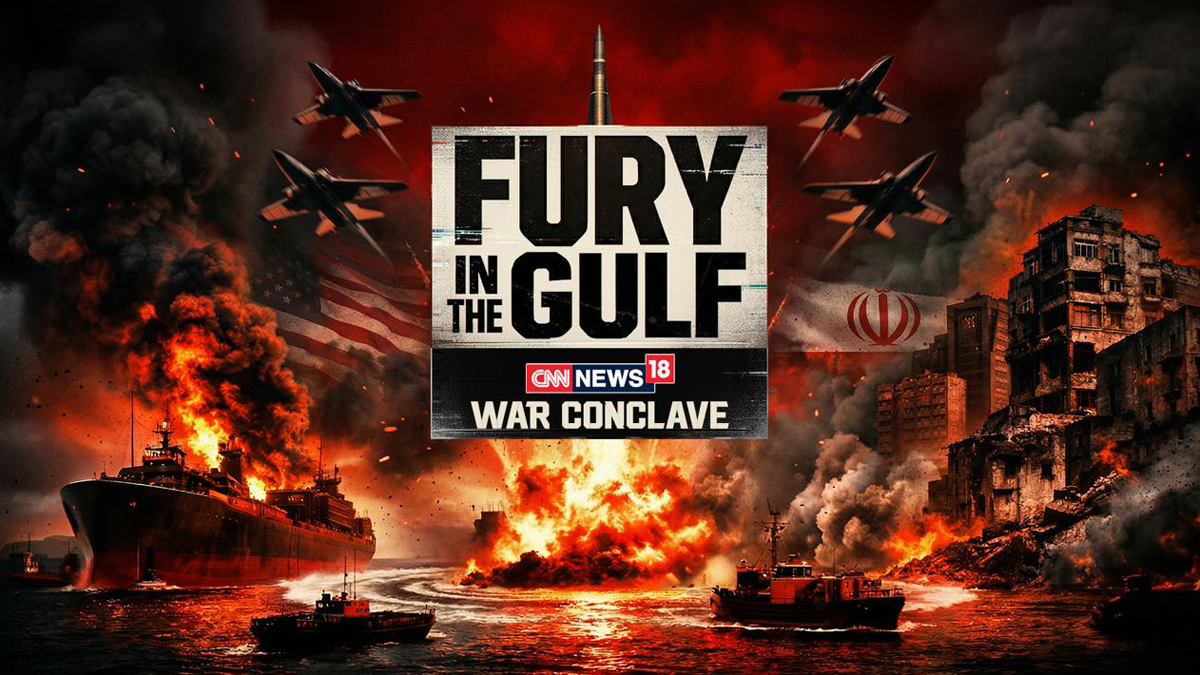
MUMBAI: CNN-News18 is set to host a special three-hour broadcast, Fury in the Gulf – War Conclave, on April 7, aiming to decode the escalating West Asia crisis and its far-reaching implications for India.
Scheduled from 4:00 PM to 7:00 PM, the conclave comes at a time when tensions between Iran and the United States are reshaping global geopolitics and triggering economic uncertainty. With India’s deep energy ties, trade links and large diaspora in the Gulf, the developments carry significant domestic relevance.
Built around the theme ‘Conflict, Consequences, and The Future,’ the programme will feature six curated sessions combining one-on-one interviews and panel discussions. The focus is to cut through the clutter and offer viewers a clearer understanding of the fast-evolving situation.
Key sessions include ‘Diplomacy in Times of War’ featuring Shashi Tharoor, and ‘World After the Iran Conflict’ with voices such as Ram Madhav, Reuven Azar, representatives from the European Union and the Iranian Deputy Envoy. Another session titled ‘Another Dunkirk?’ will bring together K. J. S. Dhillon and Jitin Prasada among others.
CNN-News18 editorial affairs director Rahul Shivshankar said, “In times of war, clarity becomes the most powerful tool. Fury in the Gulf – War Conclave brings together credible voices to address the questions and confusion that arise amid an overwhelming influx of information.”
He added that the initiative is aimed at delivering “facts, perspective, and insight” at a time when misinformation can easily cloud public understanding.
Echoing the sentiment, CNN-News18 CEO– English and business news Smriti Mehra said the conflict marks a defining global moment, with consequences that extend well beyond the region. She noted that the conclave seeks to present the crisis with “depth, nuance and responsibility” so audiences can better grasp its real-world impact.
As geopolitical tensions continue to dominate headlines, the conclave positions itself as an attempt to bring order to the noise, offering viewers a structured, insight-led look at a complex and rapidly shifting global situation.






