I&B Ministry
AIDCF clarifications on certain issues raised by broadcasters

Mumbai: The All India Digital Cable Federation (AIDCF) has clarified some issues raised by broadcasters.
The new regulatory framework (NTO 1.0) announced by Trai in 2017 promised consumer choice and lower prices for channels on cable TV and DTH platforms.The framework came into effect in February 2019 after an extended 2-year legal battle between the Trai and the broadcasters.
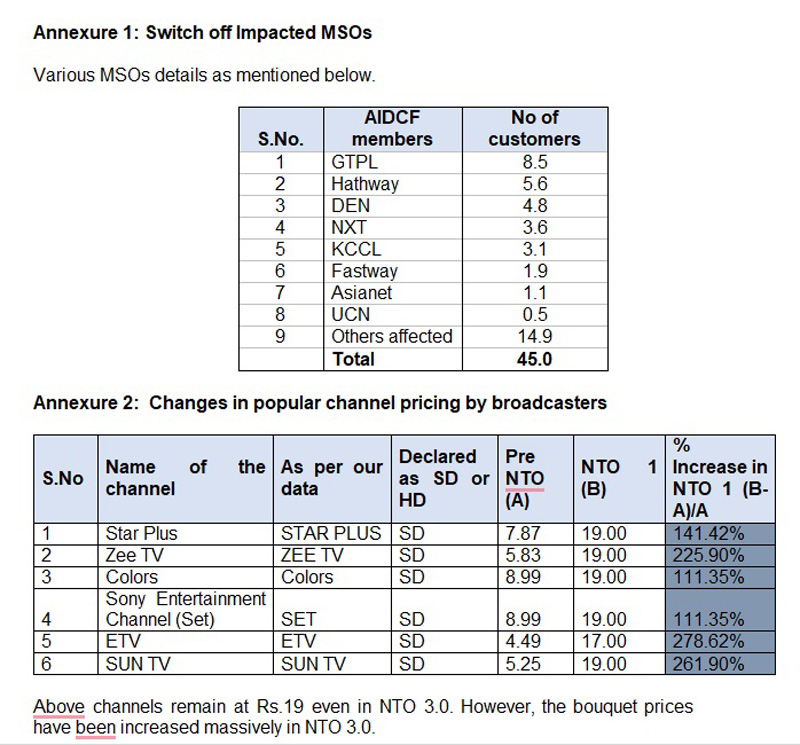
“The broadcasters announced MRP for the consumers for the first time ever which was raised by as much as 400 per cent in some cases. Most of the popular channels were announced at an MRP of Rs.19/. Annexure 2 showing details of some popular channels,” said the press release by AIDCF.

The press release further made these points
Broadcasters also announced bundles of channels that had both popular and unpopular channels in the same bundles (bouquets) However, the broadcasters effectively killed consumer choice by pricing these bouquets at heavily discounted prices as compared to the a-la-carte prices.
Consumers as well as the cable TV and DTH platforms had effectively no choice but to subscribe to the bouquets. For eg. The smallest bouquet offered by Sony was for Rs 31/ for the consumer which included 9 channels including both Sony Entertainment, Sony Sab, Sony Max, Max 2, Sony Pal, Sony Yay, Sony Wah and Sony Marathi/Sony Aath (Bengali). The a-la-carte price for just two channels Sony Entertainment and Sony Sab at Rs 19 each amounted to more than the bouquet price which included the same two channels.
The situation was similar across all broadcasters
The cost of NTO 1 was:
Loss of more than 30 million (3.00 crore) subscribers from the cable tv service providers
Increase of subscription revenue by more than 200 per cent for broadcasters and resultant massive increase in profits for them (Annexure 3 showing result of a publicly listed broadcaster before and after NTO). Even free-to-air channels of these broadcasters were converted into pay channels at minimal prices so that they could be pushed into bouquets and thereby to consumer homes.
Within a period of less than 6 months, Trai felt the need to undergo another consultation process to correct the anomalies in the structures and perverse pricing of channels and bouquets announced by broadcasters.
Consultation was followed by the amendments to the regulations (NTO 2.0) issued on 1 Jan 2020.
Broad highlights of the amendments:
Reduction of MRP from Rs 19 to Rs 12 for inclusion of a channel in a bouquet by a broadcaster
logic was given to prevent perverse pricing of bouquets compared to a-la-carte prices so that consumers could effectively choose what they want to see.
NCF announced in initial regulations was amended and a cap of a maximum of Rs.130 was introduced for 200 channels and a maximum of Rs 160 for more than 200 channels to ensure consumers were not burdened.
Discount on multi-tv homes was introduced. The cable tv platforms implemented the reduction in prices immediately so as to ease the consumers’ burden.
The broadcasters, however, again went to court against the amendments related to pricing of channels as well as the logic of pricing of channels in bouquets. The case went on till 2021 which the broadcasters lost in the High Court at Mumbai
The High Court decided the case after almost two years while upholding the structure proposed by Trai and their right to do so.
The Trai approached all the stakeholders to try and come to a solution to the impasse and held a couple of meetings. These meetings were inconclusive since the cable platforms (under AIDCF) were against any price increase for the customers while the broadcasters wanted the price for channels to be restored to Rs.19 for the channel to be included in bouquets.
The Trai brought out a minutes of meeting dated 23 December 2021 which was purportedly agreed by all stakeholders including broadcasters, DTH, cable TV platforms and Trai.
AIDCF had written to Trai and disagreed to the minutes and raised other issues too. However, Trai overlooked the communications for unknown reasons
Trai announced a consultation again in 2022 with the purpose of bringing relevant amendments.
The consultation process culminated with the issuance of the amendments (NTO 3.0) on 22 November .2022. Price of individual channels allowed to be priced at a maximum of Rs.19/- again for inclusion in a bouquet. A new provision allowing broadcasters to discount their bouquets by a maximum of 45 per cent as compared to a-la-carte prices. This effectively keeps the consumer choice limited since the situation is similar to initial regulations (NTO 1.0) and the consumer does not have the option to choose.
Cost of NTO 3.0 and its impact
Broadcasters have significantly increased their channel prices and bouquet prices by approximately 18 per cent – 35 per cent which will definitely affect the consumer price (details given Annexure 4)
Average price increase across different areas of the country is expected to be in the range of Rs 30 to Rs 100 per month depending on the channels/bouquets opted by the consumer. The above price increase will result in a cost of close to Rs 5,000 crore to Rs 8,000 crore per annum to consumers which will largely benefit the broadcasters.
AIDCF and MSOs have immediately filed a case in Hon. High court of Kerala requesting stay on this Trai amendment
Various LCO associations have also filed their requested to put a stay on this Trai amendment
Broadcasters in meanwhile, despite the matter being sub judice, sent legal notices to AIDCF members to sign the agreement within 48 hrs. of issuance of notice or to face disconnection of signal immediately
Disney-Star, Sony and Zee switched off their channels on 18 February morning.Only three broadcasters have taken action. Other broadcasters who have not affected switch-off include Colors, Times, Discovery, Sun TV, ETV, etc.
Nearly 45 million households are affected (details appended in Annexure 1) who are unable to see the channels from these broadcasters. Now, broadcasters are urging consumers to go through the inconvenience of changing their service provider for their own limited benefit.

I&B Ministry
CBFC speeds up film certification; average approval time cut to 22 days
Over 71,900 films cleared in five years as digital system shortens approval timelines

MUMBAI: The Central Board of Film Certification (CBFC) has significantly reduced the time taken to certify films, with the average approval timeline now down to 22 working days for feature films and just three days for short films.
Operating under the Ministry of Information and Broadcasting, the statutory body certifies films for public exhibition in line with the Cinematograph Act, 1952 and the Cinematograph (Certification) Rules, 2024. The rules prescribe a maximum certification period of 48 working days, though the adoption of the Online Certification System has sharply accelerated the process.
Over the past five years, from 2020-21 to 2024-25, the board certified a total of 71,963 films across formats. Of these, the majority fell under the U category with 41,817 titles, followed by UA with 28,268 films and A with 1,878 films. No films were certified under the S category during the period.
Film approvals have also steadily risen in recent years. The CBFC cleared 8,299 films in 2020-21, a figure that peaked at 18,070 in 2022-23 before settling at 15,444 films in 2024-25. During the same period, 11,064 films were certified with cuts or modifications.
Despite the high volume of certifications, outright refusals remain rare. Only three films were denied certification over the last five years, with one refusal recorded in 2022-23 and two in 2024-25.
The board may recommend cuts or modifications if a film violates statutory parameters relating to the sovereignty and integrity of India, security of the state, friendly relations with foreign states, public order, decency or morality, defamation, contempt of court or incitement to an offence.
Filmmakers can challenge CBFC decisions in court. Data shows that such disputes remain limited but have seen some fluctuation. Between 2021 and 2025, a total of 21 certification decisions were challenged before High Courts, with the number rising to 10 cases in 2025.
Responding to a question in the Rajya Sabha, minister of state for information and broadcasting L. Murugan shared the data. The question was raised by Mallikarjun Kharge.
With faster timelines and a largely digital workflow, the certification process appears to be moving at a far brisker pace, signalling a shift towards quicker clearances for India’s growing film output.







