Applications
AI and cloud are running the show-and broadcasters are just catching up

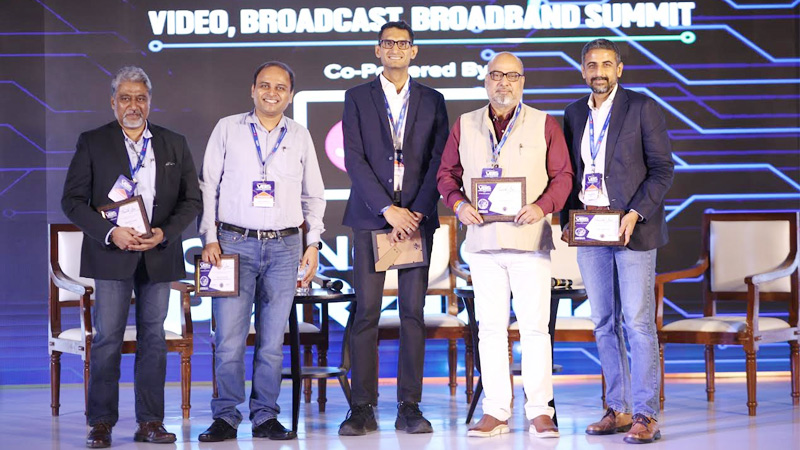
MUMBAI: Once upon a broadcast, it was enough to air a show and call it a day.
Not anymore.
As screens multiply and viewers scatter, broadcasters are strapping in for a digital arms race-armed with AI, automation, and the all-powerful cloud. At Indiantelevision.com’s Video and Broadband Summit 2025, the panel “The Smart Broadcast / OTT Revolution” unpacked this high-speed transformation, one data stream at a time.

Moderated by Amagi SVP (sales) – APAC Jay Ganesan, the discussion featured heavyweights from JioStar, Zee Entertainment, MX Player and Live Times, who shared how they’re reimagining production, distribution and monetisation in a world where content has to be everywhere, all at once.
JioStar executive director – BTO Paritosh Saha noted that their cloud-first workflow had been ahead of the curve. “Right from production, proxies, approvals to collaborative workflows—it was all built on cloud. And now AI has supercharged it,” he explained. Real-time highlight reels, AI-driven tagging, and cross-platform promotions are becoming the new norm. “The moment the match ends, the highlights are ready,” he said, adding that even commentators have AI-fed stats “right in front of them”.
Zee Entertainment Enterprises Ltd SVP – content tech Anil Tanwade spoke of the shift from traditional broadcasting to fragmented digital ecosystems. “Unless you make the whole ecosystem one, you can’t bring true efficiency,” he said. Tanwade championed hybrid models—using local systems for content creation and cloud for management and scaling. The key, he said, lies in syncing creativity with tech.
Amazon MX Player head of product & business analytics Shreyans Shrimali took the spotlight on AI’s role in localisation and marketing. From automatic dubbing and subtitles to AI-generated posters, trailers, and social promos, Shrimali laid out a future where algorithms cut down grunt work. “You can generate 100 tweets out of a single trailer”, he pointed out, underscoring how automation is powering faster audience engagement.
But it wasn’t just entertainment in the spotlight. Live Times founder Dilip Singh spoke from a news-first perspective. “India is a powerful emerging story. If you’re building media from India, it can’t just be local—it has to be global,” he said. Singh has built an infrastructure spanning satellite and IP-based delivery, employing AI for everything from content validation to fact-checking in an age of ‘WhatsApp University’. “80 per cent AI, 20 per cent human intelligence,” he said, describing his editorial formula for trust in an ocean of misinformation.
The discussion also touched on ad innovation. Customised ad breaks—350 versions of the same spot—are already being deployed. “It’s not just about making money, it’s about keeping the consumer engaged,” said the panellists. Embedded commerce, branded integrations and sponsorships are all being layered into the broadcast feed.
The conversation ended on a sober note. “Ten years ago, you earned $100 doing one thing. Now, you have to do 20 different things to earn the same $100,” the moderator quipped. Cloud and AI aren’t silver bullets—but they are proving to be jet fuel in an industry fighting for scale, speed and sustainability.

Applications
With 57 per cent single new users, Ashley Madison rebrands as discreet dating platform
Platform says majority of new members now identify as single

INDIA: Ashley Madison is shedding the “married-dating” label that defined it for two decades, repositioning itself as a platform for discreet dating in what it calls the post-social media age.
The rebrand, unveiled in India on 27 February, 2026, marks a structural shift in business model and identity. Once synonymous with married dating, the company now describes itself as the “premier destination for discreet dating” under a new tagline: Where Desire Meets Discretion.
The pivot is data-driven. Internal figures show that 57 per cent of global sign-ups between 1 January and 31 December, 2025 identified as single: a notable departure from the platform’s married core. The company argues that its community has already evolved beyond its original positioning.
“In an age where our lives have been constantly put on public display, privacy has become the new luxury,” said Ashley Madison chief strategy officer Paul Keable. He framed the platform’s offering as “ethical discretion” for singles, separated, divorced and non-monogamous users seeking private connections.
The shift also taps into wider digital fatigue. A global survey conducted by YouGov for Ashley Madison, covering 13,071 adults across Australia, Brazil, Canada, Germany, India, Italy, Mexico, Spain, Switzerland, the UK and the US, found mounting discomfort with hyper-public online lives.
Among dating app users, 30 per cent cited constant swiping and messaging as a source of fatigue, while 24 per cent pointed to pressure to curate public-facing profiles and early personal disclosure. Some 27 per cent said fears of screenshots or information being shared contributed to exhaustion; an equal share cited unwanted attention.
The retreat from oversharing appears broader. According to the survey, 46 per cent of adults actively try to keep most aspects of their life private online. Only 8 per cent feel comfortable sharing most aspects publicly, while 35 per cent say they are becoming more selective about what they disclose.
Ashley Madison is betting that this cultural recalibration towards controlled visibility can be monetised. By doubling down on privacy infrastructure and reframing itself around discretion rather than infidelity, the company is attempting to convert reputational baggage into a premium proposition.






