News Broadcasting
Aggregator launches TV over broadband(TVoBB) service


MUMBAI: Aggregator Limited has announced the launch of its first TV-over-Broadband (TVoBB) service, a Russian language portal that is set to change the TV viewing habits of over half a million Russians living in the UK.
MoëTV (pronounced ‘my-oar TV’ meaning ‘My TV’ in English) will go live later this month and will provide a collection of on-demand entertainment, drama, current affairs, films, documentaries, music and children’s programming.
MoëTV is a service which combines the speed of broadband and the best in Russian television with high quality pictures and sound. Aggregator has secured licences for programming from over 20 content suppliers including Amedia, Discovery Networks, Mosfilm, MTV Russia, National Geographic, nTV and RenTV.

Consumers interested in the service can pre-register by going to www.moe.tv and entering their email address. The service will offer around 400 hours of programming at launch, growing to an average of 1000 hours, refreshed monthly.
MoëTV has no mandatory subscription charges, meaning consumers can choose to obtain content on a per-view basis of 99p to £2.99 per programme or to view unlimited content for a £15.99 monthly payment.
All that the viewer needs to do to receive MoëTV is a broadband connection from any ISP and a PC or laptop. Programming can be viewed on the PC or the TV using a media extender. Aggregator has built a unique TVoBB content delivery platform, based on open standards technologies, to provide the viewer with a quality and easy to use service – for example MoëTV can schedule downloads so that users don’t exceed their ISP’s monthly download limits.
“The launch of this service will provide broadcast-quality television services to the 500,000 Russian speakers in the UK,” said Aggregator’s co-founder and Director of Programming, Chris Griffin.
“This is a well-educated, affluent community that has grown rapidly in the UK but is woefully underserved by mainstream television platforms. MoëTV can ensure that they, and their families, stay in touch with their language and culture while they are living abroad,” Griffin added.
MoëTV is the first in a series of planned service launches targeted at niche audiences from Aggregator, the brainchild of senior television industry figures Martin Goswami and Chris Griffin. Aggregator’s TVoBB services will create a new UK pay-TV platform, an on-demand broadband service that will deliver high-quality content to ethnic and special interest communities that are currently underserved by the television market.
“In order to be successful and provide consumers with exciting services they are prepared to pay for, new TV delivery platforms such as IPTV and TVoBB need differentiated content. We are excited about the potential of a fast growing broadband universe, so we have created services that work best in an IP based environment,” said Aggregator’s co-founder and CEO Martin Goswami.
“It seems that many operators currently planning IPTV services are targeting audiences who are already well-served on existing platforms. We’ve looked at that model and rejected it. What we’ve done instead is to develop packages of the best content available for specialist audiences who are not part of the mainstream pay-TV franchise,” added Goswami.
Aggregator is well advanced with a number of services aimed at underserved communities and interest groups. In 2007, the company plans to bring all these services together under a common platform brand incorporating the Freeview channels and PVR functionality.







News Broadcasting
Network18 channels lead YouTube news viewership in March 2026
CNN-News18, News18 India and CNBC channels top categories with record views
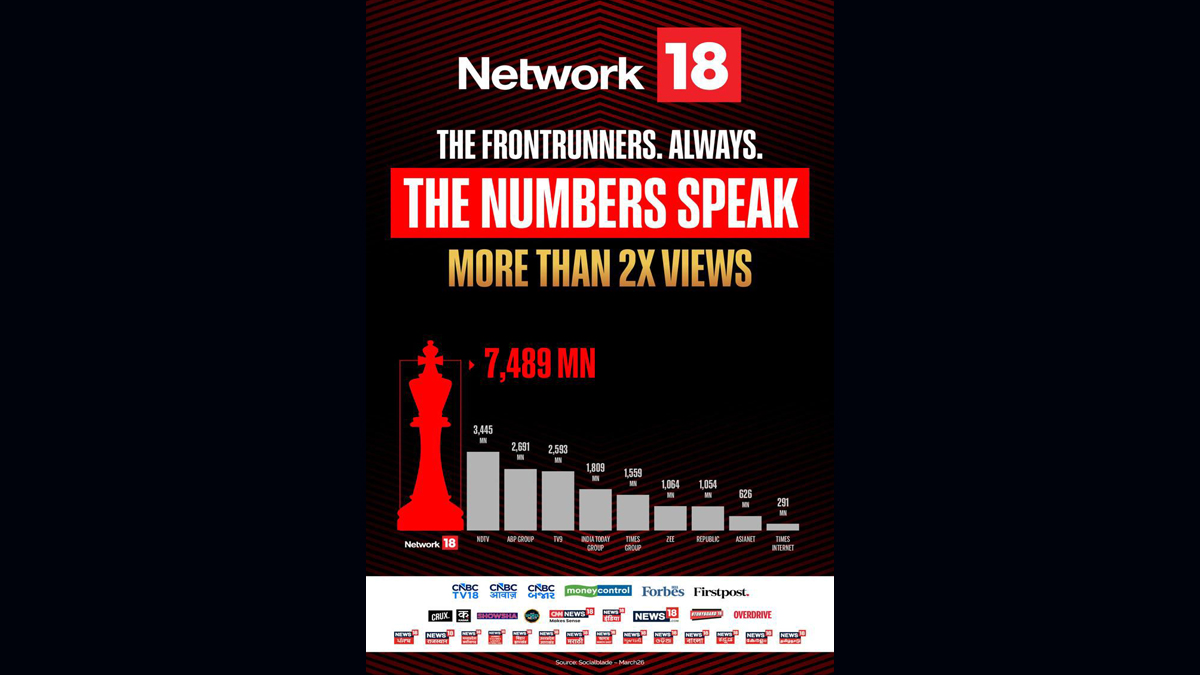
MUMBAI: When the world hit refresh on breaking news, Network18’s channels were already streaming ahead. As geopolitical tensions and war-driven headlines fuelled a surge in global news consumption, the network’s digital playbook delivered big clocking record Youtube viewership across English, Hindi and business news categories in March 2026.
At the forefront was CNN-News18, which emerged as the clear leader in the English news segment with 130 million live and video-on-demand views. The channel edged past competitors such as Times of India (126.5 million), Times Now (101.1 million), India Today (88.2 million) and NDTV (77.5 million), according to Databeings data for March.
In the Hindi news arena, News18 India delivered a commanding performance, racking up a staggering 3,297 million views on YouTube. The channel comfortably outpaced NDTV India, which recorded 3,119 million views, underlining its deep reach and consistent engagement with mass audiences, as per Playboard data.
The network’s dominance wasn’t confined to general news. In the Hindi business segment, CNBC Awaaz topped the charts with 92 million views, narrowly ahead of Zee Business (90 million) and well ahead of ET Now Swadesh (57 million). Meanwhile, its English counterpart CNBC-TV18 posted a strong 58 million views, reinforcing the network’s cross-category strength.
The spike in viewership reflects a broader shift in audience behaviour, with viewers increasingly turning to digital platforms particularly Youtube for real-time updates and in-depth coverage during high-intensity news cycles. For Network18, the numbers signal more than just scale; they underline the effectiveness of a multi-platform strategy that blends speed, credibility and continuous coverage.
In a month where the news never paused, it seems viewers chose to stay tuned where the stream never stopped.






