iWorld
After dip in revenue, ALTBalaji offers cashbacks on subscription

KOLKATA: ALTBalaji has teamed up with payment gateways Paytm and Amazon Pay to offer consumers up to Rs 300 cashback on the first Paytm wallet or Paytm UPI transaction on subscribing to the OTT platform. On the other hand, consumers can opt for Amazon Pay and get a cashback between Rs 10 to 250. Both the offers will be valid for Android, and web only from 1 December to 31 December 2020.
The offer comes on the back of the streaming service registering marginal degrowth in subscriber revenue in Q2, down to Rs 12.2 crore from Rs 12.9 crore in the preceding quarter. The company attributed this to downtrend to the Unlock phase, as customers returned “back to work and social commitments." In the same period, however, the platform clocked four million subscribers and an ARPU of around Rs 140–150.
To avail the offer through Paytm and Amazon Pay, the audience needs to buy an ALTBalaji subscription for Rs 100 or more. These offers can be availed only once, during the campaign validity. Once the whole amount is paid from Paytm wallet or UPI, cashback will be credited to the user's bank account linked to their Paytm UPI ID. For Amazon Pay users, it will be credited as Amazon Pay balance within three working days.

ALTBalaji CEO and Balaji Telefilms group COO Nachiket Pantvaidya said, “Since the launch, our main focus has been on offering quality content which is also affordable. Available to stream at 0.80 paise per day today, we are one of the most affordable OTT platforms in the country. Our association with key payment gateways like Paytm and Amazon Pay is in sync with our objective of keeping our consumers at the very core and going deeper into the Hindi heartlands.”
For the upcoming festive season, ALTBalaji has an exciting pipeline consisting of multiple shows. The festive month of November started with Mum Bhai, followed by Bicchoo Ka Khel and Dark7White. Coming up next are Paurashpur, LSD, Class of 2020 Season 2, Who’s Your Daddy Season 2, and Crashh, to name a few. Each of these new shows is high-octane dramas, which the audience can binge-watch through the festive season.
With an extensive library of 68 Indian originals across genres that cater to all kinds of audiences, the shows at ALTBalaji are a mix of thriller, drama, romance, youth drama, horror, comedy, amongst others. Romantic dramas like Kehne Ko Humsafar Hain, Karrle Tu Bhi Mohabbat, It Happened in Calcutta, Baarish, Dil Hi To hai etc enjoy a growing fandom amongst women in the 25-45 years TG. While on the other hand, thrillers like Apharan, Fixxer, Boss, Ragini MMS, Code M are consumed by men in the 22- 45 age bracket. In addition to the above, shows such as Mentalhood, The Test Case, MOM: Mission Over Mars, Bose: Dead/ Alive, The Verdict – State v/s Nanavati are being consumed extensively by the urban audience across all age groups.






iWorld
Micro-Dramas Surge in India, Redefining Mobile Content Habits
Meta-Ormax study maps rapid rise of short-form storytelling among 18–44 audiences.
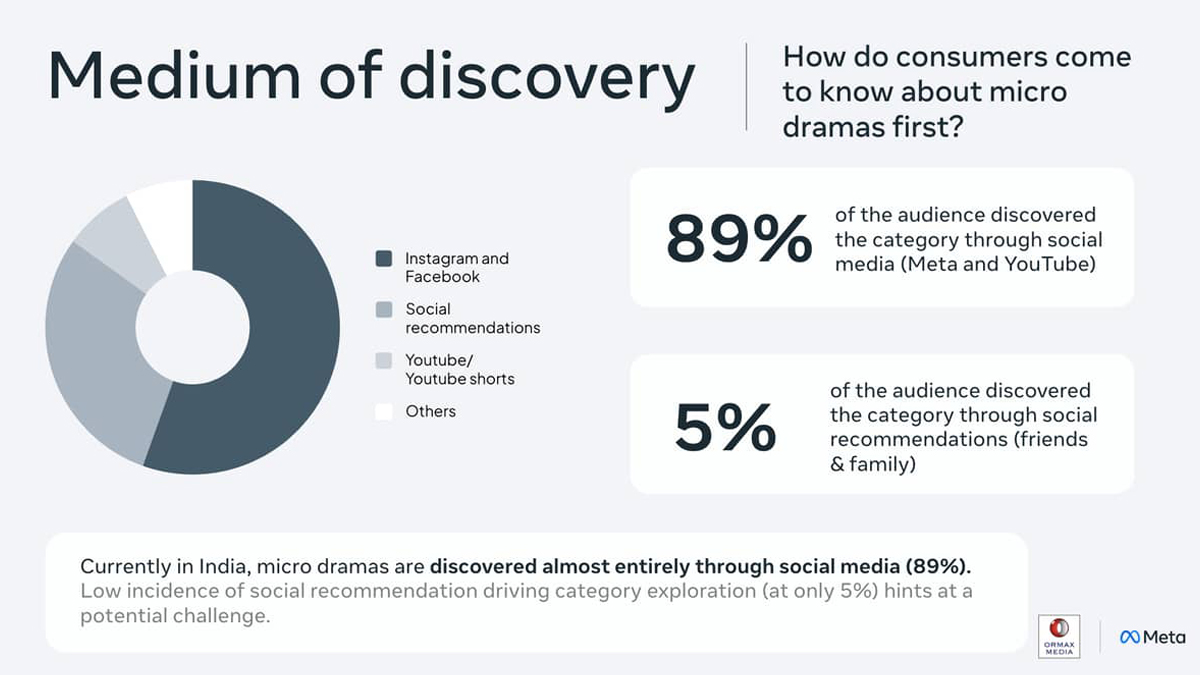
MUMBAI: Micro-dramas aren’t just short, they’re the snack that ate Indian entertainment, and now everyone’s bingeing between the sofa cushions. Meta, in partnership with Ormax Media, has released ‘Micro Dramas: The India Story’, a comprehensive study unveiled at the inaugural Meta Marketing Summit: Micro-Drama Edition. The report maps how the vertical, bite-sized format is reshaping content consumption for mobile-first audiences aged 18–44 across 14 states.
Conducted between November 2025 and January 2026 through 50 in-depth interviews and 2,000 personal surveys, the research reveals that 65 per cent of viewers discovered micro-dramas within the last year proof of explosive adoption. Nearly 89 per cent encounter the format through social feeds and recommendations, making algorithm-driven discovery the primary engine rather than active search.
Key viewing patterns show a median of 3.5 hours per week (about 30 minutes daily) spread across 7–8 short sessions. Consumption peaks between 8 pm and midnight, with additional spikes during commutes and work breaks classic “in-between moments” that the format fills perfectly. Around 57 per cent of viewing happens in ambient mode (while doing something else), and 90 per cent is solo, enabling more intimate, personal storytelling.
Romance, family drama and comedy lead genre preferences. Audiences show growing openness to AI-generated content, 47 per cent find it unique and creative, while only 6 per cent say they would avoid it entirely. Regional languages are surging after Hindi and English, Tamil, Telugu and Kannada dominate consumption.
Meta, director, media & entertainment (India) Shweta Bajpai said, “Micro-drama isn’t a passing trend, it’s rewriting the rules of Indian entertainment. In under a year, an entirely new category of platforms has emerged, built audience habits from scratch, and created a business vertical that is scaling fast.”
Ormax Media founder-CEO Shailesh Kapoor added, “Micro-dramas are beginning to show the early signs of becoming a distinct content category in India’s digital entertainment landscape. When a format aligns closely with how audiences naturally engage with their devices, it has the potential to scale very quickly.”
The study proposes ecosystem-wide responsibility, universal signposting of commercial intent, shared accountability among advertisers, platforms, creators, schools and parents, built-in safeguards, and formal media literacy in schools.
In a feed that never sleeps and a day that never stops, micro-dramas have slipped into the cracks of every spare minute turning 30-second stories into the new national pastime, one vertical swipe at a time.







