News Broadcasting
Addressability issue raised again at CII conference


Addressability. Everyone wants it but no one seems to know how it is to be instituted.
That about summed up the last session of the day as the two-day conference on “The Business of Entertainment” kicked off in Mumbai today.
But as at the Enter Media 2001 conference held in August last year (then as now organised by the Confederation of Indian Industry), where addressability was at the core of discussions at the session on television and broadcasting, this time round as well there was no fresh ground made at the discussion on “The Future of Electronic Media”.

All the panelists seemed to agree that one way the ongoing friction between MSOs and broadcasters could be resolved was for conditional access systems to come into play. How and when had no ready answer though.
There were other issues that were covered by the panelists Ashok Mansukhani, executive V-P, corporate services, HTMT (speaking for the cable industry), Ravi Gupta, CEO, B4U Worldwide, and Rajat Jain, executive V-P, SET MAX. They just seemed to get overshadowed a bit.
Mansukhani spent the largest time on the subject. But then that may have been linked to the ongoing stand-off between ESPN Star Sports and InCable Net over increased subscriber rates and the fact that ESPN Software managing director Manu Sawhney was initially pencilled in as one of the speakers. That he did not make it deflated the tenor of the discussions somewhat.
According to Mansukhani, the government was dragging its feet on two crucial issues. As he sees it, there is no political will to get in either conditional access or to push through the convergence bill.
One way to accelerate the move to an the addressable regime was for the government to make available set top boxes at an affordable cost, Mansukhani said. As an immediate measure the 68 per cent duty on the import of set tops needed to be suspended for at least the next three years, Mansukhani said.
Gupta however countered that even in a zero duty scenario this would still come in at a considerable cost. And even if costs could be managed the whole process would take a considerable time.
Bhuvan Lall, executive director, Indian Broadcast Foundation, who chaired the session, put some perspective on the subject when he said that the total worldwide manufacture of set tops in a year was 12 million. Compare that to the declared cable & satellite TV population of 39 million that has to be seeded.
Dinyar Contractor, editor and publisher of trade magazine Satellite & Cable TV raised a point that the cost per set top would come to around around Rs 5,000. Assuming a C&S TV population of about 40 million at the current numbers, the total cost works out to Rs 200,000 million that will have to be raised from the end subscriber, Contractor said.
Jain, meanwhile, pointed out that in a scenario where were over a 100 channels were scrambling for a share of the ad pie, the rush to go pay was becoming more pronounced.
The ad pie may be a limited one but there is no dearth of new entrants wanting to get into the business, is Jain’s view. According to him 30 new channels will see the light of day before the year is out.
Jain sees a lot of scope in the regional channels, especially the southern ones. According to him, it makes strategically sound sense to get strong regional language channels onto any platform as far as a bouquet completion perspective is concerned. The regional language channel market is the fastest growing today, Jain says.






News Broadcasting
Network18 channels lead YouTube news viewership in March 2026
CNN-News18, News18 India and CNBC channels top categories with record views
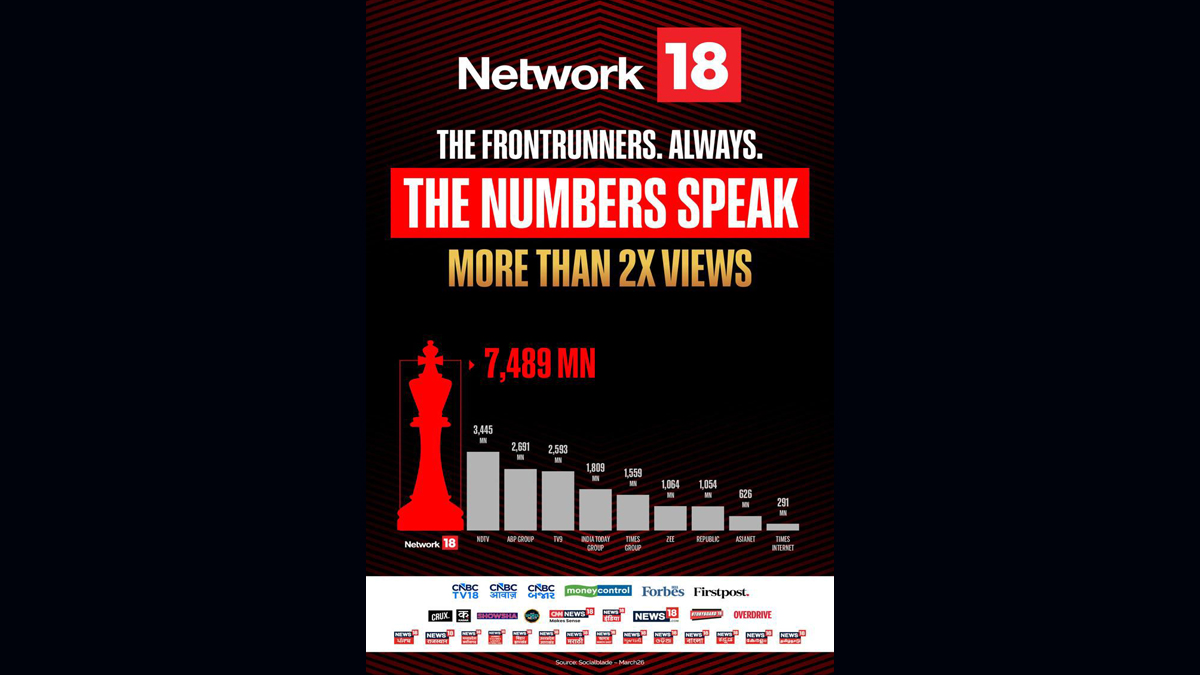
MUMBAI: When the world hit refresh on breaking news, Network18’s channels were already streaming ahead. As geopolitical tensions and war-driven headlines fuelled a surge in global news consumption, the network’s digital playbook delivered big clocking record Youtube viewership across English, Hindi and business news categories in March 2026.
At the forefront was CNN-News18, which emerged as the clear leader in the English news segment with 130 million live and video-on-demand views. The channel edged past competitors such as Times of India (126.5 million), Times Now (101.1 million), India Today (88.2 million) and NDTV (77.5 million), according to Databeings data for March.
In the Hindi news arena, News18 India delivered a commanding performance, racking up a staggering 3,297 million views on YouTube. The channel comfortably outpaced NDTV India, which recorded 3,119 million views, underlining its deep reach and consistent engagement with mass audiences, as per Playboard data.
The network’s dominance wasn’t confined to general news. In the Hindi business segment, CNBC Awaaz topped the charts with 92 million views, narrowly ahead of Zee Business (90 million) and well ahead of ET Now Swadesh (57 million). Meanwhile, its English counterpart CNBC-TV18 posted a strong 58 million views, reinforcing the network’s cross-category strength.
The spike in viewership reflects a broader shift in audience behaviour, with viewers increasingly turning to digital platforms particularly Youtube for real-time updates and in-depth coverage during high-intensity news cycles. For Network18, the numbers signal more than just scale; they underline the effectiveness of a multi-platform strategy that blends speed, credibility and continuous coverage.
In a month where the news never paused, it seems viewers chose to stay tuned where the stream never stopped.






