News Broadcasting
ABP lead suitor, but dark horses in Star News fray

NEW DELHI: When Star News president Ravina Raj Kohli told indiantelevision.com in an interview recently that Star News was probably the only news channel that is making news, she wasn’t much off the mark. Rather bang on target. The media hype that has followed Star TV boss James Murdoch’s latest visit to India is a clear indication of that.
Has the deal for Star News been signed? If inside information is to be believed, then not till this afternoon at least. “Such deals would not get signed in such a hurry, even if preliminary talks have been held before,” a source close to the deal-making party said.
Then, what is the status of the discussions? Yes, industry sources have confirmed that Indian industrialists like Nusli Wadia did meet up with Murdoch yesterday, but no conclusions have been reached yet. “You see, Star’s India head (Peter Mukerjea) has already briefed James about the various options as also some others, and James is meeting up with various people to finalise a suitor. Still, he is keeping his cards close to his chest,” the source said.
And the front-runner? As of now, Aveek Sarkar, the owner of the Ananda Bazar Publications (ABP) in Kolkata, publisher of Telegraph newspaper and Business World news magazine, is a couple of steps ahead of the others in the race.
Sarkar is said to have started a meeting with Murdoch at around 3 pm at an undisclosed destination in Mumbai. It could have been at The Oberoi, where both Sarkar and Murdoch are staying, or at a Star office in the townside of Mumbai or it could have also been the Mahalaxmi-based studio of Star News or maybe even ABP’s Mumbai office.
Sarkar is said to be followed closely by Hindustan Times’ Shobhna Bhartia, who again, is close to the deal making and did meet up with the Murdochs in London about a fortnight ago, according to sources. Whether she would be meeting Murdoch again today or tomorrow is not known.
But, sources point out, dark horses cannot be ruled out, which include the likes of Sunil Bharti of the telecom giant Bharti group. Bharti may not be directly in the business of media, but is cash-rich and is active in related fields like broadband, telecom infrastructure and services and a submarine cable project. Then, of course, there is the usual suspect, the Reliance Group.
While Star sources term talk of discussions being held with Reliance as “bunkum”, industry sources insist a team from Reliance is scheduled to meet up with Murdoch in Mumbai today.
Will the existing shareholders of Media Content Communications Services (MCCS) India – especially the big shareholders – agree to dilute their stakes to accommodate a new Indian partner who would hold 51 per cent stake in the joint or multiple venture for Star News?
If any existing shareholder decides to play hardball, Star and the would-be 51 per cent shareholder would have the option of infusing fresh equity into the venture, thereby reducing the existing shareholders’ holdings accordingly.
“Infusion of fresh equity is one option that is being considered actively to accommodate a new Indian partner,” the source said, basing his views on the various permutations and combinations that are being presently studied by Star.
Hypothetically speaking, if the uplinking applicant company’s paid up capital has to be Rs 400 million and fresh equity is infused into the company, then a 30 per cent shareholder (when the paid up capital was Rs 40 million) would end up having just three per cent after the final restructuring.
Though the Indian government had unofficially hinted that a company with a paid-up capital of Rs 400 million would have the adequate financial muscle to run a news operation, nothing formal has been stated in this regard in the revised uplinking norms issued by the government late last month.
“The government has indicated now that paid-up capital of Rs 250 million would be considered okay,” a source active in the Star News deal-making said.
But one thing is certain. After the Star News company is restructured as per government mandate, with a dominant 51 per cent shareholder, Mumbai would see a new newspaper in the city soon. Times of India better watch out!
With the top bosses of Star India flying out with Murdoch to Dubai tomorrow for a Star sales meet, it would be highly unlikely that a deal would be inked, signed and delivered today or tomorrow. But if that happens, Star certainly seems dead serious this time, and does not want to mess up things further – with the deadline set by the government now just 20 days away.



News Broadcasting
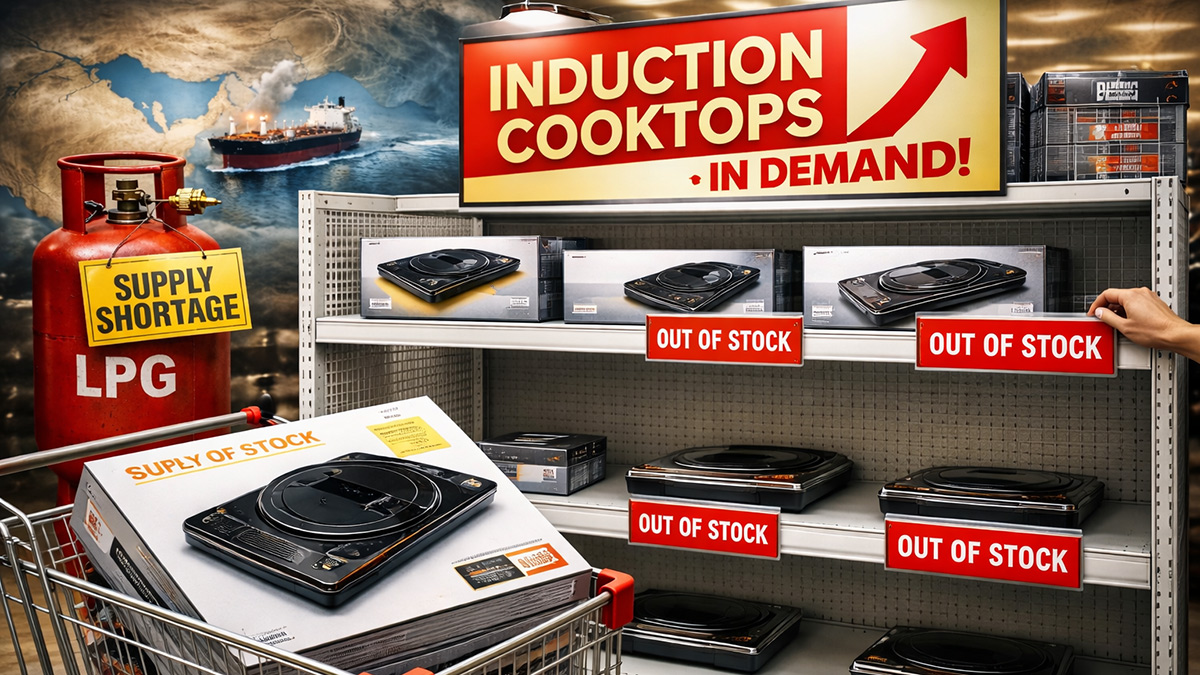
Induction cooktop demand spikes 30× amid LPG supply concerns
Supply worries linked to West Asia tensions push households and restaurants to turn to electric cooking alternatives
MUMBAI: As geopolitical tensions in West Asia ripple through global energy supply chains, the familiar blue flame in Indian kitchens is facing an unexpected challenger: electricity.
What began as concerns over the availability of liquefied petroleum gas (LPG) has quickly evolved into a technology-driven shift in cooking habits. Households across India are increasingly turning to induction cooktops and other electric appliances, initially as a backup but now, for many, a necessity.
A sudden surge in demand
Recent data from quick-commerce and grocery platform BigBasket highlights the scale of the shift. According to Seshu Kumar Tirumala, the company’s chief buying and merchandising officer, demand for induction cooktops has risen dramatically.

“Induction cooktops have seen a significant surge in demand, recording a fivefold jump on 10 March and a thirtyfold spike on 11 March,” Tirumala said.
The increase stands out sharply when compared with broader kitchen appliance trends. Most appliance categories are growing within 10 per cent of their typical demand levels, while induction cooktops have witnessed explosive growth as households rush to secure an alternative cooking option.
Major e-commerce platforms including Amazon and Flipkart have reported rising searches and orders for induction stoves. Quick-commerce apps such as Blinkit and Zepto have also witnessed stock shortages in major metropolitan areas including Delhi, Mumbai and Bengaluru.
What was once considered a convenient appliance for hostels, small kitchens or occasional use has suddenly become an essential addition in many homes.
A crisis thousands of miles away
The trigger for this shift lies far beyond India’s kitchens.
Escalating conflict in the Middle East has disrupted shipping routes through the Strait of Hormuz, one of the world’s most critical energy corridors. Nearly 85 to 90 per cent of India’s LPG imports pass through this narrow waterway, making the country particularly vulnerable to supply disruptions.
The ripple effects have been swift.
India currently meets roughly 60 per cent of its LPG demand through imports, and tightening global supply has already begun to affect domestic availability and prices.
Earlier this month, the price of domestic LPG cylinders increased by Rs 60, while commercial cylinders rose by more than Rs 114.
To discourage panic buying and hoarding, the government has also extended the mandatory waiting period between domestic refill bookings from 21 days to 25 days.
Restaurants feel the pressure
The strain is not limited to households. Restaurants, hotels and roadside eateries are also grappling with supply constraints as commercial LPG availability tightens under restrictions imposed through the Essential Commodities Act.
In cities such as Bengaluru and Chennai, restaurant associations report that commercial LPG availability has dropped by as much as 75 per cent, forcing many establishments to rethink their kitchen operations.
Some restaurants have reduced menu offerings, while others are rapidly installing high-efficiency induction systems, creating hybrid kitchens where electricity now shares the workload with gas.
For smaller eateries and roadside dhabas, the shift is less about sustainability and more about survival.
A potential structural shift
The government has maintained that there is no nationwide LPG crisis and has directed refineries to increase production to stabilise supply.
Nevertheless, the developments of March 2026 may already be triggering a longer-term behavioural shift.
For decades, LPG has been the backbone of cooking in Indian households. However, recent disruptions have highlighted the risks of relying on a single fuel source.
Increasingly, households appear to be hedging against uncertainty by adopting electric cooking options to guard against price volatility and delivery delays.
If the current trend continues, the induction cooktop, once viewed as a niche appliance, could emerge as a quiet symbol of India’s evolving kitchen economy.