News Broadcasting
Aaj Tak now breaking news on Sony’s ‘Saaksshi’

MUMBAI: “In today’s competitive world, nothing you do is enough,” says Aaj Tak marketing head Rajesh Sheshadri. And of course that holds true, even if we are talking about the numero uno Hindi news channel in the country – Aaj Tak.
Indian news channels have been making their presence felt on the big screen lately. While Star News was seen in Ram Gopal Varma’s Ek Hasina Thi, NDTV was prominent in Yash Raj Films’ Hum Tum and Aaj Tak has also been involved in a lot of brand placements in flicks like Company, Koi Mil Gaya and Khakee.
And that’s not where it ends. Aaj Tak has now taken the television route to increase viewer recall for its channel.

In the last four weeks, Aaj Tak has been strategically placed twice in Sony Entertainment Television’s recently launched weekend serial Saaksshi. Says Sheshadri, “We have been exploring new avenues for a while now. And we were in talks with Sony on this for quite some time. In Saaksshi, we found a brand fit that worked well for both of us.”
Saaksshi revolves around a middle class girl who has rare aspirations and dreams and who refuses to be tied down by the rules of society. She works as an undercover operative in an anti-terrorist squad. And where does Aaj Tak fit? In the last episode which was aired on 12 June at 9 pm, a character in the serial – Baaz hatches a devious plan, where he hires an Aaj Tak cameraman for a make believe news production house. He gives him a tape and asks him to make a copy. In the tape, there is a bomb hidden and the target is the Aaj Tak office. Prior to that, in the episode aired on 22 May, the protagonist of the serial – Saaksshi – was shown sitting in the canteen, when she sees some breaking news on television and the channel is but of course – Aaj Tak.
While regular mass media advertising will also be continued by the channel, more and more innovative advertising is also being looked at to cut through the clutter and ensure maximum impact for the brand. “This kind of advertising helps us stay top of mind,” says Sheshadri.
One thing that the channel keeps in mind is that the brand is placed where it is relevant to whatever context it is being placed in. While a lot of things on these lines are being looked at by the channel. Sheshadri says, “Before we associate with any channel or movie, we do a credential check of the people involved in the project. When a brand placement in a movie is being considered, we first check out the producer, the size of the movie, the stars involved in it and more importantly how our brand is going to be placed in it.”







News Broadcasting
News18 India launches Command Centre war explainer with Arya
New show shifts from debates to decoding global conflicts and impacts
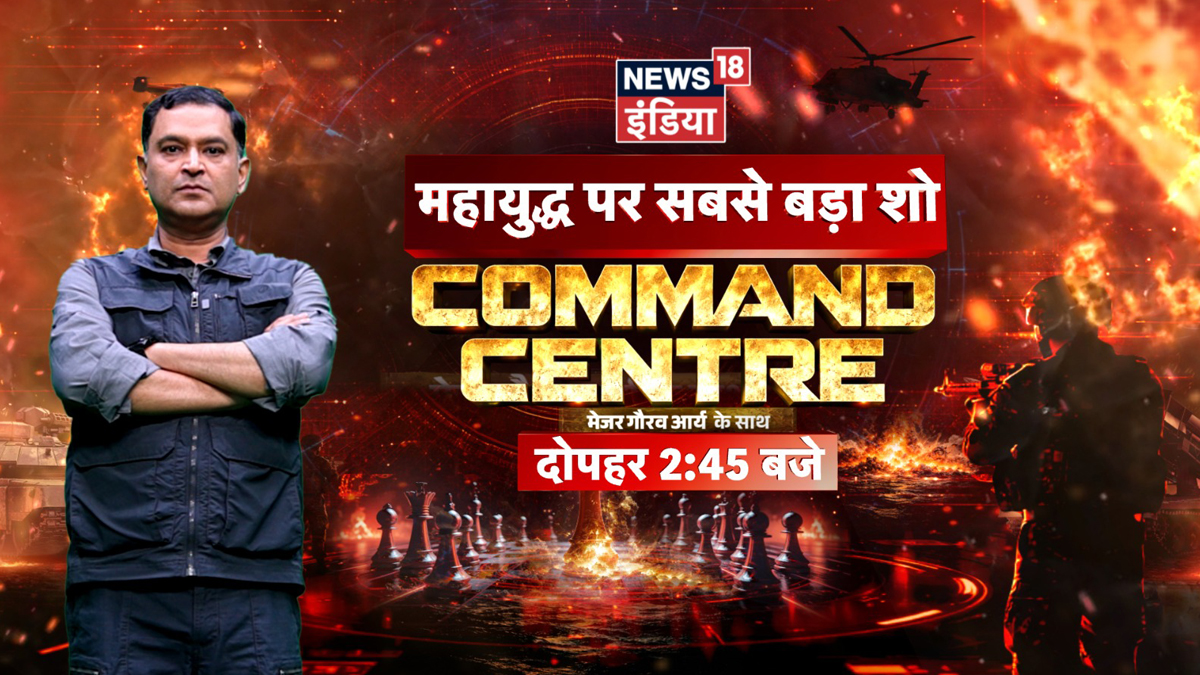
MUMBAI: News18 India has rolled out a new war-focused programme, Command Centre, featuring Gaurav Arya, as it looks to offer viewers a sharper, more grounded take on global conflicts amid rising tensions in West Asia.
Positioned as an “insider war room”, the show moves away from conventional panel debates and instead focuses on explaining military developments, decoding strategy and connecting global events to their everyday impact, from fuel prices to economic shifts.
The format leans heavily on visuals and data. The studio has been designed like a command hub, complete with large LED war maps, real-time graphics and an alert system to track developments as they unfold.
At the centre of it all is Arya, who brings his military background to simplify complex war strategies for viewers. His signature line, “Seedhi baat samjhiye”, anchors the show’s promise of clarity over noise.
News18 India managing editor Jyoti Kamal said, “Command Centre, featuring Major Gaurav Arya is designed to deliver accurate insights and a clear perspective on how evolving conflicts impact everyday life, from household budgets to national security. With expert voices analysing every development in real time, the show goes beyond headlines to decode what’s happening now, what it means, and what could come next.”
Echoing the intent, Gaurav Arya added, “In times of war, confusion is the biggest threat. With News18 India’s Command Centre, we are bringing viewers inside the war room, decoding strategies, tracking every escalation, and explaining, in the simplest terms, what it means for India and for every household. Seedhi baat samjhiye, this is where you understand not just what is happening, but what happens next.”
The weekday show will air in the afternoon slot and will also feature Gaurav Shukla, adding to its editorial depth.
With its mix of analysis, visuals and a clear focus on impact, the show reflects a broader shift in news consumption. Viewers are no longer just watching events unfold, they are looking to understand what those events mean for them.






