News Headline
‘A revolutionary year that was also one of the government’s total failure to control the broadcasters’


One healthy thing is that the industry is moving… maybe slowly in some areas, but it is definitely moving, which was not there earlier. The manufacturers lobby which had become stagnant are looking forward again. Fibre optical networks are spreading.
New technology is coming, and words we had never used two years ago, like IPTV & Mobile TV, are now common usage. DTH has been launched already and this will give competition to the cable sector and they will be bound to improve their services. HITS is on the way and if it is operated on C band then it will be good for the cable industry, but if it is put on Ku band, that will kill the cable industry. That will be a disaster.
If it is on C band, digitalisation will become faster, but if it is on Ku band, all the DTH players would start giving out their signals, because they are already on Ku band. And the consumer will also suffer because one after another DTH players will come and ask for money for their channel bouquets if the subscribers want them, so this will hurt the latter’s interests.

But I must say that Trai has given importance to the last mile operator, and this has been a major positive this year, they have realised the worth of the LMO and understood that it is the last mile people who have created the industry. They know now that the LMO is the one who gives the connection and actually works in the field.
Thus, to get 25 per cent to carry pay channels on the network was worthwhile. That was not there at all and that is a great achievement. You can say this is only in the CAS area, but a beginning has been made, that these people ought to get this much, which is a model now. So now we can take this forward and at least demand what we deserve. When voluntary CAS is extended to the 55 cities, we shall at least get some margin for letting them use our networks, based on this model.
Again, Trai for the first time has worked out the pay channel rates. Rs 5 for CAS areas and even for the non-Cas areas they have set an upper cap and declared the prices. Yes, of course the broadcasters will protest because they do not want to be controlled. The problem for the cable operator is that he never, before this, knew what he was going to charge the customer, who also never knew what he was being charged for and at what rate.
But the best came from the High Court, the order that CAS had to be rolled out. The courts, whether TDSAT or High Court or Supreme Court has been acting only in public interest, and two of the major decisions related to fixing the price of a sports channel, when Neo wanted to charge an astronomical price but was not allowed, and when the court upheld the government Act on sharing sports events of national importance with Doordarshan.
But beyond the rosy developments, the two worst things that happened this year were failure to extend CAS, and the failure to control the broadcasters. And in fact non-extension of CAS is mainly due to resistance from broadcasters lobby. They have earned too much of money in a non-addressable system and wants the market to stay that way.
I feel sad also that the government this year did not heed to our demand, the only demand, that we be given funds for going digital, which would have really helped, but that was turned down. It is small money and the government should have facilitated the LMOs by telling banks to make it easy for them to get small loans to facilitate digitalisation.
For the government this was a year of failures on several fronts, I am a member on three government committees, and all three here failed to deliver because of lack of will of the government and the most dangerous development is vertical integration, creating absolute monopolies, and the governments failure to implement cross-media restrictions.
As far as CAS is concerned, extension, even under voluntary effort will be good for the industry. But even if an LMO, say in a place like Kota in Rajasthan ushers in voluntary CAS, the broadcasters will not give him the decoders under one pretext or the other, saying that his SMS or some other system is not accurate and he is still under-declaring his subscriber base. The government has thus squarely failed to reign in the broadcasters on all fronts.
In passing, I must say one thing: the image of the LMOs so far had been that we are rowdy, uncontrollable. But in a series of meetings the government has seen who is rowdy, the journalist broadcasters or cablewallahs and officials are now saying, at least the LMOs have some dignity! That is why the goodwill for us has increased in the government quarters.





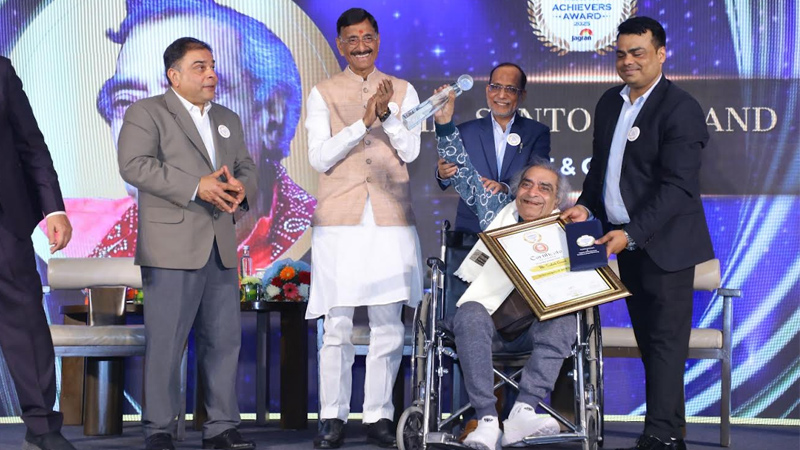
NEW DELHI: Hamdard Laboratories gathered a cross-section of India’s achievers in New Delhi on Friday, handing out the Hakeem Abdul Hameed Excellence Awards to figures who have left their mark across healthcare, education, sport, public service and the arts.
The ceremony, attended by minister of state for defence Sanjay Seth and senior officials from the ministry of Ayush, celebrated individuals whose work blends professional success with a sense of public purpose. It was as much a roll call of achievement as it was a reminder that influence is not measured only in profits or podiums, but in people reached and lives improved.
Among the headline awardees was Alakh Pandey, founder and chief executive of PhysicsWallah, recognised for turning affordable digital learning into a mass movement. On the sporting front, Arjuna Awardee and kabaddi player Sakshi Puniya was honoured for her contribution to the game and for pushing women’s participation onto bigger stages.
The cultural spotlight fell on veteran lyricist and poet Santosh Anand, whose songs have echoed across generations of Hindi cinema. At 97, Anand accepted the honour with characteristic humility, reflecting on a life shaped by perseverance and hope.
Healthcare honours spanned both modern and traditional systems. Manoj N. Nesari was recognised for strengthening Ayurveda’s place in national and global health frameworks. Padma shri Mohammed Abdul Waheed was honoured for his research-backed work in Unani medicine, while padma shri Mohsin Wali received recognition for his long-standing contribution to patient-centred care.
Education and social development also featured prominently. Padma shri Zahir Ishaq Kazi was honoured for decades of work in education, while former Meghalaya superintendent of Police T. C. Chacko was recognised for public service. Goonj founder Anshu Gupta received an award for his dignity-centred rural development initiatives, and the Hunar Shakti Foundation was honoured for empowering women and young girls through skill development.
The Lifetime Achievement Award went to former IAS officer Shailaja Chandra for her long career in public healthcare and governance, particularly in the traditional systems under Ayush.
Speaking at the event, Hamdard chairman Abdul Majeed said the awards were a tribute to those who combine excellence with empathy. “These awardees reflect Hakeem Sahib’s belief that healthcare, education and public service must ultimately serve humanity,” he said.
Minister Seth struck a forward-looking note, saying India’s young population gives the country a unique opportunity to become a global destination for learning, health and wellness by 2047.
The ceremony also featured the trailer launch of Unani Ki Kahaani, an upcoming documentary starring actor Jim Sarbh, set to premiere on Discovery on 11 February.
Instituted in memory of Unani scholar and educationist Hakeem Abdul Hameed, the awards have grown into a national platform that celebrates those building a more inclusive and resilient India. For one evening at least, the spotlight was not just on success, but on service with substance.







