I&B Ministry
892 pvt TV channels against 1500 targeted in 12th Plan

NEW DELHI: India has a total of 892 functional private television channels as on 28 February 2017 despite a claim made last year that the country will have 1500 channels by the end of this month. A master list issued by the Government includes in the 892 eleven channels whose permission has been “cancelled by the Information and Broadcasting Ministry due to security denial by Home Ministry However stay order given by Court.”
While permission was accorded to a total of 1061 TV channels, the licences of 169 were cancelled. (This does not include the eleven whose cases were stayed by Courts.)
Of the 892, 391 are news channels while 501 are general entertainment channels. Of these, 782 channels including 369 news channels are permitted to uplink from and downlink in India. Another 90 including 15 news channels are uplinked from overseas but permitted to downlink into India.

In comparison, the country has only twenty channels including seven news channels which are uplinked from India but permitted to downlinked in other countries.
Interestingly, the number of total channels has grown from 869 in February-end 2016 to 892 in February-end this year. This number had risen to 899 by the end of December 2016 when the total cancellations were 155. By January-end this year, the number had fallen to 889 of which twelve banned channels had received stay orders from Courts.
Channels permitted in February this year are: History TV18 HD uplinking and the Telugu Hindu Dharmam which only uplinking permission and Sony BBC Earth HD which has downlinking permission.
The list of the channels permitted as on 28 February 2017 along with their area and language of operation and the names of owning companies has been placed on the ministry site.
The Parliamentary Standing Committee for Information Technology which goes into issues relating to Information and Broadcasting had last year noted that the State Finance Commission while drafting its proposals for the 12th Plan (2012-17) had assumed that the number of permitted TV channels would rise to 1500.
The Committee was informed that during the year 2015-16, 11 cases were found where TV channels were in violation of content guidelines (Programme Code and Advertisement Code).
While there is no provision of pre-censorship of the content telecast on private TV channels, all programmes/ advertisements telecast on such TV channels are required to adhere to the Programme and Advertising Codes prescribed under the Cable Television Networks (Regulation) Act, 1995 and the rules framed thereunder. Action is taken whenever any violation of the Codes is noticed or brought to the notice of the Ministry.
Meanwhile, the Committee was told that the present set up of Electronic Media Monitoring Centre had developed logging and recording facility for 900 TV channels and is thus fully equipped to start monitoring of all permitted channels available on public domain.
The Broadcast Engineering Consultants India Ltd. (BECIL) is configuring all available free to air channels in the content monitoring system of the EMMC.
However, configuration of pay channels requires broadcasters to provide necessary equipment for downloading and decryption of the content/signal and this is expected to be completed within four months’ time.
By the end of Fiscal Year 2014-15, EMMC successfully achieved the Plan target of content acquisition facility of 600 TV channels. Under the 12th Plan, Rs.563.7 million had been utilized as of 31 March 2016 out of the total outlay of Rs.900 million.
The Committee was told that the budget estimate for 2016-17 had been reduced to Rs 120 million as compared to Rs 210 million in 2015-16, out of which Rs 197.6 million had been spent by 3 March 2016. The budget for EMMC for 2017-18 has again been retained at Rs 120 million, same as in the previous year.
The Ministry said its target under the Machinery and Equipment head was to develop content acquisition facility for additional 300 TV channels by the end of FY 2016-17.




I&B Ministry
CBFC speeds up film certification; average approval time cut to 22 days
Over 71,900 films cleared in five years as digital system shortens approval timelines
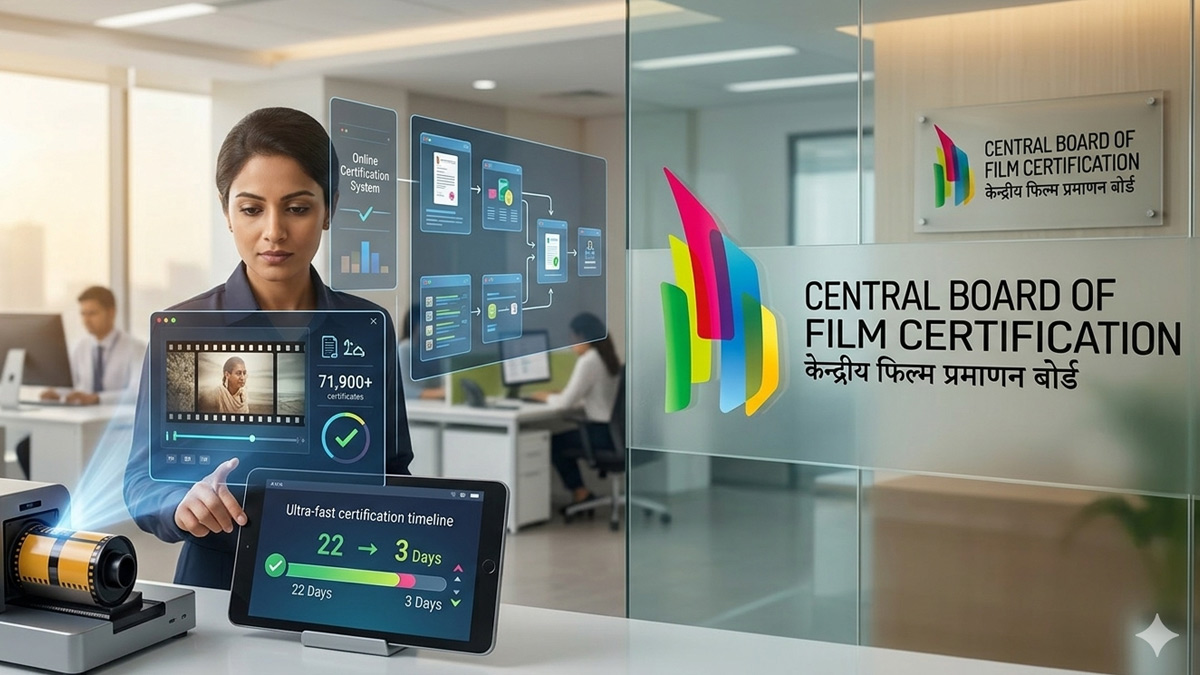
MUMBAI: The Central Board of Film Certification (CBFC) has significantly reduced the time taken to certify films, with the average approval timeline now down to 22 working days for feature films and just three days for short films.
Operating under the Ministry of Information and Broadcasting, the statutory body certifies films for public exhibition in line with the Cinematograph Act, 1952 and the Cinematograph (Certification) Rules, 2024. The rules prescribe a maximum certification period of 48 working days, though the adoption of the Online Certification System has sharply accelerated the process.
Over the past five years, from 2020-21 to 2024-25, the board certified a total of 71,963 films across formats. Of these, the majority fell under the U category with 41,817 titles, followed by UA with 28,268 films and A with 1,878 films. No films were certified under the S category during the period.
Film approvals have also steadily risen in recent years. The CBFC cleared 8,299 films in 2020-21, a figure that peaked at 18,070 in 2022-23 before settling at 15,444 films in 2024-25. During the same period, 11,064 films were certified with cuts or modifications.
Despite the high volume of certifications, outright refusals remain rare. Only three films were denied certification over the last five years, with one refusal recorded in 2022-23 and two in 2024-25.
The board may recommend cuts or modifications if a film violates statutory parameters relating to the sovereignty and integrity of India, security of the state, friendly relations with foreign states, public order, decency or morality, defamation, contempt of court or incitement to an offence.
Filmmakers can challenge CBFC decisions in court. Data shows that such disputes remain limited but have seen some fluctuation. Between 2021 and 2025, a total of 21 certification decisions were challenged before High Courts, with the number rising to 10 cases in 2025.
Responding to a question in the Rajya Sabha, minister of state for information and broadcasting L. Murugan shared the data. The question was raised by Mallikarjun Kharge.
With faster timelines and a largely digital workflow, the certification process appears to be moving at a far brisker pace, signalling a shift towards quicker clearances for India’s growing film output.







