Applications
56 per cent of Gen Z prefers GenAI over managers, finds upGrad Enterprise study

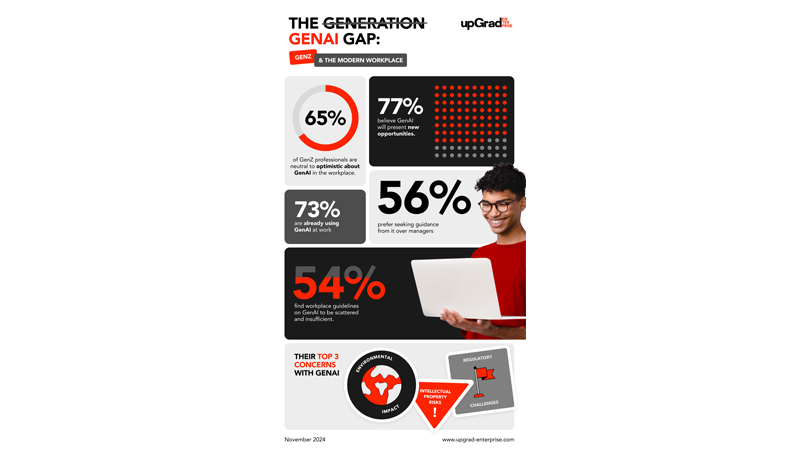
Mumbai: UpGrad Enterprise, the corporate skilling and workforce development arm of India’s largest online skilling platform upGrad, has unveiled a groundbreaking report, The GenAI Gap: GenZ & the Modern Workplace. The study captures how Gen Z professionals are integrating Generative AI (GenAI) into their workflows and outlines opportunities and challenges for organizations in adapting to this shift.
Based on insights from over 3,500 Gen Z professionals and 1,000 HR leaders, the report examines GenAI usage patterns, workplace attitudes, and the growing demand for AI-focused organisational policies and training.
The findings reveal that Gen Z is embracing GenAI at a rapid pace:

1 73 per cent of Gen Z professionals already use GenAI in their daily tasks, with 72 per cent trusting outputs with minimal edits.
2 56 per cent prefer consulting GenAI over their managers, citing constant accessibility and impartiality as key reasons.
3 65 per cent of Gen Z professionals feel optimistic about GenAI’s potential, viewing it as a catalyst for new opportunities, despite job security concerns.
4 54 per cent believe their organization lacks adequate GenAI guidelines, while 52 per cent express dissatisfaction with workplace AI training programs.
5 21 per cent of HR professionals feel comfortable using GenAI for regulatory training, highlighting a need for compliance-focused resources.
upGrad Enterprise, CEO, Srikanth Iyengar emphasised the report’s relevance, “Years of working closely with global organizations have provided us with valuable insights into the challenges faced by both professionals and businesses navigating AI adoption. This report sheds light on Gen Z’s enthusiastic embrace of GenAI and highlights the urgent need for organizations to implement robust policies and targeted training. At upGrad Enterprise, we are committed to equipping professionals with the skills and tools they need to succeed in an AI-powered world.”
The report also reveals Gen Z’s environmental consciousness, with this demographic being three times more concerned about GenAI’s ecological impact compared to organizations. The findings urge companies to address skills gaps and align workplace policies with Gen Z’s aspirations for innovation and efficiency.
The GenAI Gap: GenZ & the Modern Workplace underscores India’s growing adaptability to AI and the unique expectations of Gen Z, a generation that sees technology as a key enabler of streamlined and impactful workflows.

Applications
With 57 per cent single new users, Ashley Madison rebrands as discreet dating platform
Platform says majority of new members now identify as single

INDIA: Ashley Madison is shedding the “married-dating” label that defined it for two decades, repositioning itself as a platform for discreet dating in what it calls the post-social media age.
The rebrand, unveiled in India on 27 February, 2026, marks a structural shift in business model and identity. Once synonymous with married dating, the company now describes itself as the “premier destination for discreet dating” under a new tagline: Where Desire Meets Discretion.
The pivot is data-driven. Internal figures show that 57 per cent of global sign-ups between 1 January and 31 December, 2025 identified as single: a notable departure from the platform’s married core. The company argues that its community has already evolved beyond its original positioning.
“In an age where our lives have been constantly put on public display, privacy has become the new luxury,” said Ashley Madison chief strategy officer Paul Keable. He framed the platform’s offering as “ethical discretion” for singles, separated, divorced and non-monogamous users seeking private connections.
The shift also taps into wider digital fatigue. A global survey conducted by YouGov for Ashley Madison, covering 13,071 adults across Australia, Brazil, Canada, Germany, India, Italy, Mexico, Spain, Switzerland, the UK and the US, found mounting discomfort with hyper-public online lives.
Among dating app users, 30 per cent cited constant swiping and messaging as a source of fatigue, while 24 per cent pointed to pressure to curate public-facing profiles and early personal disclosure. Some 27 per cent said fears of screenshots or information being shared contributed to exhaustion; an equal share cited unwanted attention.
The retreat from oversharing appears broader. According to the survey, 46 per cent of adults actively try to keep most aspects of their life private online. Only 8 per cent feel comfortable sharing most aspects publicly, while 35 per cent say they are becoming more selective about what they disclose.
Ashley Madison is betting that this cultural recalibration towards controlled visibility can be monetised. By doubling down on privacy infrastructure and reframing itself around discretion rather than infidelity, the company is attempting to convert reputational baggage into a premium proposition.







