News Broadcasting
46% say social media easiest to spread fake news:Chrome Study


BENGALURU: It is easiest to spread fake news through social media says a Chrome Data Analytics & Media (Chrome) study – on the query ‘platform versus trust’.Moreover, 46 percent of 389 respondents felt that social media platforms were the easiest way to spread fake news against four percent that felt social media could be a trusted platform. However, the platform that earned the lowest trust quotient – just three percent, was magazines, as opposed to 6 percent that felt that fake news was easy to spread through magazines. Newsprint with a 27 percent trust quotient was the most trusted medium, but, thirteen percent of the respondents felt that it was a medium through which fake news could be spread. The medium least likely to be used for spread of fake news was said to be radio – just 5 percent of the respondents felt that it could be a medium that was easiest to spread fake news through. At the same time, just 7 percent voted for radio as a trusted source.
Please refer to the figure below:

Chrome undertook a study on fake news by interviewing 847 respondents comprising 46 percent females and 54 percent males. The age groups of the respondents were 18 to 24 years – 21 percent; 25 to 34 years – 24 percent; 35 to 44 years – 28 percent; 45 to 54 years – 15 percent and 55+ years 12 percent.

Television was the most preferred platform for news consumption with 84 percent of the respondents using it. 61 percent used social media as a source of news, 58 percent used mobile apps; 47 percent newsprint and 13 percent radio for news.

How do you identify fake news:Less than half the respondents – just 46 percent or 389 were aware of the term ‘fake news’. Of these 389 respondents,34 percent checked the source of the information to identify fake news; 26 percent decided on the basis of her/his knowledge; 21 percent searched for the related topic or headlines; 14 percent asked family members or friends; while just 10 percent asked experts/individuals who had knowledge of that domain.
23 percent of the 389 respondents felt that Bollywood category contained the maximum fake news, while 10 percent felt that it was the spiritual category.

59 percent of the 389 respondents said that they stopped following the page or any such groups where they encountered fake news, while 3 percent said that they drafted a complaint directly to the editor or the publisher.

The top recall fake news, recalled by 44 percent of the 389 respondents was about the GPS chip in the new Rs 500 and Rs 2000 currency notes. Only 8 percent had a recall of the fake news claims about the real GurmeetRam Rahim being abroad and the fake one being inside the Rohtak jail.

Chrome founder and CEO Pankaj Krishna said through a presentation, “Fake news, a type of yellow journalism, is like a plague and immunisation through education can help. The main challenge for consumers is to understand that fake and biased news are ubiquitous and further to be vigilant in detecting and then avoiding them. My advice is to consume news from multiple sources especially from those having a good track record of credibility and reliable reporting.”



News Broadcasting
UDF poised to return to power in Kerala, says Manorama-CVoter survey
Massive opinion poll projects shift in Kerala politics ahead of 2026 Assembly elections.
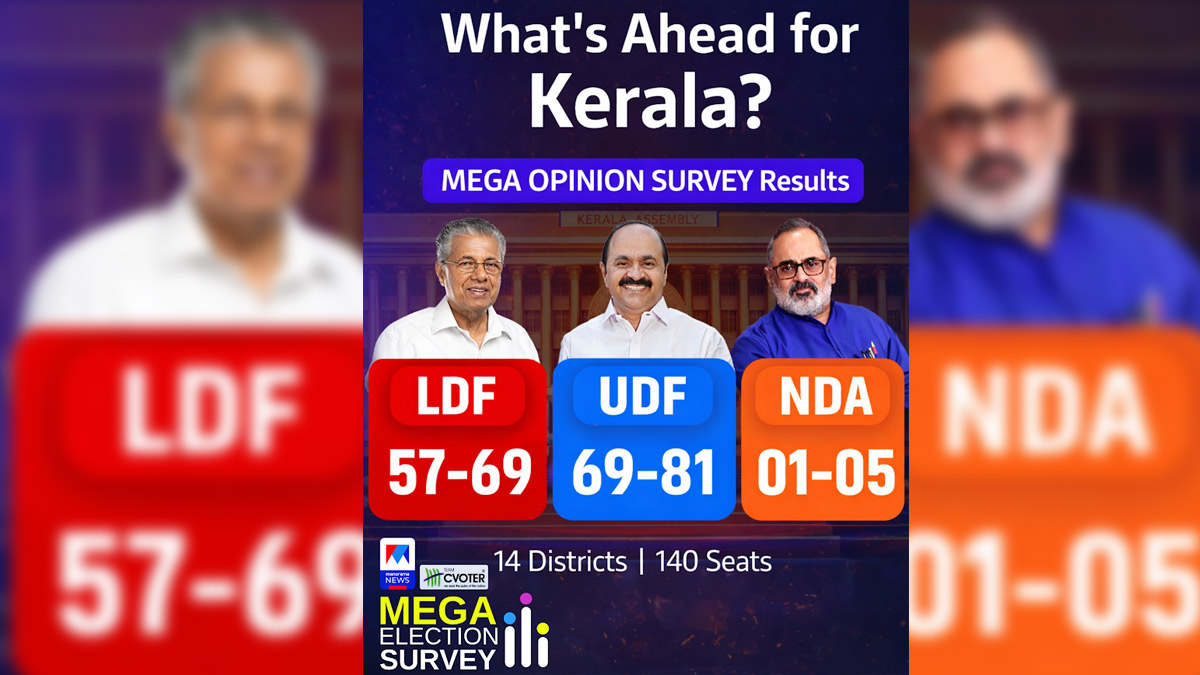
MUMBAI: The winds of change appear to be blowing through Kerala’s political landscape and this time, they seem to favour the United Democratic Front. A comprehensive mega opinion survey conducted by Manorama News in partnership with CVoter projects a potential comeback for the UDF in the upcoming Kerala Legislative Assembly Elections 2026. The survey, covering all 140 constituencies with a massive sample size of nearly 90,000 respondents, predicts the UDF could win between 69 and 81 seats.
The ruling Left Democratic Front (LDF) is expected to secure 57 to 69 seats, a significant drop from the 99 seats it won in the 2021 elections. This would mean the LDF losing 30 to 42 of its sitting seats. Meanwhile, the National Democratic Alliance (NDA), which drew a blank in 2021, is projected to open its account with 1 to 5 seats.
Region-wise, the UDF is expected to make strong gains in Malabar, winning 25 to 34 out of 48 seats, and in Central Kerala, where it could bag 29 to 33 out of 53 seats. In South Kerala, the LDF is likely to retain an edge with 21 to 25 seats, while the UDF may improve to 12 to 16 seats. The NDA could pick up 1 to 3 seats in the southern region.
The survey was conducted between 14 and 26 March 2026, with additional tracker and snap polls carried out from December 2025 to March 2026. A total of 89,693 respondents participated, ensuring representation across all demographics and social segments.
Manorama News has a strong track record of accuracy, with its previous projections closely matching the actual results of the 2019 and 2024 Lok Sabha elections as well as the 2021 Kerala Assembly polls.
In Kerala’s famously fierce political battles, this survey suggests the pendulum may be swinging back. Whether the final verdict matches these numbers or throws up another surprise, one thing is clear, the 2026 Assembly elections are shaping up to be one of the most keenly watched contests in the state’s history.






