News Broadcasting
4 entries through to Intl Emmies final round from Asia/Africa in children, drama categories

MUMBAI: Judging for the semi-final round of the International Emmy awards for the Asia/Africa region in the children and young people and drama categories has come to an end.
Four entries, whose names have not yet been disclosed, will advance to the final.
The International Academy of Arts and Sciences commissioned the Eastern Multimedia Group to conduct the judging process. There were 30 jurors, among whom was Indiantelevision.com founder Anil Wanvari.

Speaking about the event, which was held in Taipei, from 7 to 10 July, Wanvari said, “It was a fantastic experience. Judging an event like this exposes you to a diverse array of programmes. There are different palettes. The quality of the entries was extremely high and it was difficult to differentiate one from the other.
“However the judges managed to award the requisite marks to each and move on. Each entry was marked by a high level of expertise in terms of production values,” he added.
India was represented among the programmes that came through to the semi-final round in the drama series category through Star Plus’s soap Saara Akaash. The show is loosely built around the lives of air force pilots.
Another entry in the drama series came from Singapore’s SPH Mediaworks. Together Whenever deals with a traditional bakery owned by a couple with two boys and two girls. Things are going great until competition enters the scene.
SPH Mediaworks again featured with Crunch Time II, a reality based documentary drama, whose aim is to bring out the positive aspects of people who have gone through a difficult time in their lives. The show examines how they counter tough moments and come out of them.
South Africa had two entries. Soul City, a drama series produced by the Soul City Institute for Health and Development Communication’s, revolves around the Soul City community’s quest to strive over challenges as a collective.
The other one being the South African Brodcasting Corporation’s (SABC) Zero Tolerance, a 13-part, 1-hour drama series about a special investigative unit set up by the South African President. This unit, known as the Zero Tolerance unit, is responsible for investigating high high priority crime problems facing South Africa today.
The other drama series that were in the running for a final spot include: Happy and Lucky (SPH Mediaworks), A Child’s Hope (MediaCorp TV, Singapore), Always On My Mind (MediaCorp TV, Singapore) and Pure Love III (Mainichi Broadcasting System, Japan).







News Broadcasting
Network18 channels lead YouTube news viewership in March 2026
CNN-News18, News18 India and CNBC channels top categories with record views
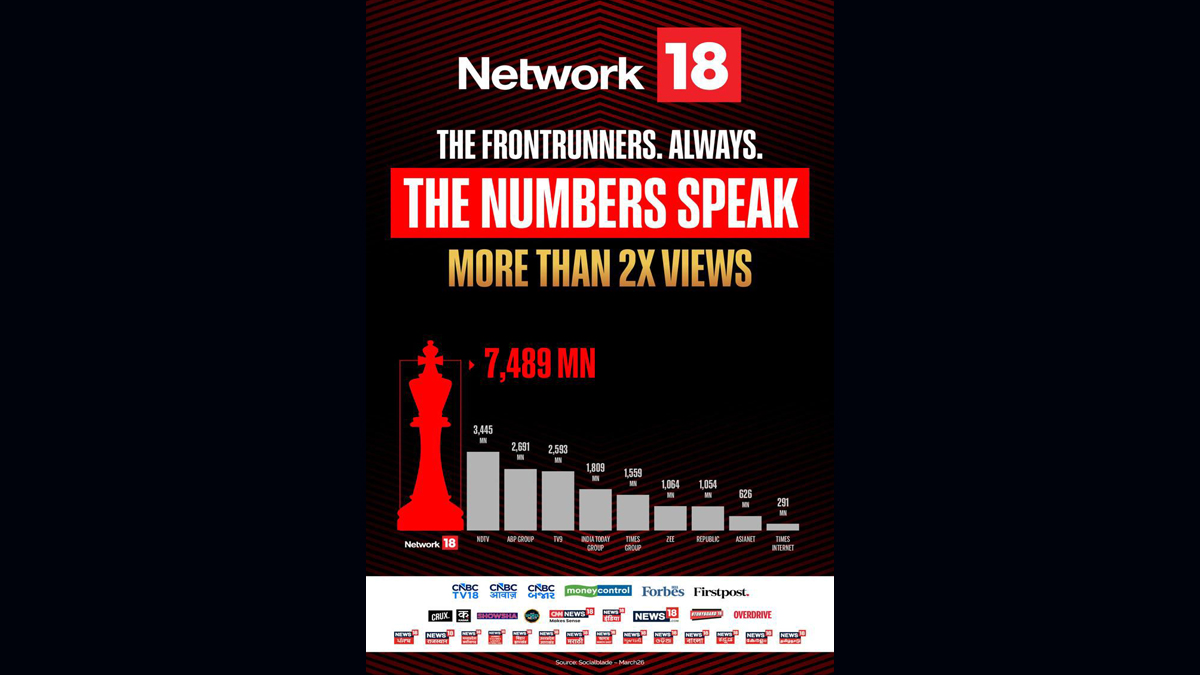
MUMBAI: When the world hit refresh on breaking news, Network18’s channels were already streaming ahead. As geopolitical tensions and war-driven headlines fuelled a surge in global news consumption, the network’s digital playbook delivered big clocking record Youtube viewership across English, Hindi and business news categories in March 2026.
At the forefront was CNN-News18, which emerged as the clear leader in the English news segment with 130 million live and video-on-demand views. The channel edged past competitors such as Times of India (126.5 million), Times Now (101.1 million), India Today (88.2 million) and NDTV (77.5 million), according to Databeings data for March.
In the Hindi news arena, News18 India delivered a commanding performance, racking up a staggering 3,297 million views on YouTube. The channel comfortably outpaced NDTV India, which recorded 3,119 million views, underlining its deep reach and consistent engagement with mass audiences, as per Playboard data.
The network’s dominance wasn’t confined to general news. In the Hindi business segment, CNBC Awaaz topped the charts with 92 million views, narrowly ahead of Zee Business (90 million) and well ahead of ET Now Swadesh (57 million). Meanwhile, its English counterpart CNBC-TV18 posted a strong 58 million views, reinforcing the network’s cross-category strength.
The spike in viewership reflects a broader shift in audience behaviour, with viewers increasingly turning to digital platforms particularly Youtube for real-time updates and in-depth coverage during high-intensity news cycles. For Network18, the numbers signal more than just scale; they underline the effectiveness of a multi-platform strategy that blends speed, credibility and continuous coverage.
In a month where the news never paused, it seems viewers chose to stay tuned where the stream never stopped.






